


Utility Trailer Expanded Metal
In the field of industrial transport and logistics, the selection of materials for utility trailers is a critical engineering decision that impacts the vehicle's durability, safety, and payload efficiency. Utility trailer expanded metal serves as a primary component for flooring, ramps, and side enclosures. Unlike traditional solid plating or perforated sheets, expanded metal offers a unique combination of high strength-to-weight ratios and functional transparency. This technical guide examines the engineering properties, material specifications, and selection criteria for integrating Perforated & Expanded Metal into industrial trailer designs.
Understanding the Role of Expanded Metal in Utility Trailer Design
Expanded metal is manufactured through a process of simultaneous slitting and stretching. A single sheet of metal—typically carbon steel, stainless steel, or aluminum—is fed through a machine that uses precision knives to create a diamond-shaped pattern. Because the material is stretched rather than punched, there is zero waste in the production process, making it an economically efficient choice for large-scale industrial applications.
For utility trailers, the structural integrity of the mesh is paramount. The "bonds" (the intersections of the diamond pattern) are integral to the sheet, meaning the material cannot unravel like woven wire mesh if a single strand is cut. This provides a fail-safe mechanism for ramps and floors that must withstand high-impact loading and constant vibration during transit. Furthermore, the open area of the mesh allows for the passage of air, water, and debris, which prevents the buildup of moisture that leads to corrosion and ensures that the trailer does not experience significant aerodynamic drag.
Technical Specifications: Standard vs. Flattened Expanded Metal
When specifying utility trailer expanded metal, engineers must choose between standard (raised) and flattened varieties. Each offers distinct mechanical advantages depending on the specific trailer component being designed.
Standard Expanded Metal
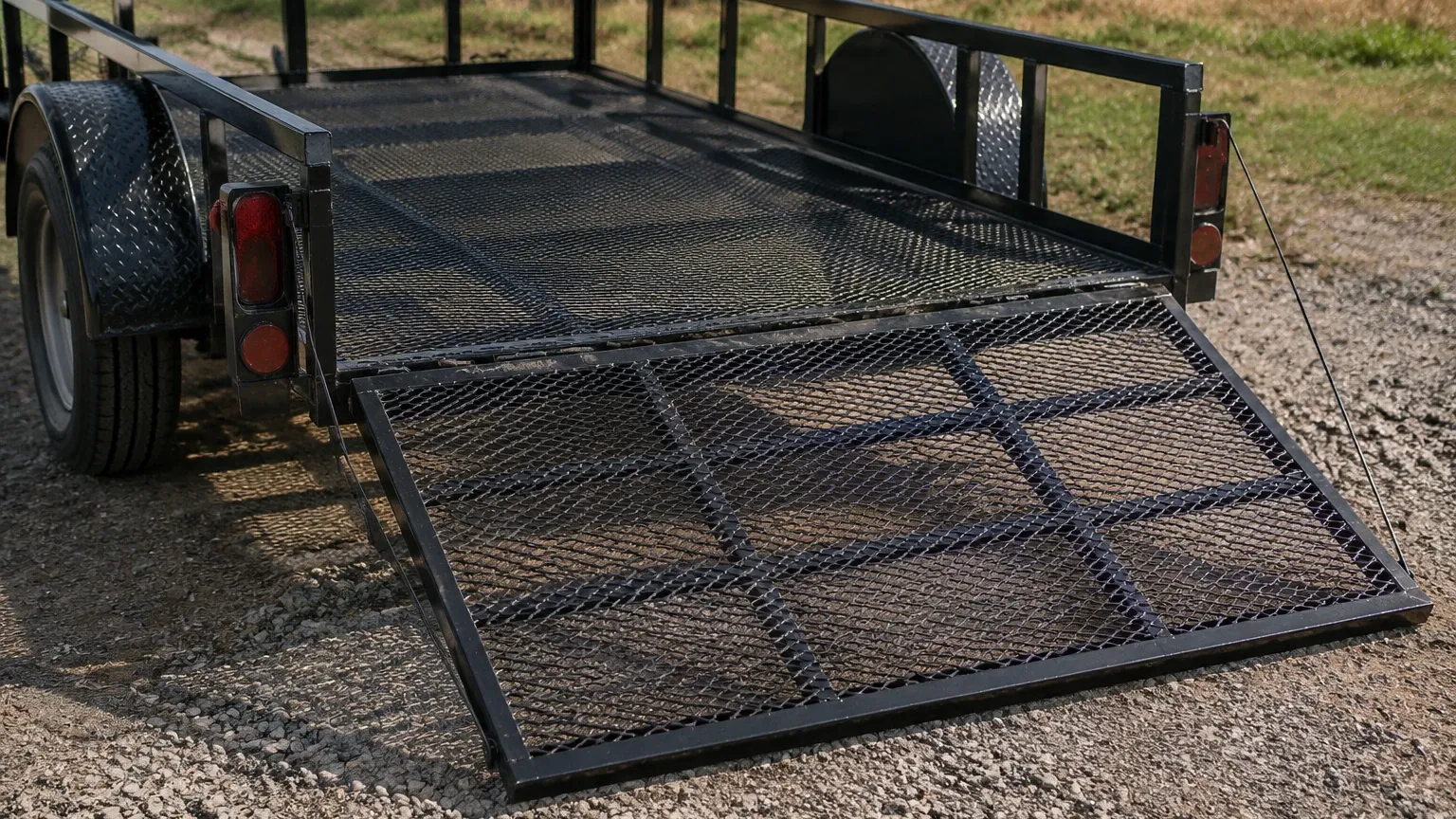
Standard expanded metal features strands that are set at a sharp angle to the plane of the sheet. This creates a three-dimensional surface with inherent slip resistance. In trailer applications, this is the preferred specification for loading ramps and walkways. The raised edges provide essential traction for equipment tires and personnel footwear, particularly in wet or oily conditions. From an engineering perspective, standard expanded metal also offers greater rigidity across the Short Way of Design (SWD) due to the angular orientation of the strands.
Flattened Expanded Metal
Flattened expanded metal is produced by passing standard expanded metal through a cold-rolling reducing mill. This process flattens the strands and bonds, resulting in a smooth, level surface. While this reduces the overall thickness of the sheet and slightly increases the Long Way of Design (LWD), it is ideal for trailer side walls or shelving where a smooth surface is required to prevent snagging or to facilitate the sliding of cargo. Flattened mesh is also easier to coat or paint uniformly, which is a consideration for trailers requiring specific aesthetic or protective finishes.
Material Selection for Industrial Environments
The choice of alloy significantly dictates the service life and maintenance requirements of a utility trailer. While carbon steel is the most common material due to its cost-effectiveness and high tensile strength, specific industrial environments require more robust solutions.
1. Carbon Steel: Usually supplied in "mill finish" or hot-dip galvanized. Galvanization is essential for utility trailer expanded metal to prevent oxidation when exposed to road salts and moisture.
2. Stainless Steel (304 and 316): For trailers used in chemical processing, food grade transport, or coastal environments, stainless steel is the gold standard. Kaifil specializes in precision stainless steel components that offer superior resistance to pitting and crevice corrosion. Stainless steel 316, in particular, is recommended for high-chloride environments.
3. Aluminum: Preferred for lightweight trailers where fuel efficiency and payload maximization are the primary goals. Aluminum expanded metal provides excellent corrosion resistance without the need for additional coatings, though it has a lower modulus of elasticity compared to steel, requiring closer support spacing in the trailer frame.
Engineering Considerations: Load Capacity and Deflection
Determining the correct gauge and mesh size for utility trailer expanded metal requires a calculation of the expected point loads and distributed loads. The load-bearing capacity is influenced by the strand thickness, strand width, and the orientation of the diamonds relative to the support members.
SWD and LWD Orientation
In structural applications, the Short Way of Design (SWD) should generally run parallel to the span between supports to maximize the load-carrying capacity. If the mesh is oriented with the Long Way of Design (LWD) spanning the supports, the material will exhibit significantly higher deflection under load, which can lead to permanent deformation or structural failure of the trailer floor.
Gauge and Opening Size
For heavy-duty utility trailers, a 9-gauge or 13-gauge expanded metal is typically specified. A 3/4" #9 flattened expanded metal is a common industry standard for trailer flooring, providing a balance between weight and the ability to support equipment such as lawnmowers, ATVs, or industrial machinery. Engineers must confirm the "percent open area" to ensure that the mesh provides sufficient drainage while maintaining enough surface area to support the smallest wheels or contact points of the intended cargo.
Customization and Precision Manufacturing
Industrial procurement often requires more than off-the-shelf dimensions. Custom utility trailer expanded metal solutions involve precise shearing, welding, and finishing to integrate seamlessly into a trailer's chassis. As a professional manufacturer, Kaifil provides customized filtration and metal components that meet specific tolerance requirements.
Customization options include:
* Variable Strand Widths: Adjusting the width of the strand can increase the structural cross-section of the mesh without changing the overall opening size.
* Edge Trimming: Providing "random sheared" or "bond sheared" edges. For trailer safety, bond shearing is often preferred to eliminate sharp, protruding strands that could pose a hazard to operators.
* Material Certification: Providing mill test reports (MTRs) to verify the chemical composition and mechanical properties of the steel, ensuring compliance with transport safety regulations.
Installation and Maintenance for Long-Term Durability
The method of attachment is as critical as the material itself. Utility trailer expanded metal is typically secured to the frame via plug welding, tack welding, or specialized heavy-duty fasteners. Because expanded metal is thin relative to the structural C-channels or angle irons of a trailer frame, welders must use appropriate heat settings to avoid burning through the mesh strands.
Corrosion Control
Even with galvanized or stainless steel options, the weld points are susceptible to corrosion if not properly treated. Post-weld cold galvanizing sprays or specialized primers should be applied to ensure the longevity of the connection points. For stainless steel components, passivating the welds is a necessary step to restore the chromium oxide protective layer.
Replacement Cycles
In high-use industrial environments, expanded metal should be inspected periodically for signs of "necking" (thinning of the strands) or broken bonds. If more than 5% of the bonds in a concentrated area are fractured, the structural integrity is compromised, and the section should be replaced. The modular nature of expanded metal allows for cost-effective repairs, as damaged sections can be cut out and replaced with new mesh panels.
Procurement Checklist for Purchasing Teams
Before finalizing a purchase order for utility trailer expanded metal, engineering and purchasing teams should confirm the following technical parameters to ensure the product is fit for purpose:
* Material Grade: Is the alloy appropriate for the environment (e.g., 304 Stainless vs. Galvanized Carbon Steel)?
* Style: Is the application better served by standard (raised) for traction or flattened for a smooth surface?
* Dimensional Accuracy: What are the tolerances for SWD and LWD? Are the sheet dimensions compatible with the trailer frame layout to minimize waste?
* Load Requirements: Has the gauge been verified against the maximum expected point load of the cargo?
* Finishing: Does the material require deburring, degreasing, or specific coatings prior to installation?
By focusing on these technical boundaries, manufacturers can ensure that their utility trailers are equipped with expanded metal components that provide reliable performance under demanding industrial conditions. For specialized requirements involving precision metal components or advanced filtration needs, reviewing Perforated & Expanded Metal options with a technical partner like Kaifil ensures that material selection aligns with engineering goals.
