


Expanded Metal Vector
In the realm of industrial design and precision manufacturing, the term "expanded metal vector" refers to the digital geometric representation of mesh patterns used in CAD (Computer-Aided Design) and CNC (Computer Numerical Control) workflows. For engineers and procurement specialists, understanding how these vector files translate into physical Perforated & Expanded Metal components is essential for ensuring filtration efficiency, structural integrity, and cost-effective production.
As a specialized manufacturer, Kaifil utilizes these technical specifications to produce custom stainless steel filtration solutions. This guide explores the engineering considerations behind expanded metal patterns, the transition from digital vector models to physical hardware, and the critical factors that influence performance in demanding industrial environments.
Understanding Expanded Metal Vector in Industrial Design
An expanded metal vector serves as the mathematical blueprint for a mesh pattern. Unlike raster images, which are composed of pixels, vector files (such as .DWG, .DXF, or .AI) use paths defined by start and end points, curves, and angles. In the context of industrial filtration, these vectors define the diamond-shaped openings that characterize expanded metal.
From an engineering perspective, the vector file is the primary communication tool between the design phase and the manufacturing floor. It dictates the stroke of the expanding machine, the width of the strands, and the overall open area of the finished product. When designing a filtration system, engineers use these vectors to simulate flow rates, pressure drops, and particle retention before a single sheet of stainless steel is processed.
The Role of Vectors in Custom Fabrication
Customization is a hallmark of modern industrial filtration. Whether a project requires a specific aperture size for chemical processing or a particular strand thickness for hydraulic support, the expanded metal vector allows for precise adjustments. By manipulating the vector parameters, manufacturers can optimize the mesh for specific mechanical properties, such as high strength-to-weight ratios or specific electrical conductivity profiles.
Engineering Specifications for Expanded Metal Patterns
To effectively use an expanded metal vector for manufacturing, several technical parameters must be clearly defined. These specifications determine the physical characteristics of the mesh and its suitability for various industrial applications.
SWD and LWD (Short Way and Long Way of Diamond)
The most critical dimensions in any expanded metal pattern are the SWD and LWD.
- SWD (Short Way of Diamond): The distance from the center of a bond to the center of the next bond across the short axis.
- LWD (Long Way of Diamond): The distance across the long axis of the diamond.
In a vector file, these dimensions must be accurately scaled to ensure that the resulting mesh meets the required filtration rating. The ratio between SWD and LWD influences the shape of the opening, which can range from narrow slits to wide hexagonal diamonds.
Strand Width and Thickness
The strand width refers to the amount of metal between the openings, while the thickness refers to the gauge of the original sheet material. These two factors combined determine the "bond"—the point where the strands intersect. In filtration applications, the strand width must be carefully balanced; thicker strands provide greater durability and support but reduce the total open area, potentially increasing pressure drop across the filter cartridge.
Percentage of Open Area
The open area is a calculation of the space occupied by the openings relative to the total surface area of the sheet. For engineers, this is a vital metric for calculating flow velocity and dirt-holding capacity. An expanded metal vector allows for the automated calculation of this percentage, enabling designers to iterate through different patterns to find the optimal balance between flow and filtration precision.
Material Selection and Performance Considerations
While the expanded metal vector defines the geometry, the material choice determines the component's longevity and compatibility with the process fluid. Kaifil specializes in high-performance alloys designed to withstand harsh industrial conditions.
Stainless Steel (304, 316, 316L)
Stainless steel is the preferred material for most industrial filtration applications due to its excellent corrosion resistance and mechanical strength.
- Grade 304: Suitable for general-purpose applications where moisture is present but chemical exposure is limited.
- Grade 316/316L: Contains molybdenum, providing superior resistance to chlorides and acidic environments, making it ideal for pharmaceutical and chemical processing.
- 316L (Low Carbon): Specifically used when welding is required, as it prevents carbide precipitation and maintains corrosion resistance at the weld joints.
Durability in Demanding Environments
In hydraulic systems or high-pressure water treatment, the expanded metal must resist deformation. The manufacturing process of expanding metal—where the sheet is simultaneously slit and stretched—work-hardens the material, often resulting in a product that is stronger than the original flat sheet. This structural advantage is why expanded metal is frequently used as a support layer for finer wire mesh in multi-stage filter cartridges.
From Vector Design to Physical Filtration Component
The transition from a digital expanded metal vector to a physical product involves specialized machinery and precise control over the expansion process. Unlike perforated metal, which involves punching holes and creating waste material, expanded metal is produced by shearing and stretching, resulting in zero material waste.
The Expansion Process
1. Feeding: A solid sheet of stainless steel is fed into the expanding press.
2. Slitting and Stretching: The machine’s upper blade descends, creating a row of slits while simultaneously stretching the metal into the diamond pattern defined by the vector specifications.
3. Advancement: The sheet moves forward, and the blade shifts laterally to create the staggered pattern of the next row of diamonds.
Flattened vs. Raised Expanded Metal
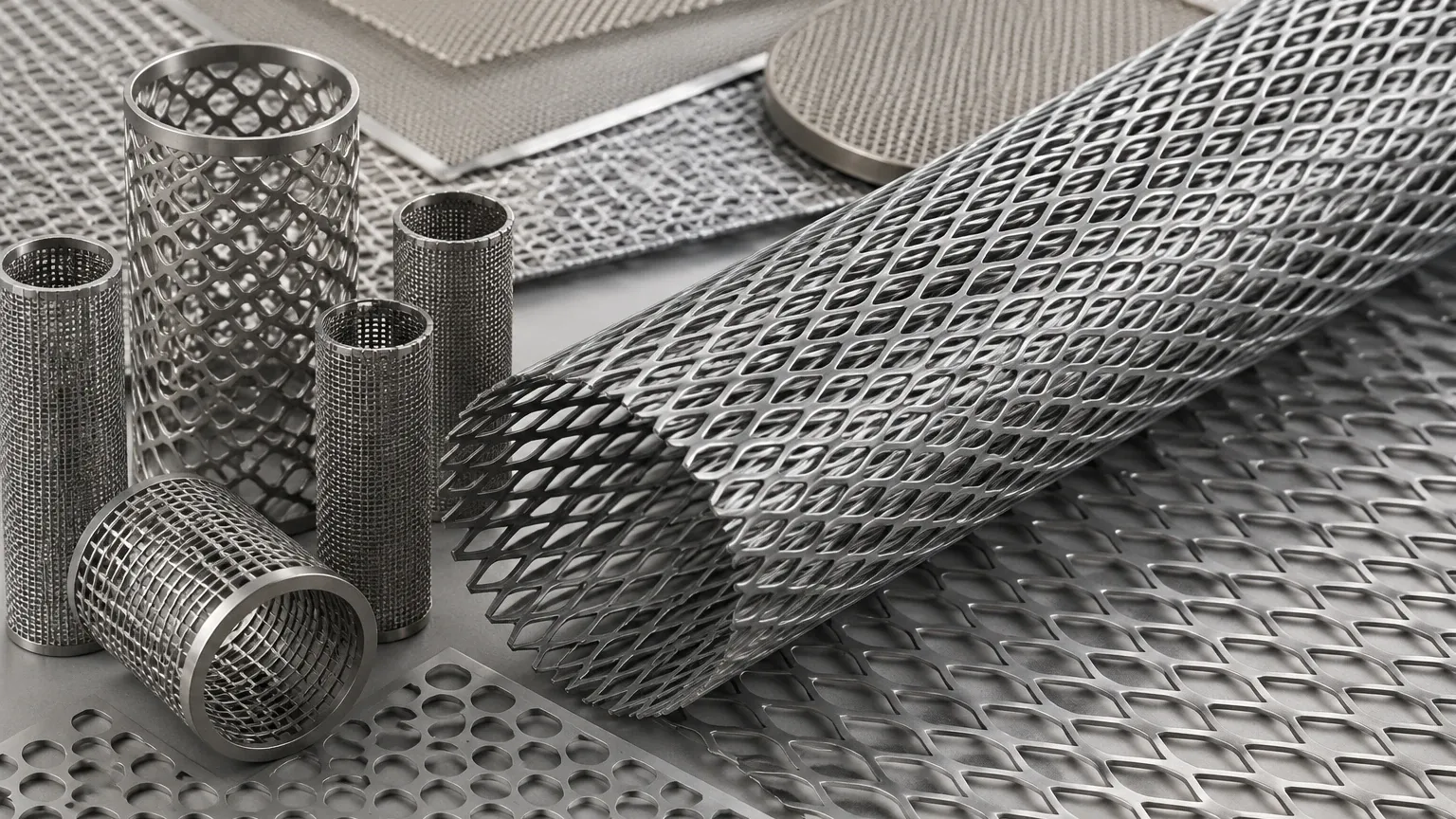
Standard expanded metal (raised) has a textured surface where the strands are set at an angle to the plane of the sheet. For many filtration applications, this texture is beneficial as it creates turbulence and increases the effective surface area. However, if a smooth surface is required—for example, to prevent bypass in a tightly fitted housing—the metal can be passed through a cold-rolling mill to produce "flattened" expanded metal. The choice between raised and flattened must be specified in the initial design phase, as it affects both the final thickness and the open area of the mesh.
Common Risks and Quality Control in Custom Fabrication
When sourcing Perforated & Expanded Metal based on a specific vector design, engineers must be aware of potential manufacturing variances that can impact performance.
Dimensional Tolerances
Because the expansion process involves stretching the metal, there is always a degree of variance in the final dimensions. Standard industrial tolerances for expanded metal are typically wider than those for machined parts. It is essential to confirm with the manufacturer what tolerances are achievable for a specific SWD and LWD to ensure the filter component fits correctly within its housing.
Edge Conditions and Safety
Expanded metal can have sharp edges (known as "random shearing") unless specified otherwise. For components that will be handled frequently during maintenance or replacement cycles, designers should specify "bond shearing," which results in a closed-loop edge, or request deburring and edge-trimming services.
Material Integrity
In high-precision filtration, even minor defects in the strands can lead to premature failure. Quality control measures, such as visual inspections for cracks at the bonds and ultrasonic cleaning to remove manufacturing oils, are standard practices at Kaifil to ensure that the final product meets the rigorous standards of the pharmaceutical and food and beverage industries.
Technical Evaluation for Purchasing and OEM Projects
For procurement teams and OEM engineers, selecting the right expanded metal solution involves more than just providing a vector file. A comprehensive evaluation of the application requirements is necessary to ensure the total cost of ownership is optimized.
Replacement Cycles and Maintenance
How often will the filter component need to be cleaned or replaced? Stainless steel expanded metal is highly cleanable, often allowing for backwashing or ultrasonic cleaning. However, if the application involves highly abrasive particles, the strand thickness may need to be increased to extend the service life, even if it slightly reduces initial flow efficiency.
Compatibility and Compliance
In industries such as food processing or pharmaceuticals, the material must comply with specific regulatory standards (e.g., FDA or 3-A Sanitary Standards). Ensuring that the manufacturer can provide material certifications (MTRs) for the stainless steel used is a critical step in the purchasing process.
Customization Options
Beyond simple flat sheets, expanded metal can be formed into cylinders, cones, or pleated structures. When discussing a project with a manufacturer, provide the expanded metal vector along with details on the required final shape and any secondary operations such as welding, annealing, or surface coating (e.g., electropolishing).
Conclusion
The expanded metal vector is the foundational element that bridges the gap between engineering theory and industrial reality. By understanding the geometric parameters, material properties, and manufacturing nuances associated with these patterns, technical professionals can specify filtration components that deliver reliable performance in the most demanding environments.
Whether you are designing a new hydraulic system or optimizing a chemical filtration process, collaborating with a manufacturer that understands the technical depth of Perforated & Expanded Metal is essential. Kaifil provides the engineering expertise and manufacturing precision needed to transform your digital designs into high-performance stainless steel filtration solutions, ensuring that every strand and bond is optimized for your specific application requirements.
