


Expanded Metal Welding
In industrial filtration and structural fabrication, the integration of expanded metal into larger assemblies requires a precise understanding of material science and joinery. Unlike woven wire mesh or solid plate, expanded metal possesses a unique geometric structure consisting of strands and bonds created through a process of slitting and stretching. When these components are utilized in high-pressure hydraulic systems, chemical processing units, or pharmaceutical filtration housings, the integrity of the expanded metal welding process determines the overall durability and performance of the final product.
For engineers and procurement professionals, selecting the correct welding methodology is not merely a matter of joining two pieces of metal; it is an engineering decision that impacts flow dynamics, structural rigidity, and corrosion resistance. This guide examines the technical nuances of welding expanded metal, focusing on the challenges inherent in its geometry and the best practices for achieving industrial-grade results.
Understanding the Geometry of Expanded Metal for Welding
Before initiating any welding process, it is essential to understand how the physical properties of Perforated & Expanded Metal influence heat distribution. Expanded metal is characterized by its Long Way of Design (LWD) and Short Way of Design (SWD), which define the diamond-shaped openings.
Strands and Bonds
The "bond" is the point where the strands intersect. In welding applications, the bond is the most critical area because it provides the greatest surface area for fusion. However, because expanded metal is essentially a network of thin strands, it has significantly less mass than a solid sheet of the same overall dimensions. This lack of mass means that the material has a lower thermal capacity, making it highly susceptible to burn-through if the welding parameters are not precisely controlled.
Standard vs. Flattened Expanded Metal
Whether the material is "standard" (raised) or "flattened" significantly affects the welding approach. Standard expanded metal has strands that are angled relative to the plane of the sheet, providing structural depth but making it difficult to achieve a flush weld against a flat frame. Flattened expanded metal has been cold-rolled to create a smooth, level surface, which is generally preferred for lap welds and edge-to-edge joints in filtration cartridges and protective screens.
Common Welding Techniques for Expanded Metal
The choice of welding process depends on the material thickness, the required aesthetic finish, and the mechanical demands of the application. In the manufacture of stainless steel filtration components, three primary methods are typically employed.
TIG Welding (Gas Tungsten Arc Welding – GTAW)
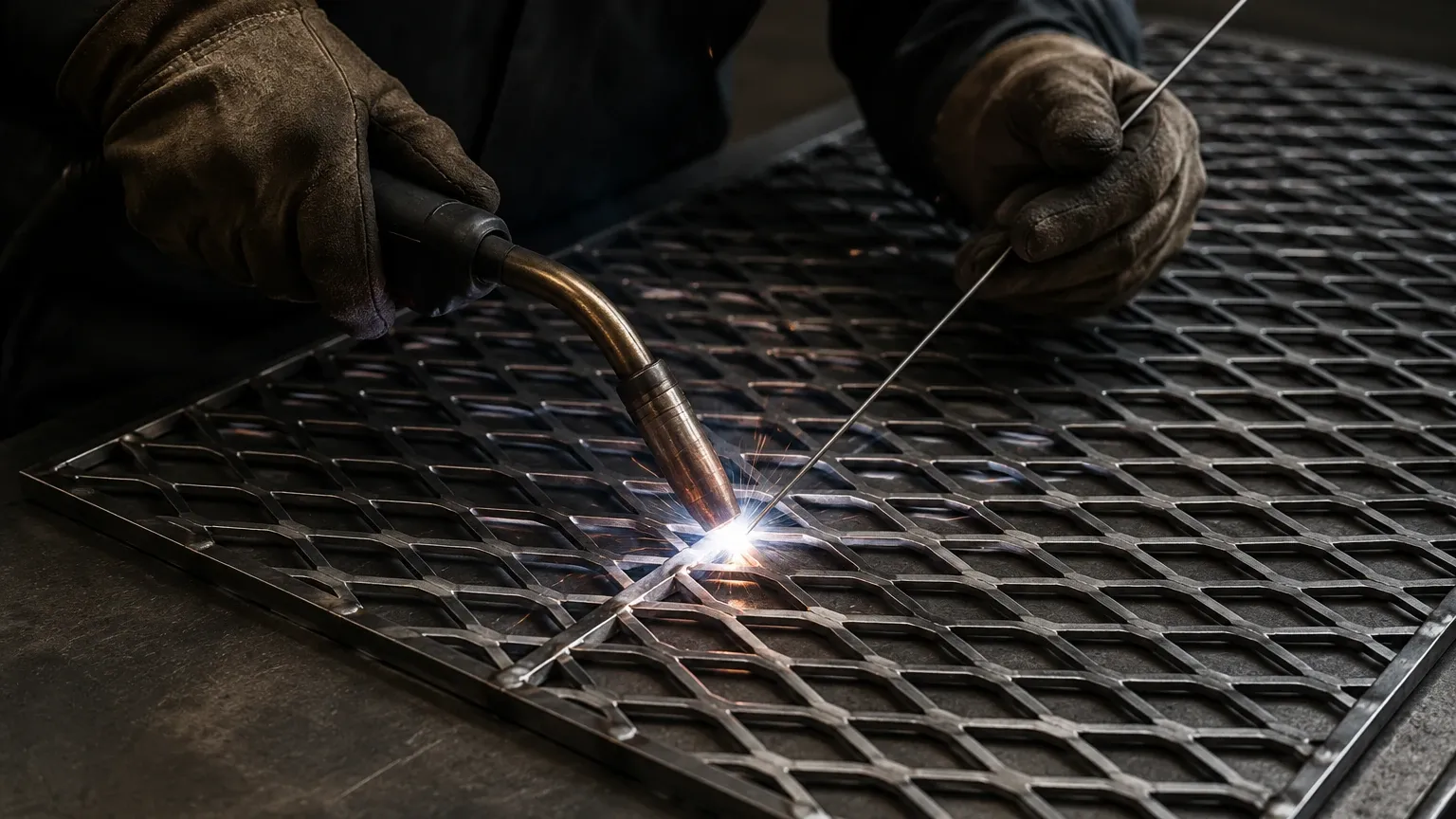
TIG welding is the gold standard for precision expanded metal welding, particularly when working with stainless steel grades like 304 or 316L. Because TIG allows for independent control of the heat source and the filler metal, it provides the high level of precision necessary to weld thin strands without melting them away.
* Advantages: Clean, spatter-free welds; excellent control over the weld pool; ideal for pharmaceutical and food-grade applications where hygiene is paramount.
* Considerations: It is a slower process and requires a high level of operator skill, especially when tacking the mesh to a heavy-gauge frame.
MIG Welding (Gas Metal Arc Welding – GMAW)
MIG welding is often used for larger structural assemblies or when welding expanded metal to heavy carbon steel or stainless steel frames. It is significantly faster than TIG welding, making it cost-effective for high-volume OEM production.
* Advantages: High deposition rate and speed.
* Considerations: MIG welding can produce spatter, which may clog the mesh openings or require extensive post-weld cleaning. For filtration applications, specialized pulse-MIG settings are often used to minimize heat input and spatter.
Resistance Spot Welding
In many filtration and basket applications, resistance spot welding is the most efficient method for securing expanded metal. This process uses electrical resistance and mechanical pressure to create a weld at the contact point between the mesh and the substrate.
* Advantages: No filler metal required; extremely fast; minimal distortion of the mesh geometry.
* Considerations: Requires specialized electrodes that can accommodate the uneven surface of raised expanded metal. It is best suited for lap joints rather than butt joints.
Key Challenges and Technical Risks
Welding expanded metal presents several engineering hurdles that must be addressed during the design and fabrication phases to avoid premature component failure.
Burn-Through and Strand Melting
The most common failure in expanded metal welding is the complete melting of the strand before a proper fusion occurs with the thicker frame or support structure. This is caused by the disparity in mass between the mesh and the frame. To mitigate this, heat should always be directed primarily toward the thicker component, allowing the weld pool to flow onto the mesh strand.
Thermal Distortion (Warping)
Stainless steel has a high coefficient of thermal expansion and low thermal conductivity. When heat is applied to a mesh sheet, it can cause the material to "potato chip" or warp out of plane. This is particularly problematic in large-scale filtration panels. Using a staggered welding sequence (skip welding) and robust fixturing is necessary to maintain flatness.
Intergranular Corrosion (Sensitization)
In stainless steel applications, excessive heat during welding can lead to chromium carbide precipitation at the grain boundaries. This reduces the material's corrosion resistance, a critical failure point in chemical processing environments. Utilizing low-carbon grades (e.g., 316L) and controlling the interpass temperature are essential strategies for maintaining the chemical integrity of the mesh.
Engineering Evaluation Criteria for Welded Assemblies
When specifying welded expanded metal components, engineers should evaluate the assembly based on the following performance metrics:
1. Weld Frequency: In structural applications, every bond that touches the frame should ideally be welded. In lighter-duty filtration applications, welding every second or third bond may be sufficient, provided the mechanical load is low.
2. Filtration Integrity: For filter cartridges, the weld must be continuous and leak-proof. Any gaps in the weld seam could allow bypass, compromising the filtration efficiency.
3. Mechanical Strength: The weld must be able to withstand the differential pressure (Delta P) across the filter. If the mesh detaches from the frame under pressure, it can lead to catastrophic system failure.
4. Surface Finish: In the food and beverage industry, welds must be ground smooth and passivated to remove any heat tint and ensure there are no crevices where bacteria can grow.
Best Practices for Preparation and Execution
Achieving a high-quality weld starts long before the arc is struck. Proper preparation is the foundation of reliable industrial fabrication.
Cleaning and Degreasing
Stainless steel expanded metal is often coated with residual lubricants from the expanding process. These oils must be completely removed using industrial degreasers. Failure to clean the material will result in porosity and weld contamination, which significantly weakens the joint.
Fixturing and Jigging
Because expanded metal is flexible, it must be held securely against the frame during welding. Custom jigs should be used to ensure the mesh remains taut and in the correct orientation. Copper chill bars can be placed behind the weld zone to help dissipate heat and prevent burn-through on thin-gauge materials.
Post-Weld Passivation
For all stainless steel expanded metal welding projects, post-weld passivation is mandatory. This chemical process restores the protective chromium oxide layer that is damaged by the high heat of welding. Without passivation, the weld area will likely develop rust, even in relatively mild environments.
Customization and OEM Considerations
For many industrial applications, standard off-the-shelf expanded metal does not meet the specific requirements for flow rate, pressure drop, or chemical compatibility. Working with a specialized manufacturer like Kaifil allows for the development of customized filtration solutions that integrate Perforated & Expanded Metal into complex geometries.
When requesting a quote or designing a component, engineers should confirm the following details with their fabrication partner:
* Material Grade: Ensure the alloy is compatible with the operating environment (e.g., 316L for marine or acidic conditions).
* Mesh Orientation: Specify the direction of the LWD and SWD, as this affects both the strength of the weld and the flow characteristics.
* Tolerance Requirements: Define the acceptable limits for warping and dimensional accuracy after welding.
* Testing Protocols: Determine if the assembly requires pressure testing, dye penetrant inspection, or X-ray verification of the welds.
Conclusion
Welding expanded metal is a specialized skill that requires a balance of thermal control and mechanical precision. By understanding the unique geometric properties of the mesh and selecting the appropriate welding technique—whether TIG for precision or Resistance for speed—engineers can ensure that their filtration and structural components perform reliably in demanding industrial environments. Proper preparation, heat management, and post-weld treatment are the keys to transforming raw expanded metal into a high-performance industrial asset.
