


Expanded Metal Weight Capacity
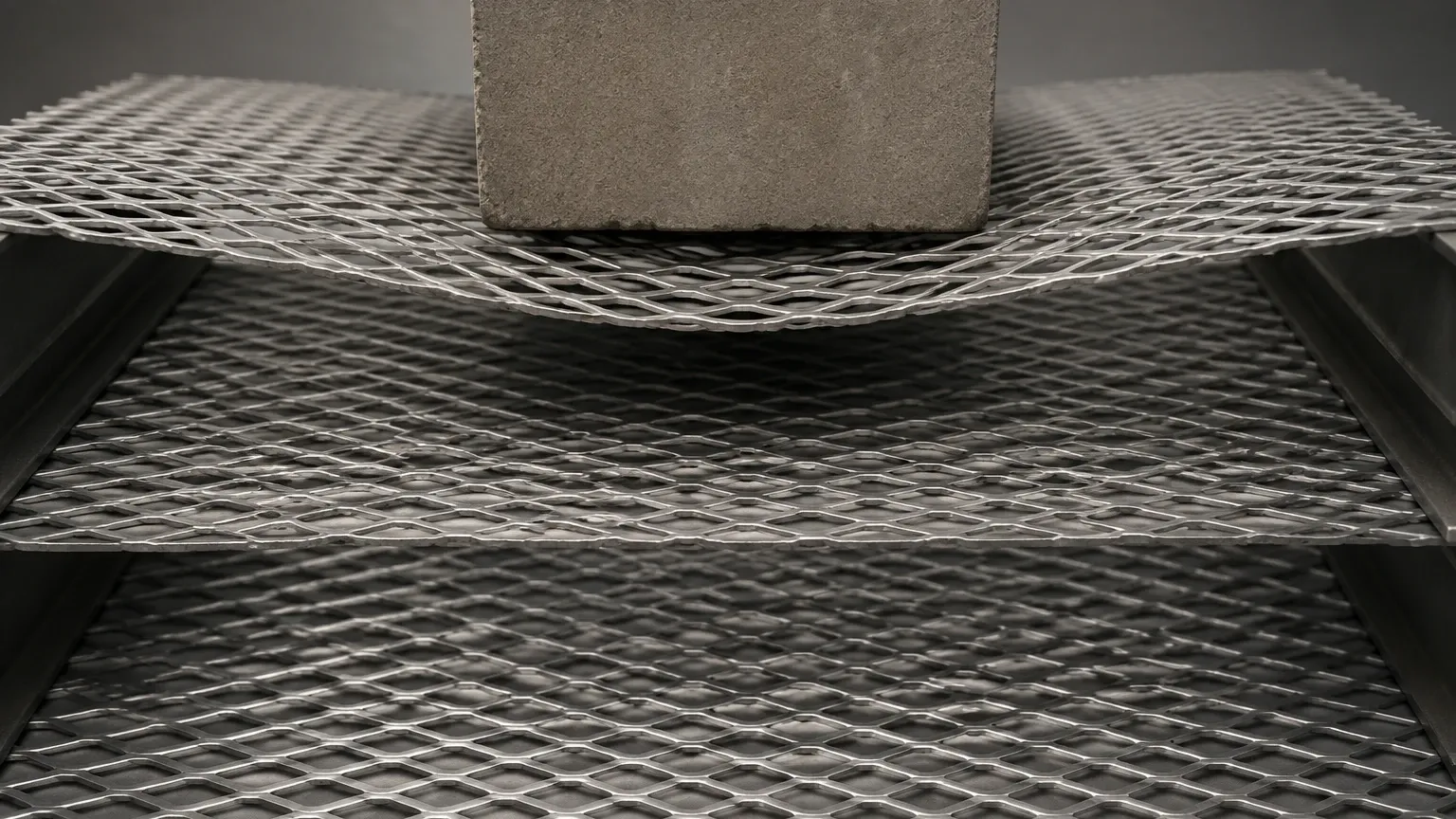
In industrial engineering and structural design, understanding the load-bearing characteristics of materials is fundamental to safety and operational efficiency. Expanded metal, a versatile material created by simultaneously slitting and stretching a metal sheet, is widely utilized for walkways, platforms, shelving, and filtration supports. However, determining the precise expanded metal weight capacity requires a technical understanding of the material’s geometry, metallurgical properties, and the orientation of the installation.
For engineers and procurement specialists, selecting the correct specification is not merely about choosing a gauge; it involves calculating how the diamond-shaped trusses will react under specific stress conditions. This guide examines the technical variables that dictate weight capacity and provides the engineering context necessary for informed selection in demanding industrial environments.
The Structural Mechanics of Expanded Metal
Unlike perforated metal, which is created by punching holes and removing material, expanded metal is produced through a process that involves no material waste. The metal is slit and then pulled, creating a series of interconnected diamonds. This process results in a "truss-like" structure where each diamond acts as a structural unit.
The strength of expanded metal is derived from the continuity of the material. Because the strands are not welded or joined but are part of a single piece of metal, the load is distributed across the entire panel. The points where the strands intersect are known as "bonds." These bonds are significantly stronger than the individual strands and are critical in maintaining the structural integrity of the sheet under load.
When evaluating expanded metal weight capacity, it is essential to recognize that the material’s performance is anisotropic—it exhibits different mechanical properties depending on the direction of the applied force relative to the diamond pattern. This architectural nuance is what makes expanded metal an efficient choice for high-strength-to-weight applications, provided the orientation is correctly engineered.
Key Variables Influencing Weight Capacity
Several physical dimensions and material properties interact to determine the ultimate load-bearing limit and the allowable deflection of an expanded metal panel.
1. Material Composition
The base metal significantly impacts the tensile strength and yield point. Stainless steel (typically Grade 304 or 316) offers high strength and excellent corrosion resistance, making it ideal for chemical processing or marine environments. Carbon steel provides high structural rigidity at a lower cost, while aluminum offers a high strength-to-weight ratio but lower absolute load capacity compared to steel of the same thickness.
2. Strand Width and Thickness
The strand is the single metal strip that forms the side of the diamond. The thickness refers to the original gauge of the base metal, while the strand width is the amount of metal fed into the machine between slits. Increasing either of these dimensions directly increases the cross-sectional area available to support a load, thereby raising the weight capacity.
3. Opening Size (SWD and LWD)
Expanded metal is measured by the Short Way of Diamond (SWD) and the Long Way of Diamond (LWD). Smaller openings generally result in a denser concentration of bonds and strands per square foot, which typically enhances the material's ability to resist concentrated loads. Conversely, larger openings reduce the overall weight of the panel but may require thicker strands to maintain the same load capacity.
4. Standard vs. Flattened Profiles
* Standard (Raised) Expanded Metal: In this form, the strands and bonds are set at a sharp angle to the plane of the sheet. This creates a three-dimensional structure that offers maximum rigidity and slip resistance. Standard expanded metal generally has a higher weight capacity for a given gauge because the angled strands act like structural beams.
* Flattened Expanded Metal: This is standard expanded metal that has been cold-rolled to create a smooth, flat surface. While this process makes the material thinner and easier to handle in certain filtration or aesthetic applications, it reduces the structural rigidity. Engineers must account for a reduction in load-bearing capacity when switching from standard to flattened profiles.
The Critical Role of Orientation: LWD vs. SWD
One of the most common errors in industrial design is the incorrect orientation of expanded metal panels. The weight capacity is heavily dependent on which way the diamonds are spanning the support structure.
For maximum load-bearing efficiency, the Long Way of Diamond (LWD) should span across the supports. When the LWD spans the gap, the bonds are positioned to act as the primary load-carrying members. If the panel is installed with the Short Way of Diamond (SWD) spanning the supports, the material is significantly more prone to deflection and failure under much lower weights.
In many technical specifications for Perforated & Expanded Metal, load tables will specify the "Span" direction. It is a fundamental engineering requirement to ensure that the LWD is perpendicular to the support beams to utilize the material's full structural potential.
Calculating Load Types and Deflection
Engineers must distinguish between different types of loads when assessing expanded metal weight capacity. A failure to distinguish between these can lead to structural deformation or safety hazards.
Uniformly Distributed Load (UDL)
This refers to a weight that is spread evenly across the entire surface of the expanded metal panel. This is common in flooring or shelving applications. Load tables typically provide the maximum UDL in pounds per square foot (psf) based on specific span distances.
Concentrated Load
This is a weight applied to a small, localized area of the panel, such as a person's foot or the wheel of a cart. Concentrated loads put significantly more stress on individual strands and bonds. When designing for concentrated loads, the safety factor must be higher, and the deflection limits more stringent.
Deflection Limits
In many industrial applications, the "capacity" isn't just about when the metal breaks (ultimate strength), but when it bends too much (serviceability). For walkways, a common deflection limit is L/240 (the span divided by 240) or a maximum of 1/4 inch. If the expanded metal flexes beyond this point, it may feel unstable to workers or cause equipment to tip, even if the metal is not in danger of snapping.
Expanded Metal in Filtration and Support Systems
In the context of industrial filtration, expanded metal often serves as a support medium for finer wire mesh or filter media. In these applications, the expanded metal weight capacity is evaluated based on its ability to withstand hydraulic pressure or the weight of accumulated filter cake.
When used as a core or outer guard in a filter cartridge, the expanded metal must resist collapse under high differential pressures. Kaifil specializes in manufacturing these precision components, ensuring that the material thickness and diamond configuration are optimized for the specific flow rates and pressure drops encountered in chemical processing or hydraulic systems. The choice between perforated and expanded metal in these scenarios often comes down to the required open area and the specific directional strength needed to maintain the filter's structural integrity.
Safety Factors and Engineering Considerations
When specifying expanded metal for load-bearing applications, a safety factor is always applied. In most structural metal applications, a safety factor of 3:1 or 5:1 is standard. This means if a panel is rated for a 100 lb load, its theoretical breaking point is 300 to 500 lbs. This margin accounts for:
* Impact Loading: Sudden drops or movements that exert more force than static weight.
* Material Fatigue: Repeated loading and unloading over time.
* Manufacturing Tolerances: Slight variations in strand width or thickness during the expansion process.
* Environmental Degradation: Potential thinning of the metal due to corrosion over years of service.
Verification Checklist for Purchasing Teams
Before finalizing a specification for expanded metal intended for load-bearing use, purchasing teams and engineers should confirm the following data points with the manufacturer:
1. Base Material and Grade: Ensure the alloy matches the environmental requirements (e.g., 316L stainless steel for high-chloride environments).
2. Exact Dimensions: Confirm the gauge, strand width, and SWD/LWD dimensions.
3. Style: Specify whether "Standard" or "Flattened" is required, noting the impact on capacity.
4. Span Direction: Clearly define the orientation of the LWD relative to the intended supports.
1. Load Requirements: Provide the expected UDL or concentrated load requirements to the technical team for verification against performance tables.
Conclusion
Expanded metal is an exceptionally efficient structural material, but its weight capacity is not a single fixed number. It is a variable dictated by geometry, material science, and installation logic. By understanding the relationship between strand dimensions, diamond orientation, and deflection limits, engineers can select a cost-effective solution that does not compromise on safety or durability.
For specialized industrial applications, particularly those involving filtration and precision metal components, working with a manufacturer that understands these technical boundaries is essential. Whether you are designing a heavy-duty industrial walkway or a high-pressure filtration system, verifying the load-bearing specifications ensures the long-term success of the project.
For more information on material specifications and custom configurations, Review product options and application support to ensure your selection meets the necessary industrial standards.
