


How Do You Measure Expanded Metal
In industrial filtration and structural engineering, precision is the foundation of performance. Expanded metal is a unique material created by simultaneously slitting and stretching a solid sheet of metal, resulting in a continuous web of diamond-shaped openings. Unlike perforated metal, which involves punching out material, expanded metal involves no waste and creates a three-dimensional structure that offers an exceptional strength-to-weight ratio. However, because of its complex geometry, many engineers and procurement professionals often ask: how do you measure expanded metal accurately to ensure it meets specific technical requirements?
Accurate measurement is critical when integrating these components into filter cartridges, hydraulic strainers, or architectural panels. Misunderstanding the dimensions can lead to improper fit, incorrect flow rates, or structural failure. This guide provides a detailed technical breakdown of the measurement standards used for Perforated & Expanded Metal, focusing on the terminology and methodologies required for industrial applications.
The Core Terminology: SWD and LWD
The most fundamental aspect of understanding how do you measure expanded metal is identifying the orientation of the diamond pattern. Expanded metal dimensions are always expressed in terms of the "Short Way" and "Long Way" of the design.
Short Way of Design (SWD)
SWD refers to the distance measured from the center of one bond to the center of the next bond across the short axis of the diamond. It is important to note that this is not the size of the hole itself, but the distance between the center points of the intersections (bonds). In technical specifications, the SWD is usually the first dimension listed.
Long Way of Design (LWD)
LWD is the distance measured from the center of one bond to the center of the next bond across the long axis of the diamond. Together, the SWD and LWD define the overall pitch of the pattern. For example, a specification of "1/2-inch #13" indicates a specific relationship between these dimensions and the material gauge.
When ordering or designing a component, the relationship between SWD and LWD determines the density of the mesh. A smaller SWD relative to the LWD results in a narrower, sharper diamond, while dimensions that are closer together create a more squared appearance. For filtration applications, these dimensions dictate how many openings occur per linear inch, which directly impacts the structural support provided to the filter media.
Measuring the Openings: SWO and LWO
While SWD and LWD measure from center-to-center of the bonds, engineers focused on filtration and fluid dynamics are often more concerned with the actual clear space through which media can pass. This is where SWO and LWO come into play.
Short Way of Opening (SWO)
SWO is the clear distance between the inside edges of the strands across the short way of the diamond. If you are using expanded metal as a primary filter or a support cage, the SWO determines the maximum particle size that can pass through the mesh in that specific orientation.
Long Way of Opening (LWO)
LWO is the clear distance between the inside edges of the strands across the long way of the diamond. In industrial filtration, the LWO is often less critical for particle retention than the SWO, but it is vital for calculating the total open area and the resulting pressure drop across the filter element.
To measure these accurately, a digital caliper is recommended. When measuring SWO, ensure the caliper tips are placed against the inner edges of the strands without deforming the metal. In standard (raised) expanded metal, these measurements can be tricky because the strands are set at an angle. In these cases, the measurement should be taken perpendicular to the plane of the opening.
Strand Width and Strand Thickness
The physical properties of the mesh—its rigidity, weight, and resistance to corrosion—are determined by the strands themselves. Understanding how do you measure expanded metal requires a clear distinction between width and thickness.
Strand Thickness
This is the thickness of the base metal from which the expanded metal was produced. In the context of stainless steel filtration, this usually corresponds to standard gauge sizes (e.g., 18 gauge, 22 gauge). It is the measurement of the metal before the expanding process begins. For high-pressure hydraulic filters, a greater strand thickness is often required to withstand the mechanical stress of fluid flow.
Strand Width
Strand width is the amount of metal fed into the expanding machine between each slit. It is essentially the "width" of the metal ribbon that forms the diamond. When you look at a sheet of expanded metal, the strand width is the dimension seen from the top view of the strand.
In standard expanded metal, the strand width and thickness are different. However, the combination of these two dimensions determines the cross-sectional area of the strand, which dictates the overall strength of the mesh. When calculating the weight per square foot, both the strand width and thickness are used in the formula alongside the LWD and SWD.
Standard vs. Flattened Expanded Metal Measurements
One of the most common points of confusion in how do you measure expanded metal is the difference between "Standard" (or Raised) and "Flattened" varieties. Each requires a slightly different approach to measurement.
Measuring Standard Expanded Metal
Standard expanded metal is the product as it comes off the expanding machine. The strands and bonds are set at a uniform angle to the plane of the sheet. This gives the material added strength and rigidity, as well as a slip-resistant surface. When measuring the thickness of standard expanded metal, you must distinguish between the *strand thickness* (the gauge of the metal) and the *overall thickness* (the total height of the raised profile). The overall thickness is often two to three times the strand thickness.
Measuring Flattened Expanded Metal
Flattened expanded metal is produced by passing standard expanded metal through a cold-roll reducing mill. This process flattens the strands and bonds into a single plane, creating a smooth, flat surface.
When measuring flattened expanded metal, the following changes occur:
1. Overall Thickness: The overall thickness becomes roughly equivalent to the strand thickness.
2. LWD Elongation: The flattening process usually elongates the LWD slightly while the SWD remains relatively constant.
3. Strand Width: The strand width increases as the metal is compressed.
For precision filtration components, flattened expanded metal is often preferred because it provides a uniform surface that won't abrade adjacent filter media, such as fiberglass or polyester felts. When specifying flattened material, it is crucial to provide the final desired thickness, as the rolling process can be adjusted to meet specific tolerances.
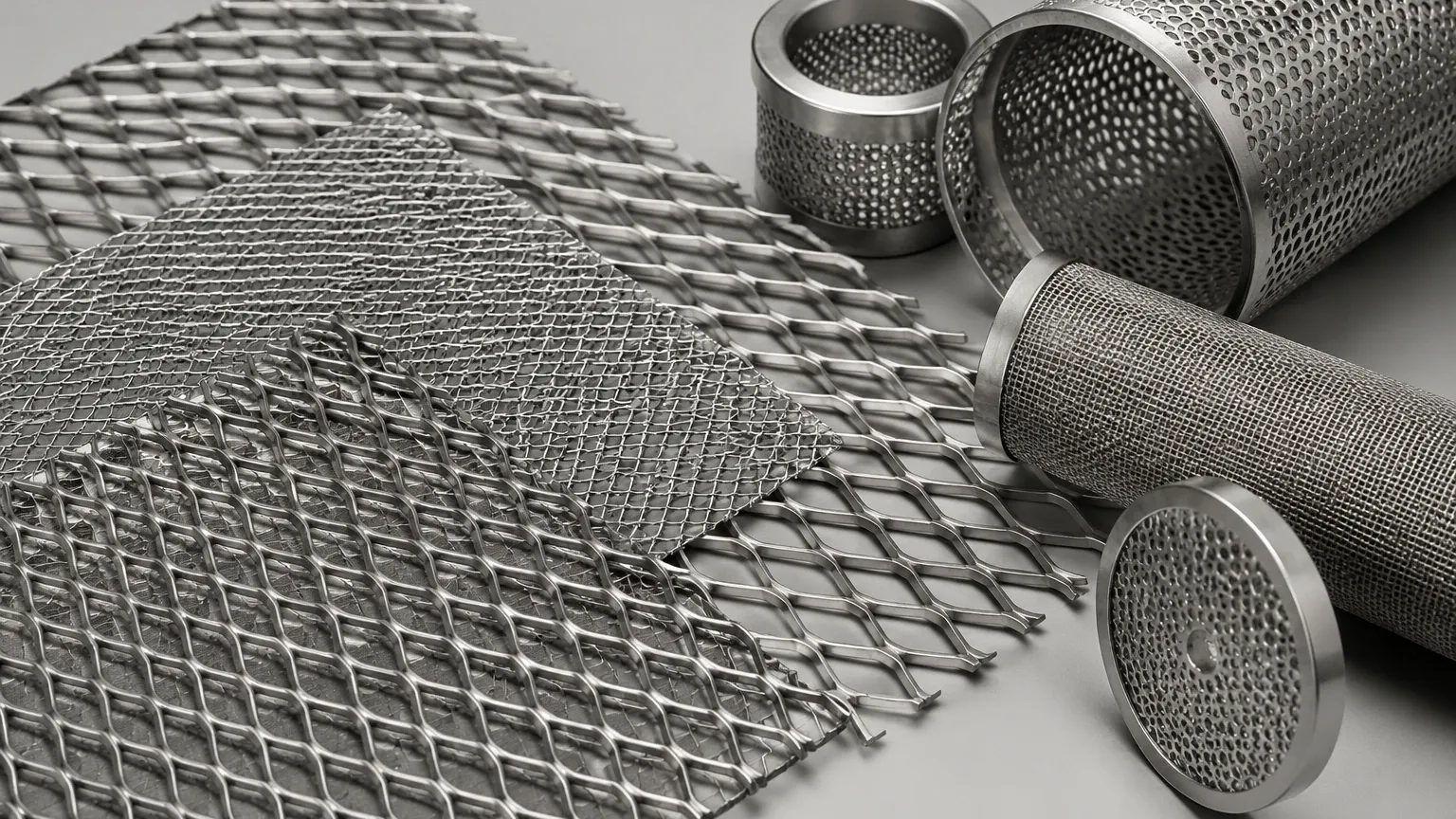
Sheet Dimensions and Orientation
In a B2B procurement context, simply providing the diamond size is not enough. You must also specify how those diamonds are oriented on the sheet. This is a critical step in how do you measure expanded metal for manufacturing.
SWD vs. LWD Orientation
When ordering a sheet, for example, 48 inches by 96 inches, you must specify which dimension the SWD follows.
* Standard Orientation: Usually, the LWD runs parallel to the length of the sheet (the 96-inch side).
* Bonded or Reversed Diamond: In some applications, the diamonds may need to run the opposite way for structural or aesthetic reasons.
For cylindrical filter cartridges, the orientation of the diamond affects how the metal behaves when rolled. If the LWD runs circumferentially, the cylinder will have different collapse strength characteristics than if the SWD runs circumferentially. Engineers should consult with manufacturers like Kaifil to determine the optimal orientation for their specific pressure and flow requirements.
Calculating Open Area for Filtration
For technical professionals, the most important outcome of measuring expanded metal is determining the percentage of open area. This value is used to calculate flow velocity and pressure drop ($ΔP$).
The formula for calculating the open area percentage in expanded metal is:
**Percentage of Open Area = (1 – (Strand Width * 2 / SWD)) * 100**
*(Note: This formula is a simplified version for standard expanded metal; flattened metal calculations may vary slightly due to the displacement of material during rolling.)*
High open area percentages are desirable for reducing energy consumption in filtration systems, but they must be balanced against the need for structural integrity. By accurately measuring the SWD and the Strand Width, engineers can fine-tune their filtration systems to achieve the perfect balance between throughput and durability.
Engineering Considerations and Customization
When selecting Perforated & Expanded Metal for industrial use, measuring the physical dimensions is only part of the process. You must also consider the tolerances and material properties.
Material Selection
Stainless steel (304, 316, 316L) is the standard for most chemical processing and food-grade applications due to its corrosion resistance. The measurement of the strand must account for the potential of corrosive thinning over time. In highly aggressive environments, specifying a slightly larger strand thickness can extend the service life of the filter component.
Tolerances
Standard industrial tolerances for expanded metal typically allow for variations in SWD and LWD of about +/- 5% to 10%, and sheet size variations of +/- 1/4 inch. However, for precision OEM components, Kaifil provides much tighter tolerances. When discussing your project, clarify whether your measurements are "nominal" or "minimum requirements."
Custom Profiles
Beyond standard diamonds, expanded metal can be produced in hexagonal or square patterns. The measurement principles remain the same—focusing on the center-to-center distance (pitch) and the clear opening—but the calculations for open area will change. Customizing the expansion ratio allows manufacturers to create a mesh that is specifically tuned to the viscosity and flow rate of a particular fluid.
Summary of Measurement Steps
To ensure you provide the correct data to a manufacturer, follow this checklist for how do you measure expanded metal:
1. Identify the Type: Is it Standard (raised) or Flattened?
2. Measure SWD and LWD: Use center-of-bond to center-of-bond distances.
3. Measure SWO and LWO: Use a caliper to find the clear opening for filtration requirements.
4. Determine Strand Dimensions: Measure both the width and the thickness (gauge).
5. Define Sheet Size and Orientation: Specify which way the diamonds should run relative to the sheet edges.
6. Calculate Open Area: Ensure the resulting percentage meets your flow requirements.
By following these technical standards, engineers and purchasing teams can avoid costly errors and ensure that their filtration solutions perform as intended. Whether you are designing a high-pressure hydraulic filter or a simple intake screen, precise measurement is the key to industrial efficiency. For specialized applications requiring custom stainless steel filtration, working with an experienced manufacturer like Kaifil ensures that these measurements are translated into high-performance components that meet the most demanding industrial standards.
