


When Cutting Expanded Metal You Want to Use
Expanded metal is a versatile industrial material produced by simultaneously slitting and stretching a solid sheet of metal, typically stainless steel, carbon steel, or aluminum. This process creates a diamond-shaped pattern of openings, framed by interconnected strands and bonds. In industrial filtration and structural engineering, expanded metal is prized for its high strength-to-weight ratio and excellent open area characteristics. However, the very geometry that gives the material its strength—the alternating bonds and angled strands—presents unique challenges during the fabrication and installation phases.
For engineers and procurement teams sourcing components for chemical processing, food and beverage, or hydraulic applications, understanding the technical nuances of fabrication is essential. When cutting expanded metal you want to use tools and methods that preserve the structural integrity of the mesh while ensuring the safety of the operator and the precision of the final component. This guide explores the engineering considerations, tool selections, and best practices for cutting expanded metal in industrial environments.
Understanding the Geometry of Expanded Metal
Before selecting a cutting method, it is critical to understand the terminology of expanded metal geometry. The material consists of "strands" (the metal strips that form the sides of the diamond) and "bonds" (the intersection points where the strands meet). The dimensions are typically defined by the Long Way of the Diamond (LWD) and the Short Way of the Diamond (SWD).
When cutting expanded metal, the orientation of the cut relative to these diamonds significantly affects the outcome. There are two primary types of cuts in the industry:
1. Bond Shearing: This involves cutting directly through the center of the bonds. This results in a "closed" edge that is safer to handle and provides a more stable perimeter for welding or framing.
2. Random Shearing: This involves cutting at any point across the mesh, often leaving "open" or jagged edges (often called "teeth"). This is common when dimensions do not align perfectly with the diamond pattern, but it requires additional edge treatment for safety and aesthetics.
Engineers must specify which shearing type is required during the design phase, as this influences the tool selection and the total cost of the project.
Manual Cutting Tools for Field Adjustments
In many industrial settings, small-scale adjustments or field installations require manual tools. While these are not suitable for high-volume production, they offer the flexibility needed for on-site modifications.
Aviation Snips and Tin Snips
For light-gauge expanded metal (typically 18-gauge or thinner), high-quality aviation snips are often the preferred choice. When cutting expanded metal you want to use snips with hardened steel blades to prevent the stainless steel strands from dulling the tool prematurely. Offset snips are particularly useful as they keep the operator's hands above the material, reducing the risk of cuts from the sharp edges of the mesh.
Heavy-Duty Hand Shears
For medium gauges, manual bench-mounted shears provide more leverage than handheld snips. These tools are effective for making straight cuts across the SWD or LWD. However, manual shearing can cause slight deformation at the cut site, which may require secondary flattening if the mesh must fit into a precision-machined filter housing.
Power Tool Selection for Shop Fabrication
For most industrial filtration applications, manual tools are insufficient. Power tools offer the speed and consistency required for professional fabrication. However, the choice of tool depends heavily on the material thickness and the desired edge quality.
Angle Grinders with Thin Cut-Off Wheels
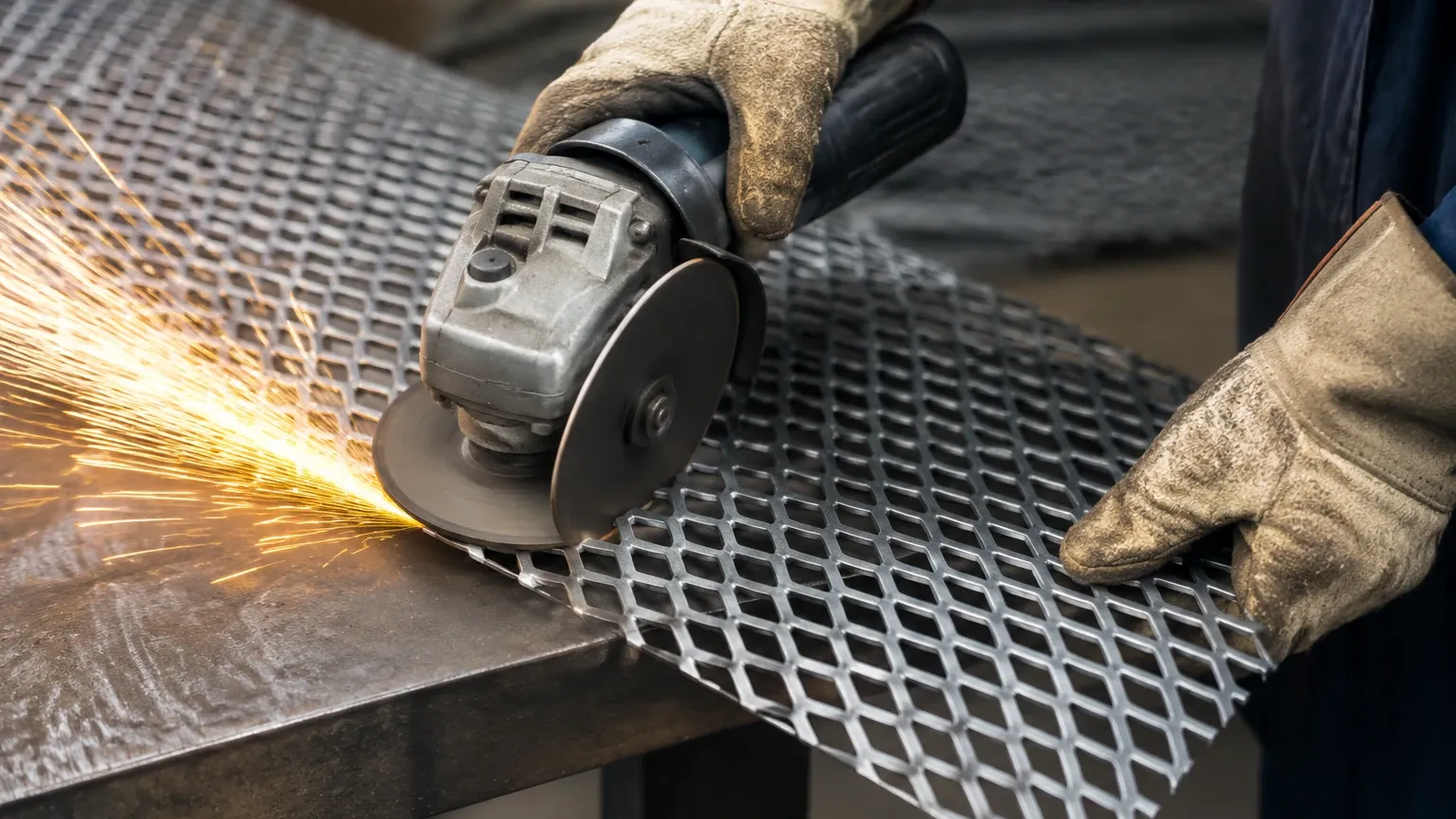
The angle grinder is perhaps the most common tool used in metal fabrication shops for expanded metal. When cutting expanded metal you want to use a thin, abrasive cut-off wheel (typically 1mm or 1.6mm thickness). The thinness of the wheel minimizes material loss and reduces the heat-affected zone (HAZ), which is vital when working with stainless steel to prevent carbide precipitation and subsequent corrosion.
When using a grinder, it is important to secure the expanded metal to a stable work surface. Because the material is porous, the grinding wheel can easily catch on a strand, leading to kickback. Operators should always cut in a direction that allows the wheel to move away from the body.
Circular Saws with Metal-Cutting Blades
For long, straight cuts in heavy-duty expanded metal, a circular saw equipped with a carbide-tipped metal-cutting blade is highly effective. Unlike abrasive wheels that melt through the metal, carbide-tipped blades produce clean, cool-to-the-touch cuts. This method is significantly faster than using an angle grinder and produces a finish that often requires no additional deburring. It is particularly effective for thick Perforated & Expanded Metal used in structural walkways or heavy-duty filtration grates.
Reciprocating Saws
While less precise than circular saws, reciprocating saws are useful for demolition or rough-cutting in tight spaces. When using a reciprocating saw, a high TPI (teeth per inch) blade is necessary to ensure that at least two to three teeth are in contact with the metal strands at all times. If the TPI is too low, the teeth will catch on the diamonds, likely breaking the blade or damaging the mesh.
Advanced Thermal and Mechanical Cutting Techniques
In high-precision manufacturing, such as the production of custom filter cartridges or pharmaceutical-grade strainers, manual and handheld power tools often fall short of the required tolerances. In these cases, automated industrial methods are employed.
CNC Plasma Cutting
Plasma cutting uses a high-velocity jet of ionized gas to melt and blow away metal. It is an excellent choice for expanded metal because it does not require physical contact with the material, which eliminates the risk of the tool snagging on the mesh. CNC plasma tables allow for complex shapes and curves to be cut with high repeatability. However, plasma cutting can leave a slight dross (hardened slag) on the edges of stainless steel, which may need to be removed via pickling or mechanical grinding.
Laser Cutting
For the highest level of precision, laser cutting is the gold standard. Fiber lasers can cut through Perforated & Expanded Metal with extreme accuracy and a very narrow kerf. This method produces the cleanest edges and the smallest heat-affected zone. For filtration components where flow dynamics and precise fitment are critical, laser cutting ensures that the open area of the mesh remains consistent right up to the edge of the cut.
Waterjet Cutting
Waterjet cutting uses a high-pressure stream of water mixed with abrasive particles. This is a "cold" cutting process, meaning there is no heat-affected zone. This is ideal for specialized alloys that are sensitive to heat. However, waterjet cutting is generally slower and more expensive than laser or plasma cutting for standard stainless steel expanded metal.
Engineering Best Practices for Edge Quality and Safety
Cutting expanded metal is only the first step; managing the resulting edges is equally important for the performance and safety of the final product.
Deburring and Edge Treatment
Regardless of the cutting method, expanded metal will almost always have sharp edges. In food processing or pharmaceutical applications, these burrs can harbor bacteria or shed metal particles into the product stream. Mechanical deburring, such as wire brushing or vibratory finishing, is often required. For structural panels, the edges are frequently "U-edged" or framed with a C-channel to encapsulate the sharp strands.
Managing Material Distortion
The process of expanding metal introduces internal stresses into the sheet. When these stresses are released during cutting—especially thermal cutting—the material may bow or warp. To mitigate this, fabricators often use a "leveling" process after cutting to ensure the component remains flat and within engineering tolerances.
Safety Protocols
Safety is paramount when handling expanded metal. The diamond edges are essentially a series of small knives. When cutting expanded metal you want to use Level 4 or Level 5 cut-resistant gloves. Additionally, because the cutting process (especially with grinders or saws) creates fine metal shards and sparks, full face shields and flame-resistant clothing are mandatory in industrial environments.
The Role of Custom Manufacturing in Cost Optimization
For many industrial projects, the most cost-effective solution is to bypass in-house cutting altogether. Professional manufacturers like Kaifil specialize in providing pre-cut, custom-sized filtration components that meet exact specifications.
Benefits of OEM Customization
By ordering custom-cut Perforated & Expanded Metal, engineering teams can reduce material waste and labor costs. Professional fabrication facilities utilize heavy-duty hydraulic shears and CNC equipment that can produce bond-sheared edges with a level of consistency that is difficult to achieve with handheld tools. This ensures that every piece fits perfectly into the assembly, reducing the total cost of ownership and speeding up the production cycle.
Furthermore, custom manufacturers can provide secondary services such as welding, forming, and surface finishing (e.g., electropolishing or passivating), which are essential for maintaining the corrosion resistance of stainless steel in harsh chemical environments.
Conclusion: Selecting the Right Approach
Choosing the correct method for cutting expanded metal depends on the gauge of the material, the required precision, and the volume of the project. For minor field adjustments, high-quality manual snips or angle grinders are sufficient. For production-level fabrication where edge quality and dimensional accuracy are paramount, CNC laser or plasma cutting is the superior choice.
Engineers should evaluate the trade-offs between in-house fabrication and sourcing custom-manufactured components. While cutting expanded metal in-house offers immediate flexibility, the specialized equipment and expertise of a dedicated manufacturer often result in a higher-quality product with lower overall risk. When performance and reliability are the primary goals—especially in demanding sectors like hydraulic filtration or chemical processing—the precision of the cut is just as important as the quality of the metal itself.
Download When Cutting Expanded Metal You Want to Use as a PDF
