


Expanded Metal 0715
In industrial filtration and structural engineering, the selection of support materials is as critical as the selection of the primary filtration media itself. Expanded metal 0715 represents a specific technical standard widely utilized for its balance of structural rigidity, open area, and weight efficiency. Unlike perforated metal, which is created by punching holes and removing material, expanded metal is manufactured by simultaneously slitting and stretching a solid sheet. This process creates a continuous, diamond-shaped pattern that offers unique mechanical advantages, particularly in high-pressure filtration environments.
For engineers and procurement professionals, understanding the specific geometry and performance characteristics of expanded metal 0715 is essential for ensuring the longevity of filter cartridges and industrial components. As a specialized manufacturer, Kaifil utilizes these materials to provide robust Perforated & Expanded Metal solutions tailored for demanding chemical, pharmaceutical, and hydraulic applications.
Technical Specifications and Geometry of 0715
The designation "0715" in the expanded metal industry typically refers to a specific set of dimensions regarding the diamond opening and the thickness of the material. While nomenclature can vary slightly between regional standards, the technical focus remains on the Short Way of Diamond (SWD), the Long Way of Diamond (LWD), and the strand dimensions.
Diamond Dimensions
In the 0715 configuration, the mesh is defined by its diamond-shaped apertures. The SWD is the distance from the center of one bond to the center of the next bond across the short axis, while the LWD follows the long axis. For 0715, these dimensions are engineered to provide a medium-density mesh. This geometry is particularly effective at supporting fine wire mesh layers in multi-stage filter cartridges, preventing the media from collapsing or deforming under differential pressure.
Strand Width and Thickness
The "15" in expanded metal 0715 often correlates to the material gauge or the thickness of the strand. In industrial filtration, maintaining a consistent strand thickness is vital for calculating the total weight and the mechanical strength of the filter core. The strands are the metal strips that form the sides of the diamond openings, and the "bond" is where these strands intersect. The thickness of the strand in 0715 provides sufficient cross-sectional area to resist tensile stress during high-flow operations.
Manufacturing Advantages: Expansion vs. Perforation
When evaluating Perforated & Expanded Metal for industrial use, the manufacturing process significantly impacts the final product's performance and cost-effectiveness. Expanded metal 0715 offers several distinct advantages over traditional perforated sheets.
1. Material Efficiency: The expansion process involves no scrap. A single sheet of metal is slit and stretched, meaning the final product can be several times the size of the original raw material. This makes expanded metal a more sustainable and cost-effective option for large-scale industrial projects.
2. Structural Integrity: Because the mesh is formed from a single piece of metal without welds or joins, it maintains a higher strength-to-weight ratio. The strands are set at an angle to the plane of the sheet, which adds a three-dimensional rigidity that flat perforated metal lacks.
3. Flow Dynamics: The angled strands of expanded metal 0715 can be used to influence fluid dynamics. Depending on the orientation of the mesh (standard vs. flattened), it can either promote turbulence to prevent bypass or offer a smooth surface for laminar flow.
Material Selection for Corrosive Environments
For B2B applications in chemical processing or food and beverage production, the base material of the expanded metal 0715 is as important as its dimensions. Kaifil specializes in stainless steel variants to ensure maximum durability.
Stainless Steel 304
This is the standard grade for general industrial applications. It offers excellent forming characteristics and good corrosion resistance. In hydraulic systems or water treatment plants where the environment is not excessively acidic, 304 stainless steel 0715 provides a cost-effective structural solution.
Stainless Steel 316L
For pharmaceutical and high-end chemical processing, 316L is the preferred choice. The addition of molybdenum and a lower carbon content provides superior resistance to chloride-induced pitting and crevice corrosion. When expanded metal 0715 is used as an outer guard or inner core in a 316L filter cartridge, it ensures that the entire assembly can withstand aggressive cleaning cycles and harsh process fluids.
Applications in Industrial Filtration Systems
Expanded metal 0715 is rarely used as a standalone filtration medium for fine particles; instead, it serves as the backbone of a filtration system. Its primary roles include:
Support Cores for Filter Cartridges
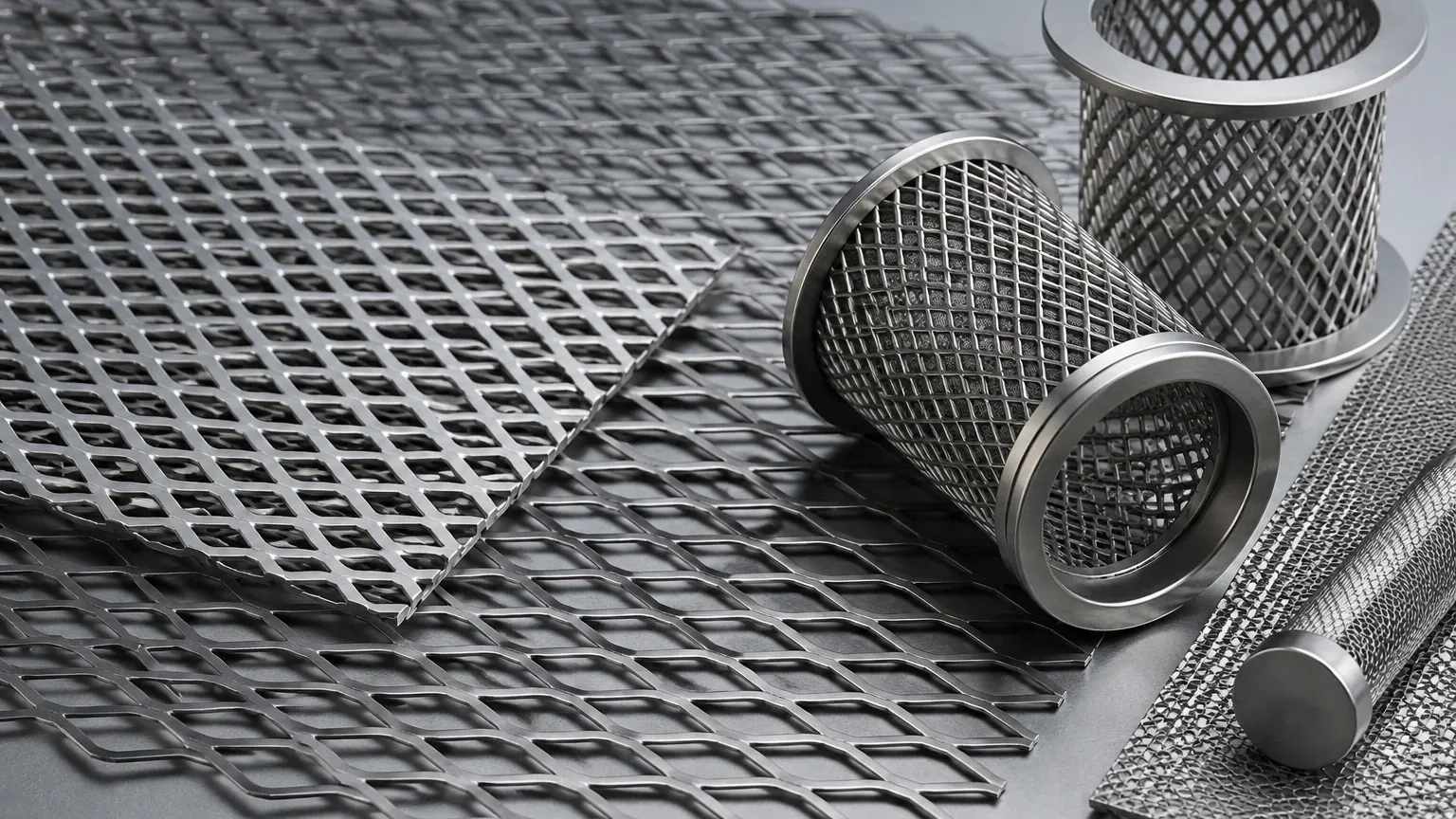
In high-pressure hydraulic or gas filtration, the primary filter media (such as sintered wire mesh or pleated fiber) requires a rigid internal structure. Expanded metal 0715 is rolled into cylinders and welded to form a core that can withstand high collapse pressures. The diamond openings allow for maximum fluid throughput with minimal pressure drop.
Outer Protective Guards
Filter elements are often susceptible to mechanical damage during installation or maintenance. An outer wrap of expanded metal 0715 protects the delicate inner mesh from abrasion and impact while allowing the process fluid to enter the filter evenly across its entire surface area.
Pre-Filtration and Debris Catchers
In larger intake systems, 0715 can act as a primary stage to catch large debris, protecting downstream pumps and finer filtration stages from catastrophic failure. Its robust construction ensures it can handle the impact of large solids without tearing.
Engineering Considerations: Open Area and Pressure Drop
One of the most critical calculations for an engineer selecting expanded metal 0715 is the percentage of open area. This figure determines how much resistance the metal will offer to the fluid flow.
* Standard Expanded Metal: The strands are turned at an angle, which provides high strength but can create a more complex flow path.
* Flattened Expanded Metal: The sheet is passed through a cold-rolling mill after expansion, resulting in a flat, smooth surface. Flattened 0715 is often preferred when the expanded metal is in direct contact with a fine wire mesh, as it prevents the strands from cutting into or damaging the thinner filtration layer.
Engineers must confirm the required open area to ensure that the introduction of a support layer does not lead to an unacceptable increase in the system's total differential pressure (ΔP). Expanded metal 0715 typically offers a generous open area, making it ideal for high-viscosity fluids or high-velocity gas streams.
Customization and OEM Capabilities
While expanded metal 0715 follows standard dimensional patterns, industrial applications often require specific modifications. Kaifil provides extensive customization options for Perforated & Expanded Metal to meet precise engineering drawings.
* Dimensional Accuracy: Precise shearing and slitting to fit specific cartridge lengths and diameters.
* Surface Treatments: Options such as electropolishing for pharmaceutical applications to ensure a burr-free surface and enhanced corrosion resistance.
* Forming and Welding: Beyond providing flat sheets, Kaifil can supply pre-formed cylinders or custom-shaped components ready for integration into the final filter assembly.
Maintenance and Replacement Cycles
In the B2B sector, the total cost of ownership is a primary concern. The durability of expanded metal 0715 contributes to longer service lives for filter elements. However, maintenance teams should monitor for:
1. Scale Accumulation: In water treatment or mineral processing, scale can build up on the strands, reducing the effective open area.
2. Mechanical Fatigue: In systems with frequent pressure pulsations, the bonds of the expanded metal should be inspected for signs of stress cracking.
3. Chemical Degradation: Even stainless steel can succumb to improper chemical cleaning agents. Regular inspection ensures the structural integrity of the support core remains intact.
By selecting high-quality 0715 mesh manufactured to tight tolerances, facilities can reduce the frequency of unplanned downtime and extend the intervals between filter replacements.
Conclusion: Selecting the Right Partner for 0715 Solutions
Choosing expanded metal 0715 is a decision that impacts the mechanical reliability and efficiency of an entire filtration system. Engineers must weigh the benefits of material type, open area, and structural rigidity to find the optimal balance for their specific application.
Kaifil’s expertise in manufacturing and engineering ensures that every piece of expanded metal meets the rigorous standards required by global industrial sectors. Whether you require standard sheets for architectural use or custom-engineered cores for high-performance filter cartridges, our team provides the technical support and manufacturing precision necessary to achieve your goals. For more information on available specifications and custom designs, you can Review product options and application support to find the ideal solution for your project requirements.
