


Metal Expanding
In the realm of industrial manufacturing and filtration, metal expanding is a sophisticated cold-forming process that transforms solid metal sheets or coils into a mesh-like structure characterized by diamond-shaped openings. Unlike perforated metal, which involves punching holes and generating significant material waste, the metal expanding process slits and stretches the material simultaneously. This results in a continuous, one-piece structure that maintains the inherent strength of the original metal while introducing porosity and increased surface area. For engineers and procurement specialists, understanding the nuances of metal expanding is essential for selecting the right components for high-performance filtration and structural support applications.
At its core, the process of metal expanding is an exercise in efficiency and structural integrity. Because the material is stretched rather than removed, there is virtually no scrap produced during the manufacturing phase. This makes expanded metal a cost-effective alternative for many industrial projects, particularly when working with high-value alloys such as stainless steel. Within the context of professional filtration solutions, expanded metal serves as a critical substrate, providing the mechanical rigidity required to support finer wire mesh layers in pressurized environments.
The Mechanics of the Metal Expanding Process
The production of expanded metal begins with a solid sheet of metal, typically stainless steel, carbon steel, or aluminum. The sheet is fed through an expanding machine equipped with a precision-engineered knife. As the knife descends, it performs a series of staggered slits across the width of the sheet. Simultaneously, the machine applies tension to stretch the metal, opening the slits into the characteristic diamond pattern.
There are two primary forms of expanded metal produced through this method: raised (or standard) and flattened.
1. Raised Expanded Metal: This is the immediate product of the expanding process. The strands and bonds (the intersections of the strands) are set at a uniform angle to the plane of the sheet. This creates a three-dimensional surface that offers high slip resistance and a high strength-to-weight ratio. In filtration, the raised profile can help create turbulence in fluid flow, which may be desirable in specific mixing or heat exchange applications.
2. Flattened Expanded Metal: To produce this variant, the raised expanded metal is passed through a cold-rolling reducing mill. This process flattens the strands and bonds back into a single plane, resulting in a smooth, level surface. Flattened expanded metal is often preferred in filtration cartridges where a smooth interface is required to prevent damage to delicate filter media or to facilitate easier cleaning and backwashing.
Technical Terminology and Geometric Specifications
To accurately specify expanded metal for industrial use, engineers must be familiar with the standardized terminology used to describe its geometry. These measurements dictate the flow characteristics, structural strength, and filtration efficiency of the final product.
* SWD (Short Way of Design): This is the distance measured from the center of one bond to the center of the next bond across the short axis of the diamond.
* LWD (Long Way of Design): This is the distance measured from the center of one bond to the center of the next bond across the long axis of the diamond.
* SWO (Short Way of Opening): The actual width of the opening, measured from the inside edge of one bond to the inside edge of the opposite bond.
* LWO (Long Way of Opening): The actual length of the opening, measured from the inside edge of one bond to the inside edge of the opposite bond.
* Strand Width: The amount of metal fed into the machine between the slits, which determines the thickness of the individual "wires" in the mesh.
* Strand Thickness: The gauge or thickness of the original metal sheet.
By adjusting these parameters, manufacturers can tailor the Perforated & Expanded Metal to meet specific open area requirements. The percentage of open area is a critical calculation for filtration engineers, as it directly impacts pressure drop and flow velocity across the filter element.
Material Selection for Industrial Filtration
While metal expanding can be applied to various materials, stainless steel remains the industry standard for demanding B2B applications, particularly in chemical processing, food and beverage, and pharmaceutical sectors. Kaifil specializes in utilizing high-grade alloys to ensure the longevity and reliability of filtration components.
Stainless Steel 304 and 304L
Grade 304 is the most common stainless steel used in metal expanding. It offers excellent corrosion resistance and formability. For applications involving welding, the low-carbon variant (304L) is often specified to prevent carbide precipitation and maintain corrosion resistance in the heat-affected zones.
Stainless Steel 316 and 316L
In environments where the metal is exposed to chlorides, acids, or high temperatures, Grade 316 is the preferred choice. The addition of molybdenum enhances its resistance to pitting and crevice corrosion. This makes 316L expanded metal ideal for marine environments, pharmaceutical manufacturing, and aggressive chemical filtration.
Specialty Alloys
For extreme conditions, such as high-temperature gas filtration or highly corrosive petrochemical processing, materials like Monel, Inconel, or Titanium may be used. The choice of material must account for chemical compatibility, thermal expansion coefficients, and the total cost of ownership over the component's lifecycle.
Applications of Expanded Metal in Filtration Systems
Metal expanding plays a multifaceted role in industrial filtration. It is rarely used as the primary filtration medium for fine particles; instead, it serves as a structural backbone for more complex filter assemblies.
Support Cores and Protective Sleeves
In cylindrical filter cartridges, expanded metal is often rolled and welded into a tube to serve as an internal support core. This core prevents the filter media—such as pleated paper, felt, or fine wire mesh—from collapsing under the pressure of the fluid flow. Conversely, expanded metal can be used as an outer sleeve to protect the filter media from mechanical damage during installation or backwashing.
Pleat Support
In pleated filter designs, expanded metal can be laminated to the filter media. This ensures that the pleats remain uniformly spaced and do not "blind" or bunch together under high flow rates. The rigid nature of the expanded metal helps maintain the structural integrity of the pleat pack, maximizing the effective filtration area.
Coarse Pre-Filtration
In water treatment and HVAC systems, expanded metal is frequently used as a pre-filter to capture large debris, such as leaves, scale, or plastic fragments, before the fluid reaches the more sensitive fine filtration stages. Its high open area allows for high flow rates with minimal pressure loss.
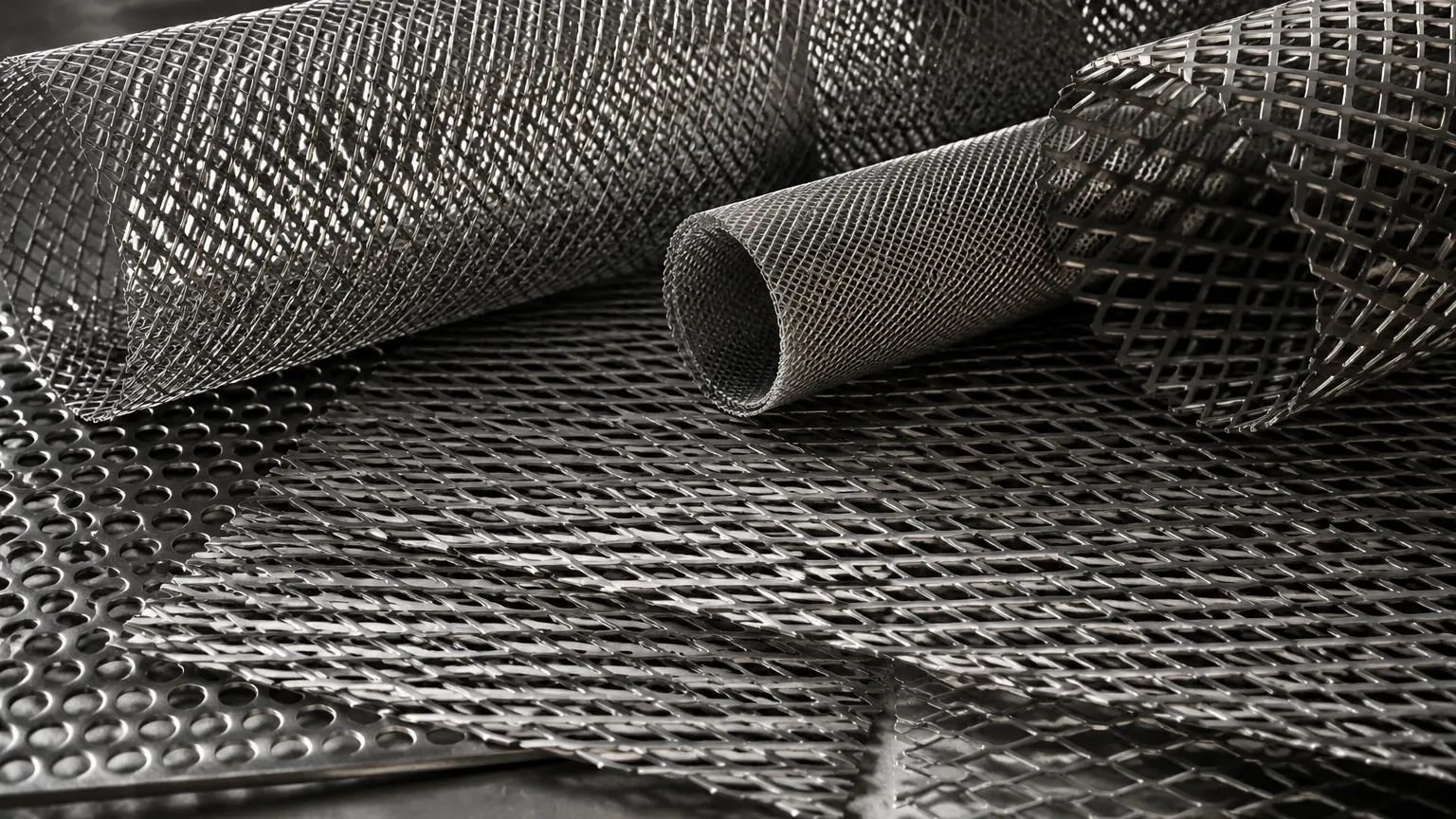
Comparing Expanded Metal and Perforated Metal
When designing a filtration system, engineers often weigh the benefits of expanded metal against perforated metal. Both have distinct advantages depending on the application requirements.
| Feature | Expanded Metal | Perforated Metal |
| :— | :— | :— |
| Material Waste | Minimal to none; material is stretched. | Significant; slugs are punched out. |
| Strength-to-Weight | High; the strands are interconnected. | Moderate; depends on hole pattern and bridge width. |
| Cost | Generally lower for large volumes due to material efficiency. | Higher, especially for expensive alloys like 316L. |
| Surface Profile | Naturally 3D (raised) or flattened. | Naturally flat. |
| Customization | Limited to diamond patterns and strand sizes. | Highly customizable hole shapes (round, square, slotted). |
| Flow Characteristics | Creates more turbulence (raised). | Predictable, laminar flow. |
For applications where weight reduction and cost-efficiency are paramount, expanded metal is often the superior choice. However, if a specific hole shape or a very high degree of precision in hole placement is required, perforated metal may be necessary.
Engineering Considerations for Customization
When sourcing expanded metal for custom filtration projects, several engineering factors must be confirmed to ensure optimal performance. Kaifil works closely with technical teams to define these specifications during the design phase.
Filtration Accuracy and Open Area
The open area percentage is calculated based on the SWD, LWD, and strand width. A higher open area reduces the pressure drop (delta P) across the filter but may decrease the structural rigidity. Engineers must balance these two factors based on the operating pressure and flow requirements of the system.
Edge Finishing and Deburring
The metal expanding process can leave sharp edges at the perimeter of the sheet. For many industrial applications, especially in the food and beverage or pharmaceutical industries, these edges must be deburred or hemmed to prevent contamination and ensure safe handling. Custom-fabricated filter components often involve specialized edge treatments to integrate seamlessly into the final assembly.
Tolerance and Flatness
Standard industrial tolerances for expanded metal are generally broader than those for machined parts. However, for precision filtration components, tighter tolerances on the SWD and LWD may be required. Furthermore, if the expanded metal is to be used in a multi-layer laminate, the flatness of the sheet is critical to ensure uniform bonding and prevent bypass.
Maintenance, Durability, and Total Cost of Ownership
One of the primary advantages of using stainless steel expanded metal in filtration is its durability. Unlike synthetic mesh or paper media, metal components can withstand high temperatures, pressure spikes, and aggressive cleaning cycles.
Cleaning and Reusability
In many industrial processes, the ability to clean and reuse filter components is a significant cost-saving factor. Expanded metal supports are easily cleaned through ultrasonic cleaning, chemical baths, or high-pressure steam. Because the material is a single continuous piece, there are no joints or wires to fray or unravel over time, which reduces the risk of downstream contamination.
Replacement Cycles
The replacement cycle for expanded metal components is typically measured in years rather than months, provided the correct material was selected for the chemical environment. When evaluating the total cost of ownership, engineers should consider not just the initial purchase price, but also the reduction in downtime, the lower frequency of replacements, and the reliability of the filtration system as a whole.
Conclusion: Selecting the Right Partner for Metal Expanding
Successful implementation of metal expanding in industrial filtration requires a deep understanding of material science, fluid dynamics, and manufacturing precision. As a professional manufacturer, Kaifil provides the technical expertise necessary to navigate these complexities. From selecting the appropriate stainless steel grade to calculating the optimal open area for a specific hydraulic application, the focus remains on delivering high-performance, durable filtration solutions.
By integrating expanded metal into filtration designs, engineers can achieve a balance of structural strength and efficient flow that is difficult to match with other materials. Whether the goal is to support a delicate membrane in a pharmaceutical process or to provide a robust pre-filter for industrial water treatment, the versatility of the metal expanding process makes it an indispensable tool in modern engineering. When specifying these components, always confirm the geometric parameters, material grades, and finishing requirements to ensure the final product meets the rigorous demands of your industrial environment.
