


Expanded Metal T 0715
In the field of industrial filtration and structural support, selecting the correct mesh geometry is critical for balancing flow efficiency with mechanical integrity. The specification known as expanded metal T 0715 represents a precise configuration of diamond-shaped apertures frequently utilized in demanding B2B applications. Unlike traditional woven wire or perforated sheets, expanded metal is produced by simultaneously slitting and stretching a solid metal sheet, resulting in a continuous, jointless structure that offers unique engineering advantages.
For engineers and procurement professionals, understanding the technical nuances of expanded metal T 0715 is essential when designing filtration systems or protective enclosures. This specification is often favored for its specific open area ratio and its ability to provide rigid support for finer filter media in high-pressure environments. As a professional manufacturer specializing in custom stainless steel filtration solutions, Kaifil provides the technical expertise necessary to integrate these components into complex industrial assemblies.
Understanding Expanded Metal T 0715 Specifications
The nomenclature "T 0715" typically refers to the geometric dimensions of the mesh diamonds. In industrial standards, this usually indicates a mesh with a Short Way of Diamond (SWD) of approximately 7mm and a Long Way of Diamond (LWD) of approximately 15mm. However, the performance of the mesh is not determined by the aperture size alone; it is a combination of four primary technical variables:
1. Long Way of Diamond (LWD): The distance from the center of one joint to the center of the next joint across the long axis.
2. Short Way of Diamond (SWD): The distance from the center of one joint to the center of the next joint across the short axis.
3. Strand Width: The amount of metal between the openings, determined by how much the machine feeds the sheet forward before each stroke.
4. Material Thickness: The gauge of the original solid sheet used for expansion.
When specifying expanded metal T 0715, engineers must confirm whether they require "raised" (standard) or "flattened" mesh. Raised expanded metal features strands that are angled relative to the plane of the sheet, which increases the overall thickness and provides a slip-resistant surface or directional flow characteristics. Flattened expanded metal is cold-rolled after the expansion process, resulting in a smooth, level surface that is easier to clean and ideal for applications where the mesh must sit flush against another layer of filter media.
Material Selection for Industrial Filtration Environments
The utility of expanded metal T 0715 is heavily dependent on the material from which it is fabricated. Because Kaifil focuses on high-performance industrial applications, stainless steel is the primary material of choice. The selection of the specific grade depends on the chemical and thermal stresses of the operating environment.
* Stainless Steel 304: The most common grade for general industrial use. It offers excellent forming characteristics and good corrosion resistance for water treatment and food processing applications.
* Stainless Steel 316L: Preferred for chemical processing and marine environments. The addition of molybdenum provides superior resistance to pitting and crevice corrosion, particularly in chloride-rich environments. The "L" (low carbon) variant is essential if the mesh is to be welded into a filter housing or support frame, as it prevents carbide precipitation.
* High-Temperature Alloys: For specialized applications in petrochemical or exhaust filtration, materials like Inconel or Monel may be used to maintain structural integrity at temperatures exceeding 500°C.
Choosing the right material ensures that the Perforated & Expanded Metal components do not become a point of failure due to oxidation or chemical degradation, thereby extending the replacement cycle and reducing the total cost of ownership.
Engineering Advantages of T 0715 in Filtration Systems
The T 0715 specification is widely utilized in filtration for several functional reasons. Its primary role is often as a support structure (a "pleat support" or "outer cage") for delicate wire mesh or synthetic membranes.
Structural Rigidity without Excess Weight
Because expanded metal is made from a single piece of material, there are no welds or weaves that can unravel. The joints (where the strands meet) act as structural nodes that distribute mechanical stress across the entire sheet. This makes T 0715 an excellent choice for hydraulic filters where high pressure-drop events might otherwise cause a filter element to collapse.
Optimized Flow Dynamics
The angled strands of raised expanded metal can be used to influence fluid dynamics. In certain gas-liquid separation processes, the orientation of the T 0715 mesh can help break up bubbles or coalesce droplets. Furthermore, the high open-area percentage of this specification ensures that the support layer does not significantly contribute to the overall pressure drop of the system.
Cost-Effectiveness and Sustainability
One of the most significant B2B advantages of expanded metal is the lack of material waste. Unlike perforated metal, which involves punching out holes and creating scrap, expanded metal is stretched. This means a smaller amount of raw material can produce a larger surface area of finished product, making it a more sustainable and cost-effective option for large-scale industrial projects.
Manufacturing Precision and Customization Options
At Kaifil, we recognize that standard off-the-shelf specifications rarely meet the exact needs of specialized engineering projects. While T 0715 provides a baseline for dimensions, the manufacturing process allows for significant customization to meet OEM requirements.
* Custom Strand Widths: By adjusting the feed rate during the expansion process, we can increase the strand width to provide higher mechanical strength or decrease it to maximize the open area for higher flow rates.
* Precision Leveling: For flattened T 0715, precision leveling is critical to ensure the sheet is perfectly flat for subsequent laser cutting or welding processes. This prevents gaps when the mesh is wrapped around a filter core.
* Surface Finishing: Depending on the application, the mesh may undergo electropolishing to remove burrs and improve corrosion resistance, or ultrasonic cleaning to ensure it meets the stringent cleanliness standards required in the pharmaceutical and food and beverage industries.
These customization options allow engineers to fine-tune the performance of the filtration component to the specific viscosity, pressure, and particle load of their application.
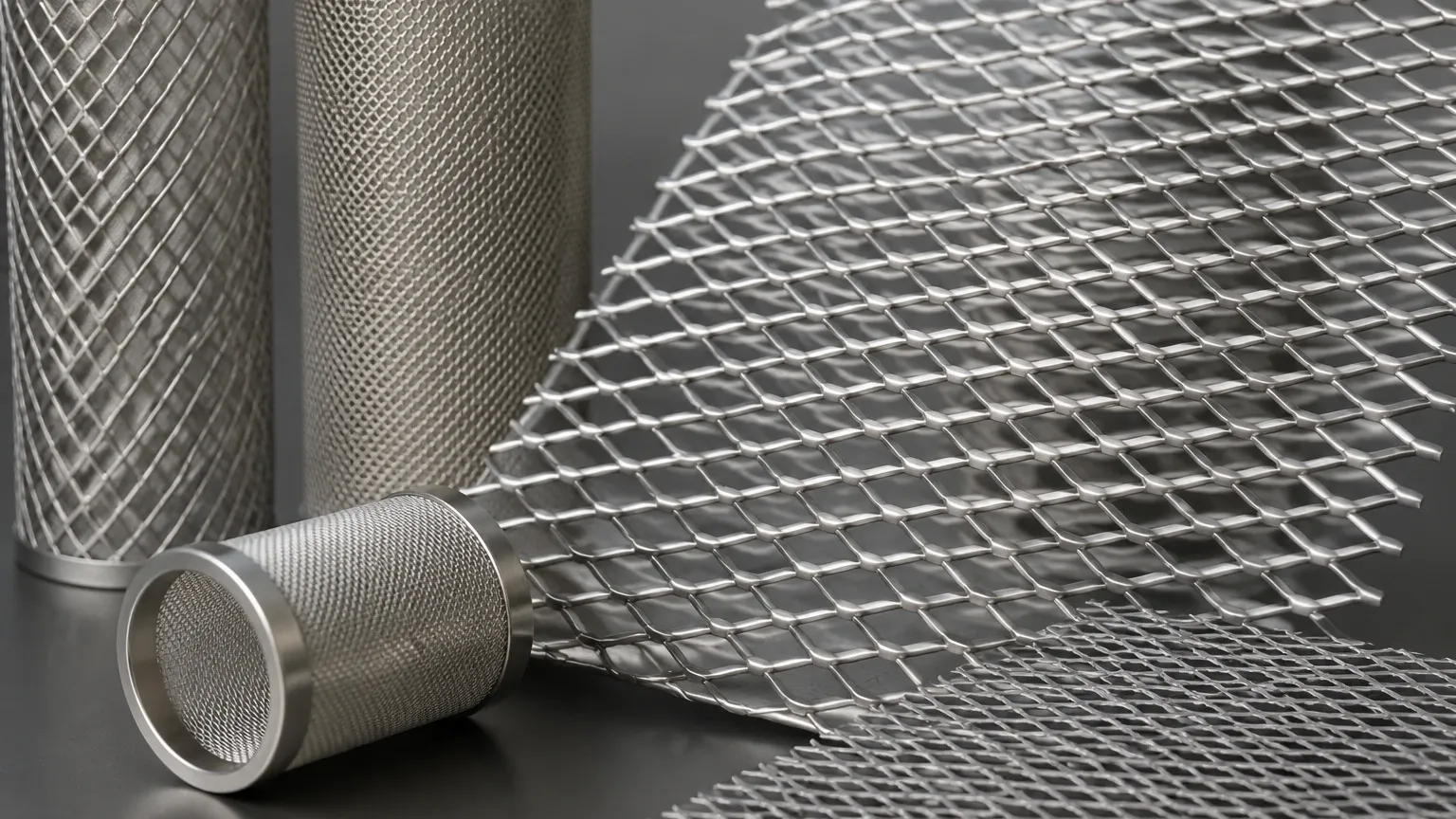
Comparative Analysis: Expanded Metal vs. Perforated Metal
When deciding between expanded metal T 0715 and perforated metal, procurement teams must evaluate the specific trade-offs of each manufacturing method. While both fall under the category of Perforated & Expanded Metal, their mechanical behaviors differ.
| Feature | Expanded Metal (T 0715) | Perforated Metal |
| :— | :— | :— |
| Material Waste | Minimal (stretched, no scrap) | High (slugs are punched out) |
| Structural Strength | High strength-to-weight ratio | Dependent on hole pattern and bridge |
| Surface Profile | Raised or Flattened | Always Flat |
| Flow Direction | Can be directional (raised) | Uniform |
| Cost | Generally lower for large areas | Higher due to material loss |
| Aperture Shape | Diamond/Hexagonal | Round, Square, Slotted |
For many filtration support applications, expanded metal is the superior choice due to its rigidity. However, if a very specific round-hole size is required for precise particle retention (without a secondary mesh layer), perforated metal may be more appropriate. Kaifil assists engineering teams in making this determination based on the required filtration accuracy and the mechanical stresses involved.
Critical Evaluation Criteria for Procurement Engineers
Before finalizing a purchase order for expanded metal T 0715, there are several technical factors that must be confirmed with the manufacturer to avoid integration issues during assembly.
1. Dimensional Tolerances
In industrial filtration, even a 0.5mm deviation in LWD or SWD can affect the fitment of a filter element into its housing. Confirm that the manufacturer can maintain tight tolerances across the entire batch, especially for custom-cut sizes.
2. Edge Configuration
Expanded metal naturally has "open" or "raw" edges where the diamonds are cut. For safety and ease of assembly, specify whether the edges should be sheared flush or if a solid border (random or bond) is required. For filter cartridges, a clean, burr-free edge is essential to prevent damage to the primary filter media during the pleating or wrapping process.
3. Flatness and Stress Relief
The expansion process introduces significant internal stresses into the metal. If the mesh is not properly leveled and stress-relieved, it may "bow" or "twist" when cut into smaller pieces. High-quality T 0715 should remain flat when laid on a surface plate.
4. Certification and Traceability
For industries such as pharmaceuticals or aerospace, material traceability is non-negotiable. Ensure the supplier provides Mill Test Reports (MTRs) confirming the chemical composition of the stainless steel used.
Installation and Maintenance Considerations
Integrating expanded metal T 0715 into a filtration system requires attention to the orientation of the mesh. In raised expanded metal, the "slope" of the strands can be used to deflect larger debris away from the filter surface or to encourage drainage. If the mesh is being used as a support for a wire mesh sleeve, the flattened version is typically recommended to prevent the strands from cutting into the finer wires under pressure.
From a maintenance perspective, stainless steel T 0715 is highly durable and often outlasts the primary filter media. During routine cleaning cycles—such as backwashing or ultrasonic cleaning—the rigid structure of the expanded metal helps the filter element maintain its shape, preventing the pleat collapse that often occurs with weaker support materials. If the mesh is used in a corrosive environment, regular inspections for signs of localized pitting or stress corrosion cracking are recommended to ensure the long-term safety of the system.
By selecting a high-quality expanded metal T 0715 specification and partnering with a manufacturer like Kaifil, industrial operators can achieve a balance of performance, durability, and cost-efficiency. Whether used as a pre-filter, a support cage, or a protective screen, this versatile material remains a cornerstone of modern industrial filtration design.
