


1 2 #13 Expanded Metal
In the landscape of industrial filtration and structural reinforcement, material selection is dictated by the balance between mechanical strength, open area, and chemical compatibility. Among the various specifications available to engineers, 1 2 #13 expanded metal stands out as a versatile standard. This specific designation—referring to a 1/2-inch nominal diamond size and a 13-gauge material thickness—is a staple in applications ranging from heavy-duty filter support to safety guards and architectural infills.
Understanding the technical nuances of 1 2 #13 expanded metal is essential for procurement teams and design engineers who must ensure that the components integrated into their systems can withstand operational stresses while maintaining precise performance parameters. As a manufacturer specializing in high-performance filtration components, Kaifil provides these materials in various alloys, primarily stainless steel, to meet the rigorous demands of chemical processing, water treatment, and industrial manufacturing.
Technical Specifications of 1 2 #13 Expanded Metal
The nomenclature "1 2 #13" follows the standard industry convention for identifying expanded metal products. To accurately specify this material for an engineering project, one must break down the dimensions into four primary measurements: Short Way of Design (SWD), Long Way of Design (LWD), strand thickness, and strand width.
SWD and LWD Dimensions
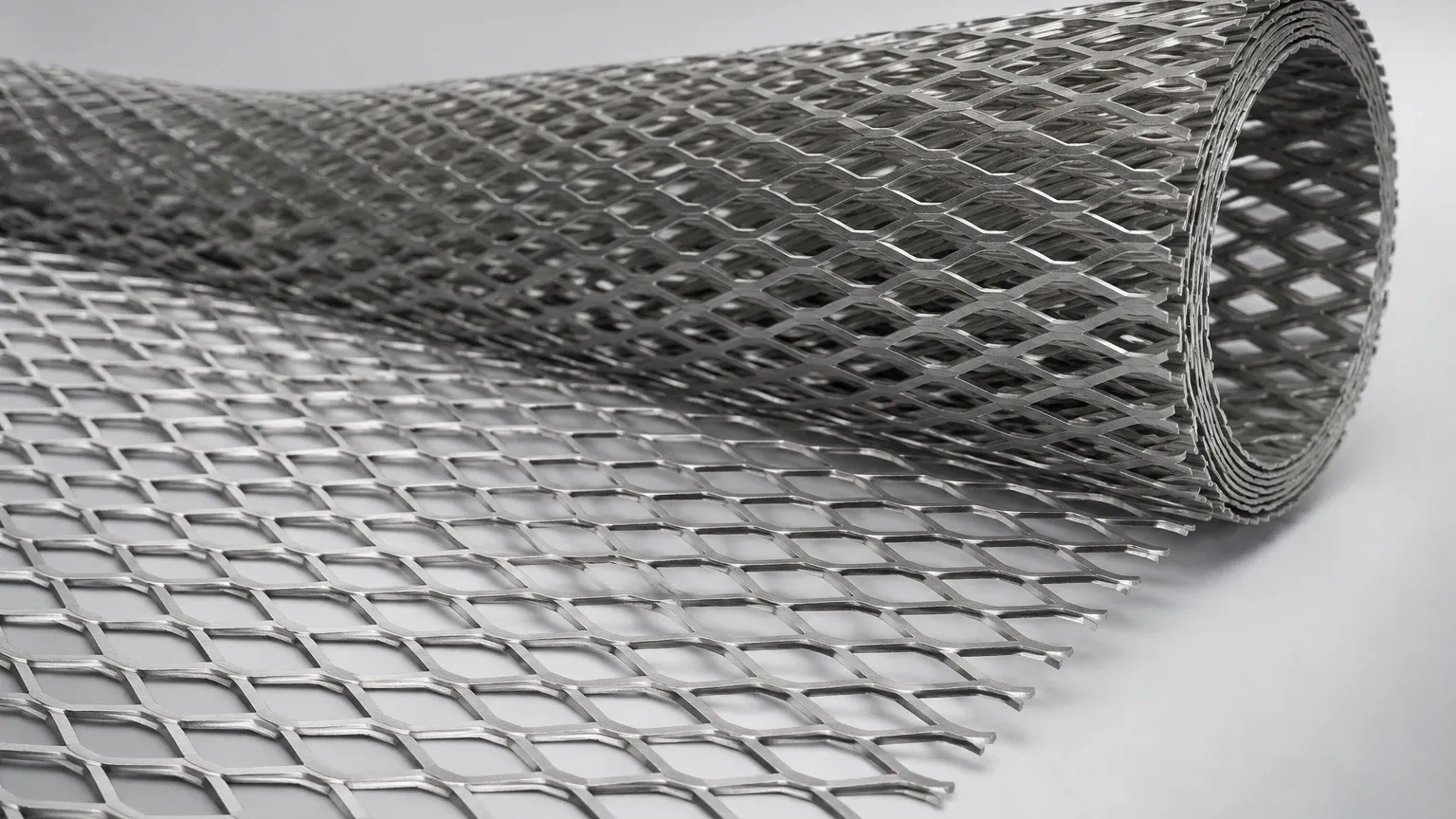
The "1/2" in the specification refers to the nominal Short Way of Design (SWD). In a standard 1 2 #13 expanded metal sheet, the SWD is approximately 0.500 inches. This measurement is taken from the center of one bond to the center of the next bond across the short axis of the diamond opening. The Long Way of Design (LWD) typically measures around 1.20 to 1.25 inches. These dimensions define the geometry of the diamond pattern, which directly influences the material's rigidity and its ability to retain or allow the passage of specific particles or fluids.
Gauge and Strand Geometry
The "#13" indicates the gauge of the base metal before it is expanded. For carbon steel and stainless steel, 13-gauge material has a nominal thickness of approximately 0.090 inches. During the expansion process, the metal is slit and stretched simultaneously. The resulting "strand width"—the amount of metal fed into the dies between strokes—is usually around 0.096 inches for this specification.
When evaluating Perforated & Expanded Metal for filtration or structural use, it is important to note that the final thickness of the expanded sheet (the "overall thickness") will be greater than the original gauge thickness because the strands are turned at an angle during the expansion process. For 1 2 #13, the overall thickness often reaches approximately 0.200 to 0.250 inches in its raised state.
Raised vs. Flattened Expanded Metal
One of the most critical decisions an engineer must make when specifying 1 2 #13 expanded metal is whether to utilize the material in its "Standard" (Raised) or "Flattened" state. Each type offers distinct physical properties that affect its performance in industrial environments.
Standard (Raised) Expanded Metal
In its standard form, the strands and bonds are set at a uniform angle to the plane of the sheet. This creates a three-dimensional surface that provides excellent slip resistance and high structural rigidity. In filtration applications, raised 1 2 #13 expanded metal is often used as a primary coarse screen or a protective outer cage. The angled strands create a turbulent flow profile, which can be advantageous in certain fluid dynamics scenarios, though it may increase pressure drop compared to flattened alternatives.
Flattened Expanded Metal
Flattened expanded metal is produced by passing the standard expanded sheet through a cold-roll reducing mill. This process levels the strands and bonds, resulting in a smooth, flat surface. Flattening reduces the overall thickness of the sheet to roughly the original gauge of the metal (approx. 0.090 inches for #13 gauge).
For filtration systems, flattened 1 2 #13 is frequently preferred when the expanded metal serves as a support substrate for a fine wire mesh or a non-woven filter medium. The flat surface prevents the delicate mesh from being punctured or deformed by the angled strands of a raised sheet. Additionally, flattened metal is easier to clean and safer to handle in manual maintenance environments.
Material Selection: The Role of Stainless Steel
While expanded metal can be manufactured from carbon steel, aluminum, or galvanized steel, industrial filtration applications often demand the superior properties of stainless steel. Kaifil specializes in custom stainless steel solutions because of the material's inherent durability in harsh environments.
Corrosion Resistance
In chemical processing and water treatment, exposure to corrosive agents is a constant factor. 304-grade stainless steel is the standard for general-purpose industrial use, providing good resistance to oxidation. However, for environments involving chlorides or high-salinity fluids, 316-grade stainless steel is the preferred choice due to its molybdenum content, which enhances pitting resistance. Using 1 2 #13 expanded metal in 316 stainless steel ensures that the structural integrity of the filter or guard remains intact over long-term exposure.
Thermal Stability
Industrial processes often involve high temperatures that can cause carbon steel to scale or lose structural integrity. Stainless steel 1 2 #13 expanded metal maintains its mechanical properties at much higher temperature thresholds, making it suitable for hot gas filtration or high-temperature fluid processing. Its low thermal expansion coefficient compared to certain plastics also ensures that the filter geometry remains stable under thermal cycling.
Applications in Industrial Filtration
1 2 #13 expanded metal is rarely a standalone filter for fine particles; rather, it functions as a critical component in a multi-stage filtration assembly. Its primary roles include support, protection, and coarse separation.
Filter Media Support
In high-pressure hydraulic or liquid filtration, fine wire mesh or pleated paper media cannot withstand the pressure differential on their own. They require a "skeleton" to prevent collapsing. 1 2 #13 expanded metal provides a high open area (typically around 60% to 70%), which allows for high flow rates with minimal resistance, while the 13-gauge strands offer the necessary tensile strength to support the primary filter media under load.
Protective Cages and Strainers
In large-scale industrial strainers, 1 2 #13 expanded metal acts as a protective outer layer. It shields the internal filtration elements from large debris or mechanical impact that could occur during installation or high-velocity flow surges. Its diamond pattern is particularly effective at catching elongated debris that might pass through circular perforations of a similar size.
Coarse Pre-filtration
In water intake systems or wastewater treatment, 1 2 #13 expanded metal serves as a coarse pre-filter. It effectively removes large solids, such as twigs, plastic waste, or large biological matter, before the fluid enters more sensitive downstream equipment like pumps or fine membrane filters.
Engineering Considerations for Integration
When integrating 1 2 #13 expanded metal into a product design, engineers must account for several fabrication and performance factors to ensure the final assembly meets the required specifications.
Open Area and Flow Rates
The open area of 1 2 #13 expanded metal is a function of the strand width and the diamond size. For a standard raised sheet, the open area is approximately 60%. This high percentage of open space is critical for maintaining low pressure drops across the filtration system. Engineers must calculate the total effective filtration area (EFA) by considering how much of this open area is obscured by frames, welds, or overlapping layers.
Edge Conditions and Safety
Expanded metal is produced by slitting, which leaves sharp edges at the perimeter of the sheet. In B2B applications where filters are frequently handled for cleaning or replacement, specifying "random sheared" vs. "bond sheared" edges is important. Bond shearing provides a more finished edge with fewer sharp points, though it may require tighter manufacturing tolerances. For many industrial filter cartridges, the expanded metal is rolled into a cylinder and welded; in these cases, the edge condition must be precise to ensure a clean longitudinal seam weld.
Load-Bearing Capacity
Although 1 2 #13 is relatively lightweight, its expanded diamond structure gives it a high strength-to-weight ratio. When used as a walkway or a heavy-duty tray in a processing unit, the orientation of the diamonds matters. The LWD should generally run perpendicular to the support spans to maximize the load-bearing capacity of the sheet.
Quality Control and Procurement Best Practices
To ensure that the Perforated & Expanded Metal components meet industrial standards, purchasing teams should verify several quality benchmarks with their manufacturer.
1. Material Certification: Always request Mill Test Reports (MTRs) to verify the chemical composition of the stainless steel. This ensures that the "316L" specified is actually 316L and not a lower-grade substitute.
2. Dimensional Tolerance: Standard industry tolerances for expanded metal can be broad. If the material is being used in a precision-engineered filter housing, specify tighter tolerances for SWD, LWD, and overall flatness.
3. Surface Finish: For food and beverage or pharmaceutical applications, the expanded metal must be free of lubricants and burrs. Specifying an electropolished finish or an ultrasonic cleaning process can ensure the material meets sanitary requirements.
4. Customization Options: Manufacturers like Kaifil can provide custom sheet sizes or pre-cut circles and cylinders. Procuring pre-fabricated components can significantly reduce assembly time and waste in the customer's facility.
Conclusion
1 2 #13 expanded metal is a foundational material in the industrial sector, prized for its durability, high open area, and structural versatility. Whether used as a support layer for sophisticated filtration media or as a rugged protective screen, its performance is dependent on precise manufacturing and correct material selection. By understanding the technical differences between raised and flattened profiles and the advantages of stainless steel alloys, engineers can optimize their filtration systems for longevity and efficiency. When sourcing these components, partnering with a manufacturer that understands the complexities of industrial filtration ensures that the final product will perform reliably in even the most demanding environments.
