


Perforated Metal Sheet
In industrial filtration and structural engineering, the perforated metal sheet serves as a foundational component known for its versatility, mechanical strength, and precise open-area configurations. As a critical element in the production of Perforated & Expanded Metal products, these sheets are engineered to meet the rigorous demands of chemical processing, food and beverage production, and pharmaceutical manufacturing. Understanding the technical specifications, material properties, and performance variables of perforated metal is essential for engineers and procurement professionals tasked with optimizing filtration efficiency and equipment longevity.
Technical Specifications and Geometry
The performance of a perforated metal sheet is primarily defined by its geometric configuration. Unlike woven wire mesh, which relies on the intersection of wires, perforated metal is created by punching or laser-cutting holes into a solid metal plate. This process allows for a high degree of precision in hole size, shape, and distribution.
Hole Patterns and Their Impact
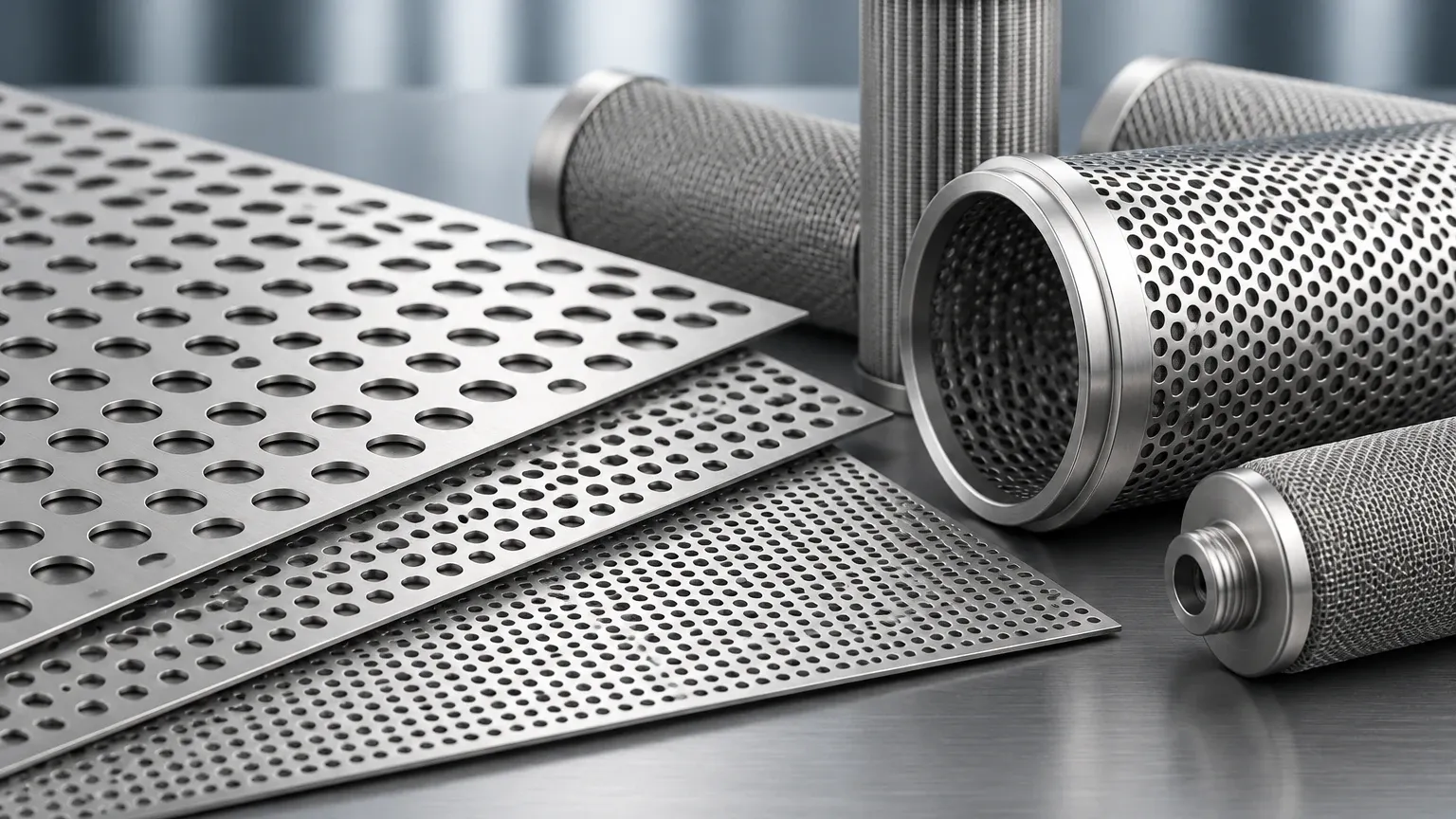
* Round Holes: The most common configuration due to its structural integrity and ease of manufacturing. A 60-degree staggered pattern is the industry standard, providing the highest open area and strength-to-weight ratio. Straight-row patterns are also available but generally offer lower structural stability.
* Square Holes: Often selected for applications requiring a high open area or specific aesthetic requirements. While they offer high throughput, the sharp corners can be stress concentration points, making them less ideal for high-pressure environments compared to round holes.
* Slotted Holes: Frequently used in solid-liquid separation and sieving. Slotted perforations are effective for filtering elongated particles or for applications where the flow direction needs to be managed.
* Hexagonal Holes: These provide an extremely high open area (up to 80%), making them suitable for high-flow ventilation or lightweight structural components, though they sacrifice some mechanical rigidity.
Calculating Open Area
The open area percentage is a critical metric for determining flow rate and pressure drop across the sheet. For a standard 60-degree staggered round hole pattern, the formula for open area is:
Open Area % = (D² × 90.69) / P²
Where *D* is the hole diameter and *P* is the pitch (the distance from the center of one hole to the center of the adjacent hole). Engineers must balance the need for a high open area (for flow efficiency) with the requirement for material thickness and structural strength to prevent deformation under hydraulic load.
Material Selection for Industrial Environments
Material compatibility is the most significant factor in the lifecycle of a perforated metal sheet. In industrial filtration, the choice of alloy determines the sheet’s resistance to corrosion, temperature fluctuations, and mechanical wear.
Stainless Steel Grades
As a specialist in stainless steel filtration solutions, Kaifil emphasizes the use of high-grade alloys to ensure durability in harsh environments:
* AISI 304/304L: The standard choice for general industrial use. It offers excellent corrosion resistance in non-acidic environments and is widely used in food processing and architectural applications.
* AISI 316/316L: Contains molybdenum, which provides superior resistance to chlorides and pitting. This is the preferred material for marine environments, chemical processing plants, and pharmaceutical applications where strict hygiene and corrosion resistance are mandatory.
* Duplex Stainless Steel: For extreme environments involving high pressure and highly corrosive chemicals, duplex grades offer twice the yield strength of austenitic stainless steels and exceptional resistance to stress corrosion cracking.
Surface Finishes and Post-Processing
Beyond the alloy itself, the surface finish of a perforated metal sheet affects its performance. Electropolishing is often employed for pharmaceutical and food-grade filters to remove burrs and create a microscopically smooth surface that prevents bacterial growth and simplifies cleaning. Other finishes, such as degreasing or pickling, ensure the removal of manufacturing oils and oxides that could contaminate the process stream.
Applications in Industrial Filtration
While perforated metal sheets are used in architectural and acoustic applications, their primary role in B2B industrial sectors is filtration and separation. They function either as standalone filters or as critical support structures for finer media.
Support Media for Wire Mesh
In many high-pressure filtration systems, a fine wire mesh is responsible for the actual particle capture. However, wire mesh lacks the structural rigidity to withstand high differential pressures. A perforated metal sheet is used as a "backup" or support layer, providing the necessary mechanical strength to prevent the mesh from collapsing or pleating under load. This configuration is common in stainless steel filter cartridges used in hydraulic systems and oil-gas separation.
Coarse Filtration and Strainers
For applications involving the removal of large debris—such as in water intake systems, pulp and paper processing, or cooling towers—perforated metal acts as the primary filter. Its durability allows it to handle high flow velocities and abrasive particles that would quickly degrade thinner filtration media.
Centrifuge Liners
In the chemical and food industries, perforated sheets are used as liners in centrifuge baskets. The precision of the hole size ensures consistent separation of solids from liquids while the high strength of the metal plate withstands the intense centrifugal forces generated during operation.
Engineering Considerations for Procurement
When specifying a perforated metal sheet for an industrial project, several engineering constraints must be addressed to ensure the product is fit for purpose.
The Hole Diameter to Thickness Ratio
A fundamental rule in metal perforation is that the hole diameter should generally not be smaller than the material thickness. For example, if a sheet is 2mm thick, the minimum recommended hole diameter is also 2mm. Attempting to punch holes smaller than the thickness increases the risk of tool breakage and results in irregular hole shapes. For applications requiring extremely fine perforations in thick plates, laser cutting or electron beam drilling may be required, though these processes increase production costs.
Margins and Blank Areas
Standard perforated sheets often come with "minimum margins" along the edges. However, for custom OEM components, engineers may require specific blank areas for welding, mounting, or bolting. Providing a detailed technical drawing that specifies the exact location of the perforated area versus the solid margins is essential to avoid assembly issues during the manufacturing of the final filter assembly.
Flatness and Stress Relief
The punching process introduces significant internal stress into the metal, which can cause the sheet to curl or bow. For high-precision applications, such as those used in automated assembly lines or precision cartridges, the sheets must undergo a leveling process. Roller leveling restores flatness, ensuring the component can be accurately integrated into larger systems.
Maintenance and Total Cost of Ownership
In B2B procurement, the initial purchase price of a perforated metal sheet is only one component of the total cost of ownership (TCO). Durability and ease of maintenance are the primary drivers of long-term value.
Cleaning Protocols
Stainless steel perforated sheets are highly conducive to various cleaning methods, extending their replacement cycles. Common industrial cleaning techniques include:
* Backwashing: Using reverse flow to dislodge particles trapped on the surface.
* Ultrasonic Cleaning: Utilizing high-frequency sound waves in a chemical bath to remove fine contaminants from within the holes.
* Chemical CIP (Clean-in-Place): Using caustic or acidic solutions to dissolve organic or mineral buildup without disassembling the filtration unit.
Replacement Cycles
Unlike disposable synthetic filters, a well-engineered perforated metal sheet can last for years. The primary reasons for replacement are mechanical damage (such as erosion from high-velocity abrasive particles) or chemical degradation (if the wrong alloy was selected for the environment). Regular inspections for "blinding" (permanent clogging of holes) and structural thinning are necessary to maintain system efficiency.
Customization and OEM Capabilities
For specialized industrial applications, off-the-shelf perforated sheets may not suffice. Customization allows for the optimization of filtration performance based on specific fluid dynamics and particle characteristics. Kaifil works closely with global customers to develop bespoke solutions, from material selection and hole pattern design to the production of finished filter components. This collaborative approach ensures that the resulting perforated metal products meet the exact tolerances and performance benchmarks required by demanding industrial sectors.
When evaluating a supplier for perforated metal components, technical professionals should confirm the manufacturer's ability to provide material certifications (MTRs), precision leveling, and secondary fabrication services such as rolling, welding, and surface treatment. These capabilities ensure that the perforated metal sheet transitions seamlessly from a raw material into a high-performance industrial component.
