


Mcnichols Perforated Metal
In the landscape of industrial materials, perforated metal stands as one of the most versatile components for filtration, separation, and structural support. Engineers and procurement specialists often look toward industry standards such as mcnichols perforated metal to establish a baseline for quality, availability, and technical specifications. Whether used as a protective screen, a decorative architectural element, or the structural core of a high-pressure filter cartridge, understanding the mechanical properties and fabrication limits of perforated and expanded metal is essential for optimizing industrial performance.
Selecting the right material requires more than just picking a hole size. It involves a deep dive into metallurgy, open area calculations, and the specific demands of the operating environment. This guide examines the technical nuances of these materials and how they integrate into complex industrial systems.
Technical Specifications and Hole Patterns
The performance of perforated metal is primarily defined by its hole pattern, hole size, and the distance between centers (pitch). These factors dictate the material's "open area," which is the percentage of the sheet that consists of holes. For engineers, the open area is the most critical metric for calculating flow rates and pressure drops in filtration applications.
Round Hole Patterns
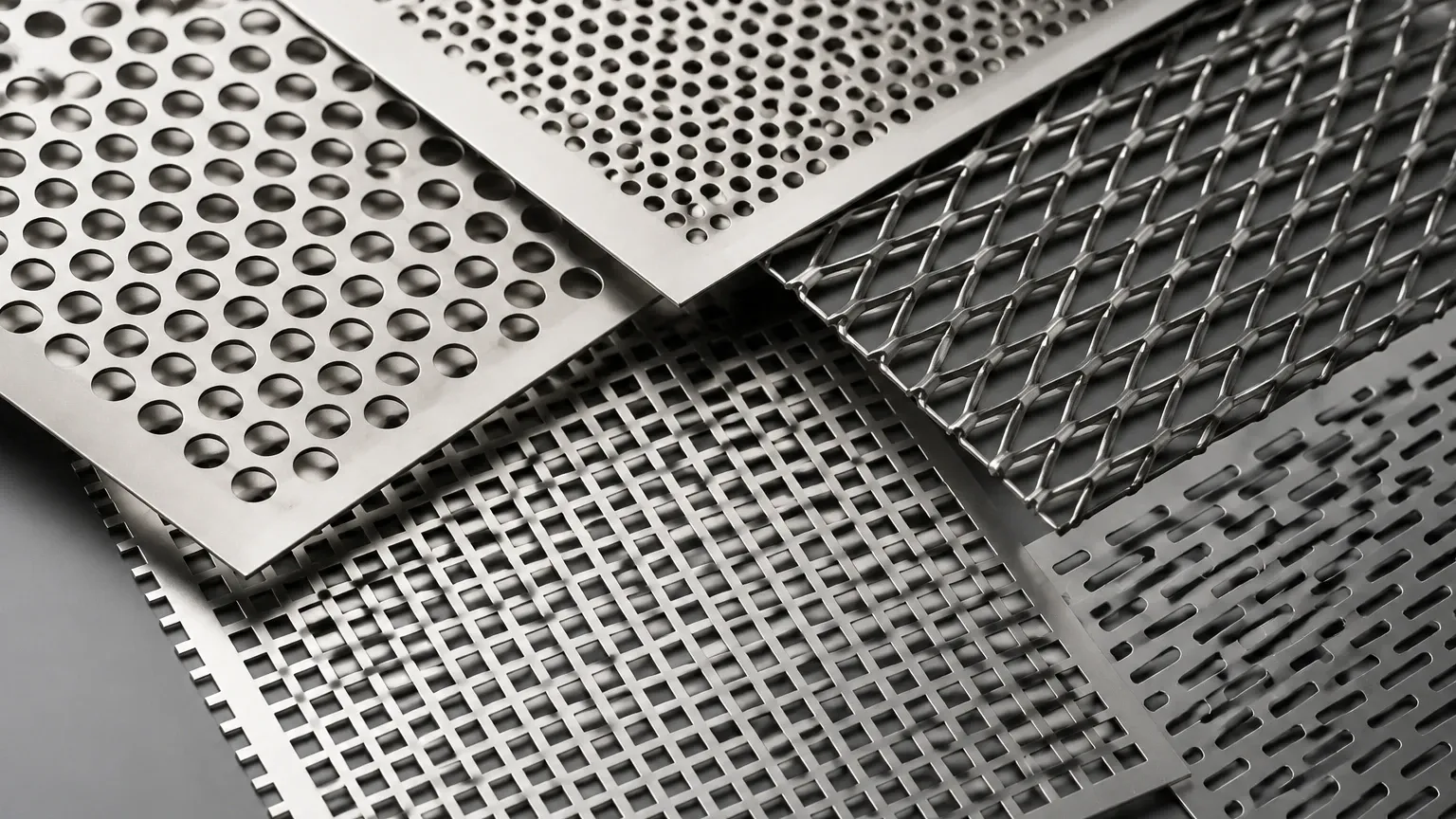
Round holes are the most popular choice due to their versatility and structural efficiency. They are typically offered in two configurations:
1. 60-Degree Staggered: This is the industry standard. It provides the highest open area and the most uniform strength across the sheet. The staggered alignment ensures that the material remains rigid even with a high percentage of perforations.
2. Straight Line: In this configuration, holes are aligned in rows and columns. While easier to align for certain aesthetic applications, it generally offers lower structural integrity compared to staggered patterns under mechanical stress.
Square and Slotted Holes
Square holes offer a higher open area than round holes of the same width, which can be beneficial when maximum airflow or visibility is required. Slotted holes are often utilized in sorting and sifting applications, particularly in the food and beverage or agricultural industries, where the elongated shape helps orient materials during the filtration process.
Calculating Open Area and Flow Efficiency
When evaluating Perforated & Expanded Metal for fluid dynamics, the open area percentage determines how much resistance the material will offer to a liquid or gas stream. A common challenge in filtration is balancing the need for a high open area (to reduce energy consumption and pressure drop) with the need for structural strength (to withstand system pressure).
For a standard 60-degree staggered round hole pattern, the formula for calculating open area is:
Open Area % = (D² × 90.69) / P²
Where:
* D = Hole Diameter
* P = Center-to-Center Pitch
Understanding these calculations allows engineers to predict how a perforated plate will behave when integrated into a larger system. For instance, in hydraulic filtration, a perforated core must be strong enough to prevent the collapse of the surrounding wire mesh media during high-pressure surges, while still allowing the fluid to pass through with minimal resistance.
Material Selection for Industrial Environments
The choice of alloy is as important as the hole pattern. While mcnichols perforated metal is available in various materials, industrial filtration typically demands high-performance alloys to ensure longevity and chemical compatibility.
Stainless Steel (304 and 316L)
Stainless steel is the preferred material for most B2B filtration applications. Grade 304 provides excellent strength and basic corrosion resistance, making it suitable for general industrial use. However, for chemical processing, pharmaceutical, or marine environments, Grade 316L is required. The addition of molybdenum in 316L enhances resistance to pitting and crevice corrosion in chloride-rich environments.
Carbon Steel and Aluminum
Carbon steel is a cost-effective option for indoor applications or environments where corrosion is not a primary concern, often requiring a secondary coating like galvanization or powder coating. Aluminum is selected for its high strength-to-weight ratio and natural resistance to atmospheric corrosion, though it lacks the high-temperature stability of stainless steel.
Comparing Perforated and Expanded Metal
While often grouped together, perforated metal and expanded metal are manufactured through different processes, resulting in distinct physical characteristics. Choosing between them depends on the specific mechanical requirements of the project.
Perforated Metal Characteristics
Perforated metal is created by punching holes into a solid sheet. This process allows for precise control over hole size and placement. It can be manufactured with "margins" (solid areas around the edges), which are critical for welding the sheet into a frame or a filter housing. The thickness of the material can range from thin foils to heavy plates exceeding 1/2 inch.
Expanded Metal Characteristics
Expanded metal is produced by simultaneously slitting and stretching a sheet. This process creates diamond-shaped openings. Unlike perforation, expanding the metal produces no scrap, making it a highly resource-efficient option. The resulting material is often more rigid than the original sheet because the strands and bonds are set at an angle, providing a truss-like structure. Expanded metal is frequently used for safety grates, walkways, and as a support layer in multi-stage filtration systems where high rigidity is required without adding excessive weight.
Engineering Considerations for Custom Fabrication
When moving from standard stock items like mcnichols perforated metal to custom-engineered filtration components, several fabrication factors must be confirmed to ensure the final product meets operational standards.
The 1:1 Rule
A fundamental rule in perforation engineering is that the hole diameter should not be smaller than the material thickness. For example, punching a 1mm hole through 2mm thick stainless steel is technically difficult and often leads to tool breakage or excessive burring. If a project requires a hole-to-thickness ratio smaller than 1:1, alternative methods like laser cutting or chemical etching may be necessary.
Flatness and Leveling
The punching process introduces internal stresses into the metal sheet, which can cause it to curl or bow. For precision applications, such as filter cartridges that must fit into tight housings, the material must undergo a leveling process to ensure it meets flatness tolerances. Engineers should specify the required flatness to avoid installation issues.
Deburring and Surface Finishing
Perforation naturally leaves small burrs on the "exit" side of the hole. In industries like food processing or pharmaceuticals, these burrs can trap contaminants or shed metal particles. Secondary processes such as deburring, electropolishing, or pickling are essential to ensure a smooth, hygienic surface that complies with safety regulations.
Sourcing Strategies: Stock vs. Custom Manufacturing
For many maintenance and repair operations (MRO), sourcing standard sheets of mcnichols perforated metal from a distributor is the most efficient path. Distributors provide immediate access to common sizes and patterns. However, for Original Equipment Manufacturers (OEMs) and specialized industrial projects, custom manufacturing offers several advantages:
* Tailored Margins: Custom sheets can be produced with specific solid borders to facilitate easier welding and assembly into final products.
* Optimized Flow: Custom hole patterns can be designed to match specific flow requirements that stock patterns cannot satisfy.
* Material Efficiency: Ordering custom-sized blanks reduces scrap waste and secondary cutting costs at the assembly plant.
* Integrated Fabrication: Specialized manufacturers can provide perforated metal that is already rolled, welded into cylinders, or fitted with end caps, streamlining the supply chain for filter assembly.
Applications in High-Demand Sectors
Perforated and expanded metals are foundational to several critical industries. Their role extends beyond simple screening to becoming an integral part of process efficiency.
* Chemical and Petrochemical: Used in catalyst support grids and internal tower components where resistance to high temperatures and corrosive chemicals is paramount.
* Food and Beverage: Utilized in drying trays, grain screens, and centrifugal liners. Here, the focus is on smooth surfaces (316L stainless steel) to prevent bacterial growth.
* Water Treatment: Perforated plates serve as the primary intake screens to protect pumps and downstream filtration media from large debris.
* Hydraulic Systems: Perforated tubes act as the internal support core for pleated wire mesh filters, preventing the mesh from collapsing under the force of high-viscosity fluids.
Conclusion: Selecting the Right Solution
Choosing between perforated and expanded metal, and deciding between stock or custom fabrication, requires a clear understanding of the application's mechanical and environmental constraints. While distributors provide essential stock materials, working with a manufacturer that understands the complexities of industrial filtration ensures that the components will perform reliably under pressure. By confirming hole patterns, material grades, and fabrication tolerances early in the design phase, engineers can achieve a balance of durability and efficiency that standard off-the-shelf solutions may not provide.
