


Perforated Metal Mesh
In the landscape of industrial filtration and structural engineering, perforated metal mesh serves as a critical component that balances mechanical strength with precise permeability. Unlike woven wire cloth, which is created by interlacing wires, perforated metal is manufactured through a cold-punching process where holes are precisely stamped out of a solid metal sheet. This results in a robust, rigid structure capable of withstanding high-pressure differentials and harsh mechanical stresses, making it an indispensable material for engineers designing filtration systems, acoustic panels, and protective guards.
For technical professionals and procurement teams, selecting the right Perforated & Expanded Metal requires a deep understanding of material properties, geometric configurations, and the specific demands of the operating environment. This guide explores the technical nuances of perforated metal mesh, its application in industrial filtration, and the engineering considerations necessary for optimal performance.
Engineering Fundamentals of Perforated Metal Mesh
The performance of perforated metal mesh is defined by its geometric configuration. Engineers must specify several key parameters to ensure the material meets the flow and structural requirements of an application.
Hole Patterns and Geometry
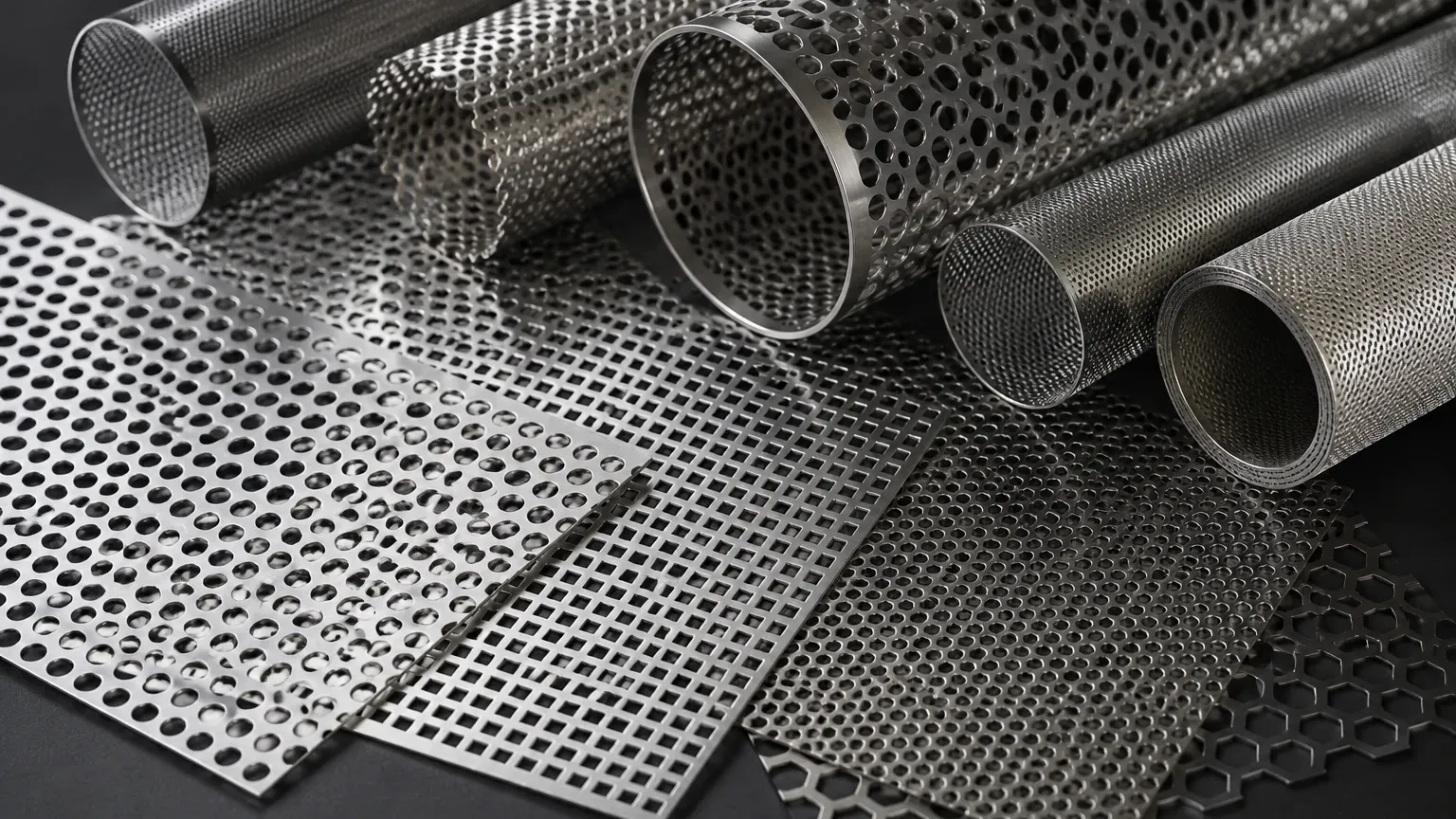
The most common hole shape is the round hole, primarily due to its ease of manufacture and uniform stress distribution. However, square, slotted, and hexagonal patterns are also utilized for specific functional or aesthetic requirements.
* Staggered Pattern (60-degree): This is the industry standard for round holes. It provides the highest open area and the greatest strength-to-weight ratio. The 60-degree orientation ensures that the bridges (the metal between holes) are uniform, which prevents structural weak points.
* Straight Pattern: Holes are aligned in both horizontal and vertical rows. While simpler to align for certain aesthetic applications, straight patterns typically offer lower structural integrity than staggered configurations.
* Slotted Holes: Often used in sorting and sifting applications, slotted perforations allow for the passage of elongated particles while blocking wider ones.
Calculating Open Area
The "Open Area" is perhaps the most critical specification for filtration engineers, as it dictates the flow rate and pressure drop across the mesh. It is expressed as a percentage of the total sheet area that is occupied by the holes. For a standard 60-degree staggered round hole pattern, the formula is:
Open Area % = (D² × 90.69) / R²
Where *D* is the hole diameter and *R* is the center-to-center pitch. Achieving the correct balance between open area and structural rigidity is essential; an excessively high open area may lead to material deformation under hydraulic load, while an insufficiently low open area will cause excessive backpressure.
Material Selection and Corrosion Resistance
In industrial filtration, the choice of material is dictated by the chemical composition of the fluid, the operating temperature, and the required lifespan of the component. Kaifil specializes in stainless steel solutions, which are preferred in demanding B2B environments for their durability and hygiene.
Stainless Steel Grades
* Type 304: The most common grade, offering excellent corrosion resistance in standard atmospheric and fresh-water environments. It is widely used in food processing and general industrial applications.
* Type 316L: Containing molybdenum, 316L provides superior resistance to chlorides and acids. This makes it the standard choice for marine environments, pharmaceutical manufacturing, and chemical processing where "pitting" corrosion is a concern.
* Specialty Alloys: For extreme environments involving high temperatures or highly corrosive chemicals, materials like Duplex stainless steel or nickel alloys may be required to prevent premature failure of the perforated metal mesh.
Surface Finishes and Treatments
Beyond the base metal, secondary treatments can enhance performance. Electropolishing is frequently used in the pharmaceutical and food industries to remove surface imperfections and create a microscopically smooth finish, which reduces bacterial adhesion and simplifies the cleaning process (CIP – Clean-In-Place).
Applications in Industrial Filtration Systems
Perforated metal mesh rarely acts alone in high-precision filtration; instead, it serves as a foundational element in complex filter assemblies. Its primary roles include support, protection, and coarse filtration.
Support Cores for Filter Cartridges
In high-pressure hydraulic and liquid filtration, fine wire mesh or pleated filter media lack the structural integrity to resist collapsing under flow pressure. Perforated metal tubes are used as internal support cores or external cages. The rigidity of the perforated metal mesh ensures that the primary filter media remains in position, maintaining the integrity of the filtration surface even during pressure surges.
Basket Strainers and Pre-filters
For large-scale water treatment or chemical processing, perforated metal is used to create basket strainers. These components act as the first line of defense, removing large debris (stones, scale, or plastic fragments) before the fluid reaches more sensitive downstream equipment like pumps or fine membrane filters. Because perforated metal is easy to clean and mechanically tough, these baskets can be reused indefinitely with proper maintenance.
Diffusers and Flow Distributors
In reactor vessels and gas filtration, perforated sheets are used to break up concentrated flow streams. By forcing the fluid through a calculated pattern of holes, the mesh ensures an even distribution across the entire surface of a secondary filter bed or catalyst, optimizing the efficiency of the chemical reaction or filtration process.
Perforated vs. Expanded Metal: Engineering Trade-offs
While often grouped together, perforated metal and expanded metal are produced via different methods and offer distinct mechanical properties. Understanding these differences is vital for correct component selection.
| Feature | Perforated Metal Mesh | Expanded Metal |
| :— | :— | :— |
| Manufacturing | Stamped/Punched (material is removed) | Slit and Stretched (no material waste) |
| Surface | Flat and smooth | Raised/3D (unless flattened) |
| Open Area | Highly precise and customizable | Variable based on expansion ratio |
| Strength | High rigidity in all directions | High strength-to-weight; directional |
| Cost | Higher (due to material waste) | Lower (more efficient material use) |
Perforated metal is generally preferred for precision filtration where exact hole sizes and flat surfaces are required for cleaning or for supporting fine mesh. Expanded metal is often chosen for heavy-duty guards, walkways, or coarse structural supports where cost-efficiency and high grip are prioritized.
Manufacturing Precision and Customization Options
B2B applications often require more than just a standard sheet of perforated metal. Customization is where engineering expertise becomes critical to the success of the final product.
Margins and Unperforated Areas
A significant advantage of custom-manufactured perforated metal mesh is the ability to specify "margins." These are the solid metal borders around the perforated area. Margins are essential for welding the mesh into a frame or housing. Without a solid margin, welding through a perforated area can lead to burn-through and structural failure at the joints.
Secondary Operations
To integrate perforated metal into a filtration system, the flat sheet often undergoes several secondary processes:
* Rolling and Welding: Forming the sheet into cylinders or cones for filter cartridges. Precision welding (such as TIG or plasma welding) is required to ensure the seam is as strong as the base material.
* Deburring: The punching process can leave sharp edges or "burrs" on the exit side of the hole. For filtration applications, deburring is mandatory to prevent these metal fragments from breaking off and contaminating the downstream fluid.
* Degreasing: Removing lubricants used during the punching process, ensuring the component is compatible with oxygen-clean or food-grade environments.
Selection Criteria for Engineers and Purchasing Teams
When evaluating a supplier for perforated metal components, technical teams should confirm several factors to ensure the total cost of ownership is optimized and the risk of failure is minimized.
1. Tolerances: Standard commercial tolerances may not be sufficient for precision filter housings. Confirm the supplier's ability to maintain tight tolerances on hole diameter, pitch, and overall dimensions.
2. Flatness Requirements: The punching process can introduce internal stresses that cause the sheet to curl. For applications requiring high-precision stacking or automated assembly, leveled sheets are necessary.
3. Material Traceability: In regulated industries like pharmaceuticals or aerospace, Mill Test Reports (MTRs) are required to verify the chemical composition of the stainless steel.
4. Replacement Cycles: Consider the ease of cleaning versus the cost of replacement. While stainless steel perforated mesh has a high initial cost, its ability to be ultrasonically cleaned or backflushed often makes it more cost-effective over the long term than disposable synthetic filters.
Conclusion: Strategic Value of Precision Perforation
Perforated metal mesh is more than a simple screen; it is a precision-engineered component that determines the efficiency and safety of industrial processes. Whether it is providing the structural backbone for a high-pressure hydraulic filter or acting as a coarse strainer in a chemical plant, the quality of the perforation—and the material it is punched from—directly impacts the reliability of the entire system.
By focusing on exact specifications, such as the 60-degree staggered pattern for optimal flow and the use of high-grade 316L stainless steel for corrosion resistance, engineers can ensure their filtration solutions meet the rigorous demands of modern industry. For those seeking customized solutions, collaborating with a manufacturer that understands both the mechanical and chemical requirements of industrial filtration is the most effective path to achieving durable, high-performance results.
To explore specific configurations or discuss technical requirements for your next project, Review product options and application support to find the ideal balance of strength and filtration precision.
