


Perforated Metal Acoustic Panels
In industrial and commercial environments, noise control is a critical engineering challenge that impacts both personnel safety and operational efficiency. Perforated metal acoustic panels have emerged as a primary solution for managing sound in demanding settings such as manufacturing plants, mechanical rooms, data centers, and transportation hubs. Unlike traditional fabric-wrapped or foam-based acoustic treatments, metal-faced panels offer the structural integrity, fire resistance, and durability required for heavy-duty applications.
Selecting the right acoustic solution requires a deep understanding of how sound interacts with physical barriers. For engineers and procurement specialists, the choice of material, hole pattern, and open area percentage determines not only the acoustic performance but also the long-term maintenance costs and environmental suitability of the installation.
Understanding the Mechanics of Perforated Metal Acoustic Panels
A common misconception is that the metal panel itself absorbs sound. In reality, the metal acts as a "transparent" protective face. The actual sound absorption occurs when sound waves pass through the perforations and are trapped by an acoustic medium—such as mineral wool, fiberglass, or specialized foam—housed behind the metal sheet.
When sound waves strike the surface of Perforated & Expanded Metal, a portion of the energy is reflected, but a significant percentage enters the holes. Inside the acoustic core, the sound energy is converted into low-grade heat through friction as the air molecules vibrate against the fibers of the infill material. The perforated metal serves three vital functions:
1. Protection: It shields the delicate acoustic infill from mechanical damage, impact, and industrial contaminants.
2. Sound Transparency: It is engineered to allow sound waves to pass through with minimal reflection.
3. Structural Support: It provides a rigid framework that can be easily mounted to walls, ceilings, or machinery enclosures.
Engineering the Open Area in Perforated & Expanded Metal
The most critical technical specification in the design of perforated metal acoustic panels is the "open area percentage." This refers to the ratio of the total area of the holes to the total area of the sheet. For acoustic transparency, the open area must be sufficient to allow sound waves to enter the panel rather than bouncing off the metal surface.
In most industrial acoustic applications, an open area ranging from 20% to 40% is considered optimal. If the open area is too low (e.g., below 10%), the panel begins to act more like a solid reflector, which can lead to standing waves and increased reverberation in the room. Conversely, if the open area is excessively high, the structural integrity of the panel may be compromised, making it prone to sagging or deformation under its own weight.
Engineers must also consider the relationship between hole diameter and material thickness. A standard rule of thumb in metal perforation is that the hole diameter should not be smaller than the material thickness. For example, if using a 2mm thick stainless steel sheet, the holes should generally be at least 2mm in diameter to ensure clean punches and maintain tool longevity during manufacturing.
Material Considerations for Industrial Environments
The choice of alloy for perforated metal acoustic panels depends heavily on the operating environment. While aluminum and galvanized steel are common in commercial HVAC and office settings, industrial applications often demand the superior properties of stainless steel.
Stainless Steel (Grades 304 and 316)
Stainless steel is the preferred material for chemical processing plants, food and beverage facilities, and marine environments. Grade 304 offers excellent corrosion resistance for most indoor industrial uses. However, in environments exposed to chlorides or heavy salt spray, Grade 316 is recommended due to its increased molybdenum content, which prevents pitting and crevice corrosion.
Aluminum
Aluminum is valued for its high strength-to-weight ratio and natural resistance to atmospheric corrosion. It is an excellent choice for ceiling-mounted acoustic baffles where reducing the load on the building structure is a priority. Additionally, aluminum panels can be anodized or powder-coated to meet specific aesthetic or chemical resistance requirements.
Galvanized Steel
For indoor mechanical rooms where moisture and corrosive chemicals are not a primary concern, galvanized steel provides a cost-effective solution. The zinc coating offers basic protection against rust, making it suitable for standard industrial noise enclosures.
Hole Patterns and Acoustic Performance
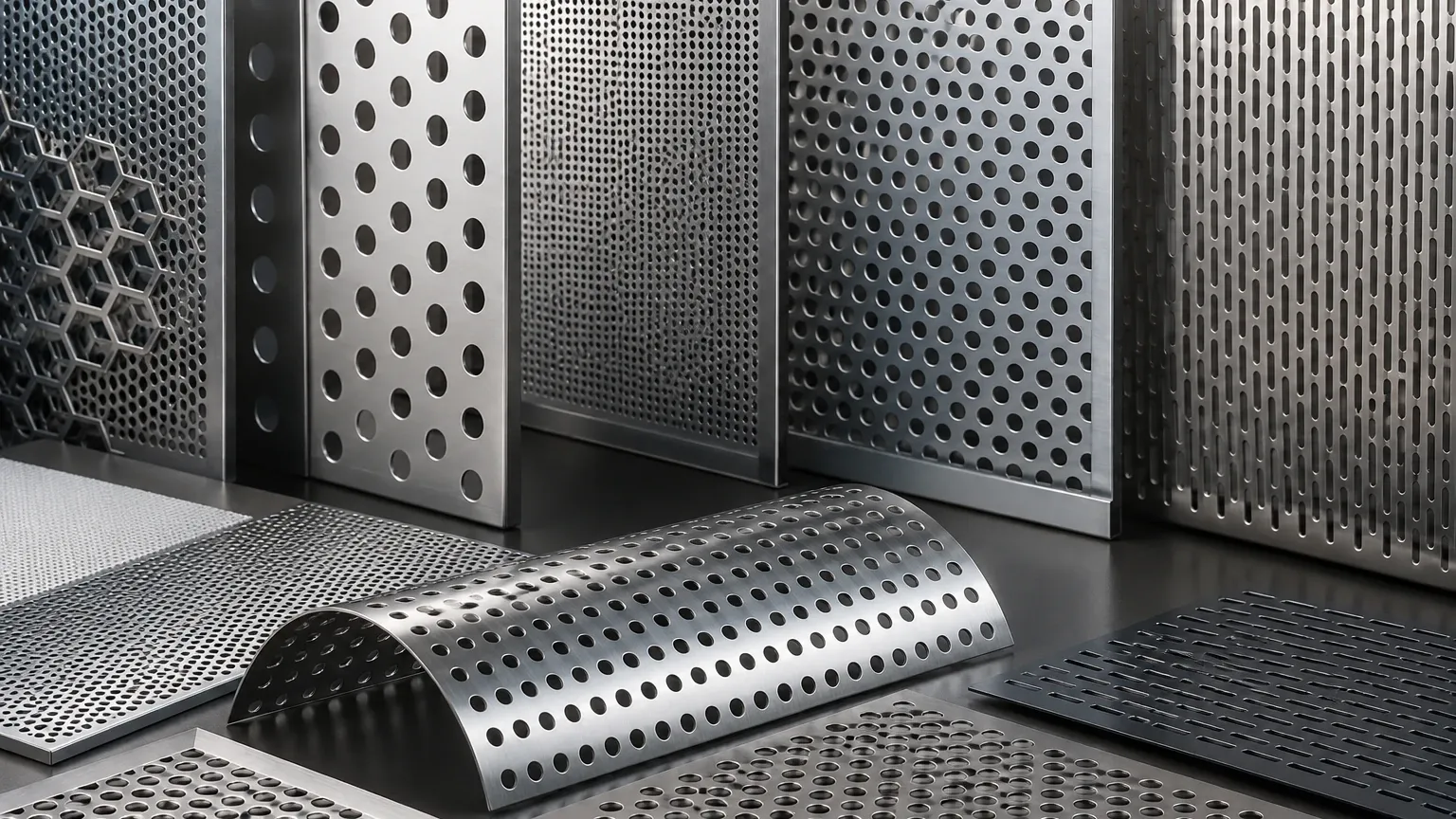
The geometry of the perforations affects both the visual appearance and the acoustic "transparency" of the panel. There are three primary patterns used in the production of perforated metal acoustic panels:
* Round Holes (Staggered): This is the most common and structurally sound pattern. The 60-degree staggered orientation provides the highest level of open area while maintaining the rigidity of the metal sheet. It is the industry standard for most acoustic applications.
* Round Holes (Straight Line): While aesthetically clean, straight-line patterns are generally less rigid than staggered patterns and may require thicker gauges to prevent warping.
* Square or Slotted Holes: These patterns are often chosen for specific architectural designs. While they can provide high open area percentages, they may have lower structural stability compared to round-hole configurations.
Beyond aesthetics, the hole size itself plays a role in high-frequency sound management. Smaller, more densely packed holes can sometimes provide better performance for high-frequency noise, while larger holes are sufficient for low-to-mid frequency industrial hums.
Integration with Acoustic Media and Fire Safety
The effectiveness of a metal acoustic system is largely determined by the infill material. In industrial settings, fire safety is a non-negotiable requirement. Most perforated metal acoustic panels are paired with Class A fire-rated mineral wool or formal-dehyde-free fiberglass.
To prevent the acoustic fibers from migrating through the perforations—a common concern in food processing or cleanroom environments—a thin, non-woven black acoustic tissue is often placed between the metal face and the mineral wool. This tissue is acoustically transparent but acts as a physical barrier to keep the infill contained. It also provides a uniform black background behind the holes, which enhances the visual finish of the panels.
For high-moisture environments, such as wastewater treatment plants, the acoustic core may be encapsulated in a thin polymer film (like Mylar or Tedlar). While this film protects the core from water absorption, it must be extremely thin (typically 0.5 to 1.0 mil) to ensure that it does not reflect high-frequency sound waves.
Critical Performance Metrics: NRC and Transmission Loss
When evaluating perforated metal acoustic panels, engineers typically look at two primary metrics:
1. Noise Reduction Coefficient (NRC): This is a scalar representation of the amount of sound energy absorbed by the panel. An NRC of 0.0 indicates total reflection, while an NRC of 1.0 indicates total absorption. High-quality industrial metal acoustic panels often achieve NRC ratings between 0.80 and 1.00, depending on the thickness and density of the backing material.
2. Sound Transmission Class (STC): While NRC measures absorption (reducing echoes within a room), STC measures the panel's ability to block sound from passing through to the other side. Perforated panels are primarily designed for absorption. If sound blocking is the goal, the perforated panel must be combined with a solid metal backing or a high-mass septum layer.
Selection Guide: What Engineers Must Confirm Before Purchase
To ensure the successful implementation of an acoustic project, the following technical details should be confirmed during the procurement phase:
* Material Gauge: Industrial panels typically range from 22-gauge to 16-gauge. Thicker gauges are necessary for large spans or high-impact areas.
* Hole Specifications: Define the hole diameter, the center-to-center distance (pitch), and the pattern (staggered or straight).
* Open Area Calculation: Verify that the calculated open area meets the acoustic consultant’s requirements (typically >23% for general noise control).
* Environmental Exposure: Identify if the panels will be exposed to high humidity, wash-down chemicals, or extreme temperatures. This dictates the choice between 304 and 316 stainless steel or aluminum.
* Installation Method: Determine if the panels will be mechanical fastened, suspended as baffles, or integrated into a T-grid ceiling system. Custom margins (unperforated edges) are often required to facilitate mounting and provide a finished look.
* Regulatory Compliance: Ensure the assembly meets local fire codes (ASTM E84 Class A) and any industry-specific standards, such as USDA or FDA requirements for food-contact zones.
By focusing on these technical parameters, engineers can specify perforated metal acoustic panels that provide reliable, long-term noise reduction in the most challenging industrial environments. Whether the goal is to protect worker hearing or to meet municipal noise ordinances, the combination of precision-manufactured metal and high-performance acoustic media remains the gold standard for industrial sound management.
