


Perforated Metal Board
In the landscape of industrial filtration and structural engineering, the perforated metal board serves as a foundational component. Often utilized as a support structure for finer filtration media or as a primary screening element, these boards are engineered to withstand significant mechanical stress while maintaining precise flow characteristics. For engineers and procurement specialists, selecting the correct perforated metal board involves a deep understanding of material science, geometric configurations, and the specific demands of the operating environment.
At Kaifil, the production of Perforated & Expanded Metal is centered on precision and durability. Whether used in chemical processing, food production, or hydraulic systems, these components must meet rigorous standards to ensure the longevity and efficiency of the overall filtration system.
Understanding the Fundamentals of Perforated Metal Board
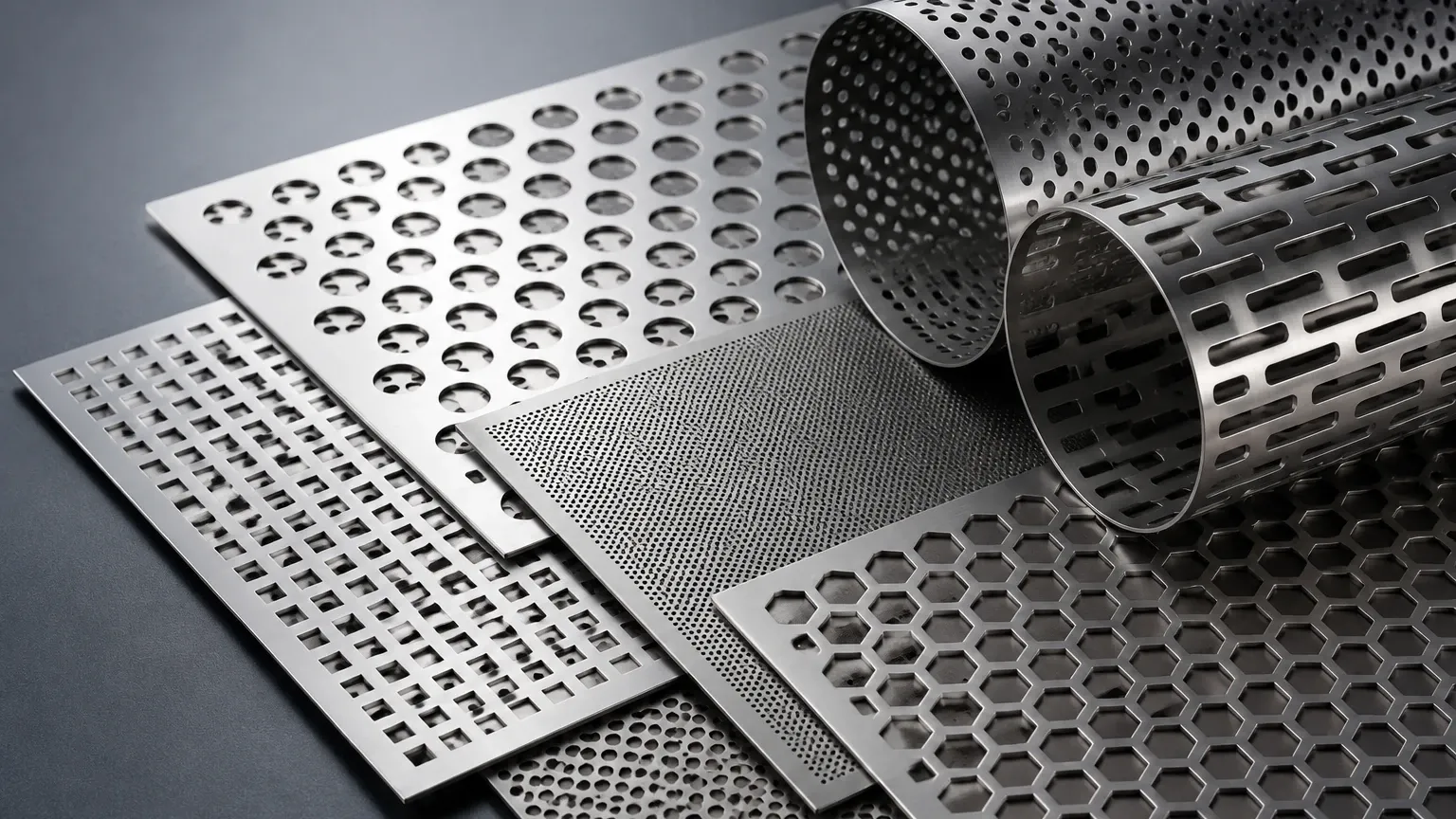
A perforated metal board is a sheet or plate of metal that has been mechanically punched or stamped to create a specific pattern of holes, slots, or decorative shapes. Unlike woven wire mesh, which is formed by interlacing wires, a perforated board is a solid piece of material that retains a high degree of structural integrity. This makes it an ideal choice for applications requiring rigid support and resistance to high differential pressures.
The primary function of these boards in an industrial context is twofold: providing a controlled passage for fluids or gases and offering a robust frame for secondary filter layers. In many high-pressure filtration systems, a perforated metal board acts as the internal core or external sleeve for a filter cartridge, preventing the delicate wire mesh from collapsing or bursting under flow surges.
Material Selection for Industrial Filtration Environments
The choice of material for a perforated metal board is the most critical factor in determining its service life and compatibility with the process fluid. Industrial applications frequently demand materials that can resist corrosion, high temperatures, and chemical degradation.
Stainless Steel (304 and 316L)
Stainless steel is the industry standard for most filtration applications. Grade 304 offers excellent corrosion resistance for general industrial use and is cost-effective for water treatment and food processing. However, in more aggressive environments, such as those involving chlorides or marine conditions, Grade 316L is preferred. The addition of molybdenum in 316L provides superior resistance to pitting and crevice corrosion, while the "L" (low carbon) designation ensures better weldability and resistance to intergranular corrosion after welding.
Specialized Alloys
For extreme environments involving high-temperature oxidation or highly acidic/alkaline solutions, specialized alloys like Monel, Inconel, or Hastelloy may be required. These materials are selected when standard stainless steels fail to provide the necessary chemical stability. In hydraulic systems, carbon steel may be used if the fluid is non-corrosive and cost is a primary constraint, though it often requires surface treatments like galvanizing or plating to prevent rust during storage and installation.
Geometric Configurations and Open Area Calculations
The performance of a perforated metal board is largely defined by its hole pattern and the resulting "open area." Engineers must balance the need for high flow rates (high open area) with the requirement for mechanical strength (lower open area).
Hole Patterns
* Round Holes: The most common and efficient pattern. Round holes offer the best structural stability and are the easiest to manufacture with high precision. They are typically arranged in a 60-degree staggered pattern, which provides the highest open area and uniform strength across the board.
* Square Holes: These provide a higher open area than round holes but are more prone to stress concentrations at the corners, which can lead to material fatigue in high-vibration environments.
* Slotted Holes: Often used for screening elongated particles or in applications where the flow direction is specific. Slotted patterns are common in pulp and paper processing or grain separation.
Calculating Open Area
For a standard 60-degree staggered round hole pattern, the open area percentage (OA%) is calculated using the formula:
OA% = (D² × 90.69) / R²
Where:
* D = Hole diameter
* R = Center-to-center spacing (pitch)
Understanding this calculation is vital for predicting the pressure drop across the filter. A higher open area reduces resistance to flow but decreases the board's ability to resist deformation. Engineers must specify the minimum required open area to meet flow requirements without compromising the structural safety factor.
Manufacturing Processes and Precision Finishing
The manufacturing of a perforated metal board involves more than just punching holes. To be suitable for industrial filtration, the board must undergo several precision processes.
CNC Punching and Perforating
Modern CNC (Computer Numerical Control) punching presses allow for extreme accuracy in hole placement and diameter. This precision is necessary when the perforated board must align perfectly with other components in a filter assembly. For thicker plates, laser cutting or waterjet cutting may be employed to maintain edge quality and prevent thermal distortion.
Leveling and Flatness
The punching process naturally introduces internal stresses into the metal, which can cause the board to curl or warp. Precision leveling is required to return the board to a perfectly flat state. This is essential for subsequent fabrication steps, such as rolling the board into a cylinder for a filter core or welding it into a frame.
Deburring and Surface Treatment
In filtration, burrs (small fragments of metal left at the edge of the holes) are unacceptable. Burrs can break off and contaminate the downstream fluid, or they can pierce and damage the fine wire mesh layered against the perforated board. Kaifil utilizes advanced deburring techniques, including mechanical grinding and electropolishing, to ensure all edges are smooth. Electropolishing is particularly beneficial for stainless steel, as it removes surface impurities and enhances the chromium-rich passive layer, further improving corrosion resistance.
The Role of Perforated Metal Board in Filtration Systems
In complex filtration assemblies, the perforated metal board rarely acts alone. Its role is typically integrated into a multi-stage filtration strategy.
Support Cores for Filter Cartridges
In high-pressure hydraulic or chemical filtration, the filter media (such as pleated paper or fine wire mesh) is wrapped around a central perforated core. As fluid flows from the outside in, the core provides the necessary rigidity to prevent the media from collapsing. The hole size of the core is usually much larger than the filtration rating of the media, designed purely for structural support and flow distribution.
Protective Outer Sleeves
Conversely, a perforated board can be used as an outer sleeve to protect the filter media from large debris or high-velocity flow that could cause mechanical erosion. This is common in "backwash" filters where the flow direction may periodically reverse.
Basket Filters and Strainers
In coarse filtration or pre-filtration stages, the perforated metal board itself may serve as the primary filter. Basket strainers used in water intake systems or chemical pipelines often use perforated boards with hole sizes ranging from 1mm to 10mm to capture large particulates before they reach more sensitive equipment like pumps or fine membranes.
Engineering Evaluation: Strength vs. Flow Efficiency
When specifying a perforated metal board, engineers must conduct a thorough evaluation of the mechanical loads the component will face. The "collapse pressure" is a critical metric for cylindrical filter cores. This is the differential pressure at which the perforated cylinder will fail structurally.
Factors influencing collapse pressure include:
1. Material Yield Strength: Higher grade alloys provide more resistance.
2. Wall Thickness: Increasing the thickness of the board exponentially increases its strength but also increases weight and cost.
3. Diameter-to-Thickness Ratio: Larger cylinders require thicker boards to maintain the same pressure rating.
4. Unperforated Margins: Leaving solid metal borders (margins) at the ends and along the longitudinal seam of a rolled board significantly increases its structural integrity and provides a clean surface for high-quality welding.
By optimizing these factors, engineers can ensure that the perforated metal board provides a reliable foundation for the entire filtration process without adding unnecessary bulk or cost.
Customization Parameters for OEM Applications
Every industrial process has unique requirements, making customization a standard part of the procurement process for perforated metal boards. At Kaifil, we work closely with engineers to define several key parameters:
* Custom Hole Sizes and Shapes: Beyond standard round holes, we can produce specific geometries tailored to unique flow or particle separation needs.
* Variable Margins: We can program the perforating equipment to leave solid areas anywhere on the board. This is useful for mounting brackets, welding points, or reinforcing specific zones of the plate.
* Forming and Fabrication: Many applications require the perforated board to be supplied as a finished component, such as a rolled and welded cylinder, a conical strainer, or a flanged disc. Our in-house fabrication capabilities ensure that the structural integrity of the perforations is maintained throughout the forming process.
* Surface Coatings: In addition to electropolishing, we offer coatings such as PTFE for non-stick properties or specialized plating for enhanced wear resistance.
Conclusion
The perforated metal board is an indispensable component in modern industrial filtration. Its ability to combine mechanical strength with precise flow control makes it the preferred choice for supporting high-performance filter media and acting as a primary screen in demanding environments. By carefully considering material selection, hole geometry, and manufacturing quality, engineers can significantly enhance the reliability and efficiency of their filtration systems.
For technical teams seeking high-quality, customized solutions, Kaifil provides the engineering expertise and manufacturing precision required to produce Perforated & Expanded Metal that meets the most stringent industrial specifications. Whether you are designing a new filtration system or optimizing an existing process, confirming the material compatibility and structural requirements of your perforated metal board is a critical step toward operational excellence.
