


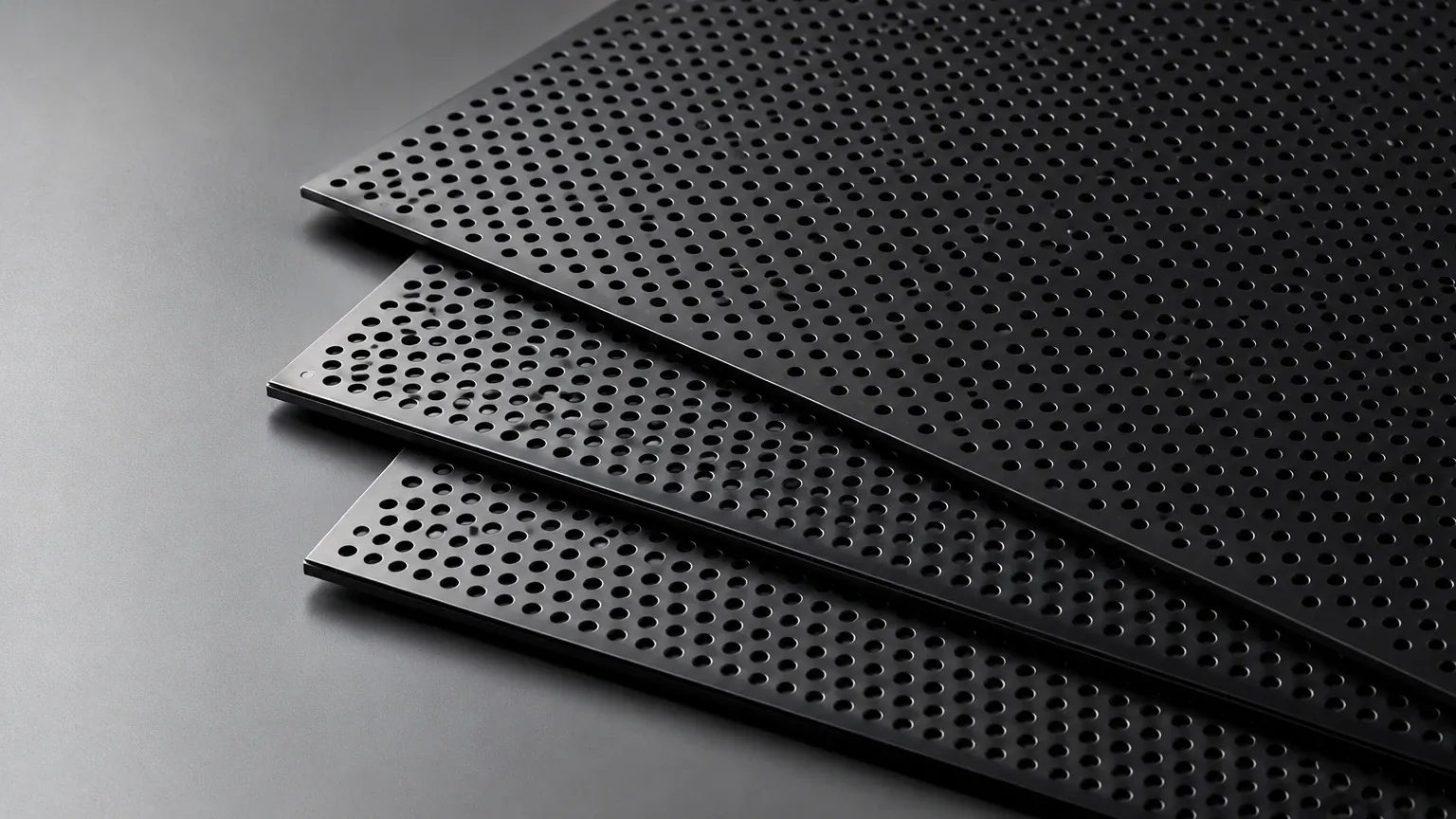
Black Perforated Metal Sheet
In industrial engineering and filtration design, the selection of materials often hinges on a balance between mechanical performance and environmental resistance. The black perforated metal sheet represents a specialized category of industrial components where functional utility meets specific aesthetic and protective requirements. While the "black" designation typically refers to the surface finish applied to a base metal, the underlying engineering of the Perforated & Expanded Metal remains the critical factor in determining its suitability for demanding applications.
For engineers and procurement teams, understanding the nuances of how these sheets are manufactured, treated, and specified is essential for ensuring long-term reliability in sectors ranging from chemical processing to heavy machinery manufacturing. This guide examines the technical specifications, coating technologies, and selection criteria necessary for integrating black perforated metal into industrial systems.
Understanding Black Perforated Metal Sheet in Industrial Contexts
A black perforated metal sheet is essentially a metal substrate—most commonly carbon steel, aluminum, or stainless steel—that has been mechanically punched or stamped to create a pattern of holes and subsequently treated with a black protective coating. In industrial environments, the black finish is rarely chosen for appearance alone; it often serves as a functional barrier against corrosion, UV radiation, and chemical exposure.
In the context of filtration and fluid dynamics, the perforation pattern is the primary functional element. The hole size, shape, and arrangement (pitch) dictate the flow rate, pressure drop, and particle retention capabilities of the sheet. When a coating is applied to achieve the black finish, engineers must account for the slight change in hole dimensions and open area percentage, as the thickness of the coating can impact the precision of the filtration media.
Manufacturing Processes for Perforated & Expanded Metal
The production of these components involves high-precision machinery designed to maintain structural integrity while removing material. The two primary methods used to create the base structures are perforation and expansion.
Perforation Methods
Perforation involves punching holes into a solid metal sheet. This is typically achieved through CNC punching or rotary pin perforation. CNC punching allows for high customization, enabling complex patterns and varying hole sizes across a single sheet. For high-volume production, wide-strip perforation presses can process large coils of metal efficiently. The resulting sheet retains a high degree of flatness and dimensional stability, which is crucial for subsequent coating processes.
Expanded Metal Characteristics
Unlike perforated sheets, expanded metal is created by simultaneously slitting and stretching the material. This process produces a diamond-shaped mesh without any material waste. While expanded metal is highly cost-effective and provides excellent strength-to-weight ratios, it presents a more complex surface for black coatings due to the angular edges of the strands. In filtration, expanded metal is frequently used as a support layer for finer mesh elements.
Surface Treatment Options for Achieving a Black Finish
The performance of a black perforated metal sheet is heavily dependent on the coating technology used. Since the base metal is often exposed to moisture, chemicals, or abrasive particles, the coating must provide a robust bond. The three most common industrial methods include:
1. Powder Coating
Powder coating is one of the most prevalent methods for achieving a durable black finish. An electrostatic charge is used to apply a dry powder (typically epoxy or polyester) to the metal surface, which is then cured under heat to form a hard, continuous skin.
* Advantages: Excellent resistance to chipping, scratching, and UV degradation. It provides a thick protective layer that covers sharp edges well.
* Engineering Consideration: The thickness of powder coating (typically 60 to 120 microns) can significantly reduce the effective diameter of small perforations. Engineers must specify "over-sized" holes if precise flow rates are required.
2. Electrophoretic Deposition (E-Coating)
E-coating involves submerging the metal part in a bath containing a water-based epoxy or acrylic paint. An electric current is applied, causing the paint particles to deposit uniformly across the entire surface, including inside the holes of the perforated sheet.
* Advantages: Provides superior corrosion resistance and extremely uniform thickness. It is ideal for complex geometries where spray-based powder coating might not reach every interior surface of the perforations.
* Engineering Consideration: E-coating is generally thinner than powder coating, making it better for high-precision filtration components where minimal dimensional change is desired.
3. Black Oxide
Black oxide is a conversion coating produced by a chemical reaction with the surface of the iron or steel. It creates a magnetite (Fe3O4) layer on the surface.
* Advantages: There is virtually no dimensional change to the part, preserving the exact tolerances of the perforations. It also provides a non-reflective finish.
* Engineering Consideration: Black oxide offers limited corrosion resistance compared to powder coating or E-coating. It is usually reserved for indoor applications or parts that will be continuously coated in oil (such as internal hydraulic components).
Technical Engineering Specifications and Calculations
When specifying a black perforated metal sheet for an industrial project, several geometric and mechanical factors must be calculated to ensure the component meets performance expectations.
Open Area Percentage
The open area is the ratio of the total area of the holes to the total area of the sheet, expressed as a percentage. This is the most critical value for determining flow capacity and pressure drop. For a standard 60-degree staggered round hole pattern, the formula is:
Open Area % = (D² × 90.69) / P²
Where:
* D = Hole diameter
* P = Center-to-center pitch
When using a black perforated metal sheet, engineers must use the *post-coating* diameter for calculations. If a 2mm hole receives a 100-micron powder coating on all sides, the effective diameter reduces to 1.8mm, which significantly alters the open area and flow characteristics.
Strength and Stiffness
Perforating a metal sheet reduces its cross-sectional area, which inherently lowers its mechanical strength. The "equivalent solid material" approach is often used in structural calculations. For black sheets used as machinery guards or walkways, the load-bearing capacity must be verified against the specific pattern and material thickness.
Industrial Applications and Performance Requirements
Black perforated metal sheets are utilized across diverse sectors due to their versatility. Each application carries specific performance requirements that dictate the choice of material and finish.
Filtration and Separation
In liquid and gas filtration, these sheets serve as either the primary filter media or as a support cage for wire mesh cartridges. The black coating is often used in water treatment or chemical processing to prevent galvanic corrosion when the filter is in contact with dissimilar metals. The smooth, coated surface also aids in the cleaning and backwashing of the filter element.
HVAC and Air Distribution
In ventilation systems, black perforated sheets are used for air diffusers and grilles. The black finish is often required to minimize light reflection within ductwork or for architectural integration in open-ceiling designs. From a technical standpoint, the perforation pattern must be engineered to minimize noise generation (aeolian tones) as air passes through the sheet.
Acoustic Damping
Perforated metals are highly effective in sound absorption systems. When backed with acoustic insulation, the holes allow sound waves to pass through and be trapped by the insulation material. Black finishes are standard in power plant enclosures and engine rooms where oil and grime are prevalent, as the dark surface maintains a cleaner appearance over time.
Protective Guarding
In heavy industry, machinery guards must protect operators while allowing for visibility and airflow. A black perforated metal sheet provides a high-contrast barrier that is easier to see through than a bright or reflective surface, enhancing safety in well-lit factory environments.
Selection Criteria for Procurement and Engineering Teams
To ensure the successful integration of a black perforated metal sheet, technical professionals should confirm the following parameters before procurement:
1. Base Material Compatibility: Is the substrate appropriate for the environment? For example, use stainless steel if the coating is ever breached in a corrosive environment, or carbon steel for cost-effective indoor applications.
2. Coating Durability: Does the application require the impact resistance of powder coating or the precision of E-coating?
3. Hole Precision: What are the allowable tolerances for the hole diameter after the black finish is applied? This is vital for filtration accuracy.
4. Edge Requirements: Should the sheet have "safe edges" (unperforated borders) for welding or mounting? This also affects how the coating adheres to the perimeter.
5. Environmental Exposure: Will the sheet be exposed to high temperatures? Some black coatings can degrade or outgas at temperatures exceeding 200°C.
For specialized requirements, reviewing the available Perforated & Expanded Metal options allows engineers to compare different mesh styles and perforation patterns against their specific flow and strength needs.
Maintenance and Lifecycle Considerations
The total cost of ownership for a black perforated metal sheet is influenced by its maintenance requirements and service life. In filtration applications, the integrity of the black coating must be inspected periodically. If the coating is compromised, localized corrosion (pitting) can occur, which may lead to structural failure or contamination of the filtrate.
Cleaning methods should be compatible with the coating. Abrasive cleaning or harsh chemical solvents can strip powder coatings or E-coatings. For filters, ultrasonic cleaning is often preferred as it can remove debris from the perforations without damaging the protective black finish.
By carefully selecting the right combination of perforation geometry, base metal, and black coating technology, industrial operations can achieve a balance of performance and longevity. Whether used for precision filtration or robust industrial guarding, the black perforated metal sheet remains a fundamental component in modern engineering design.
