


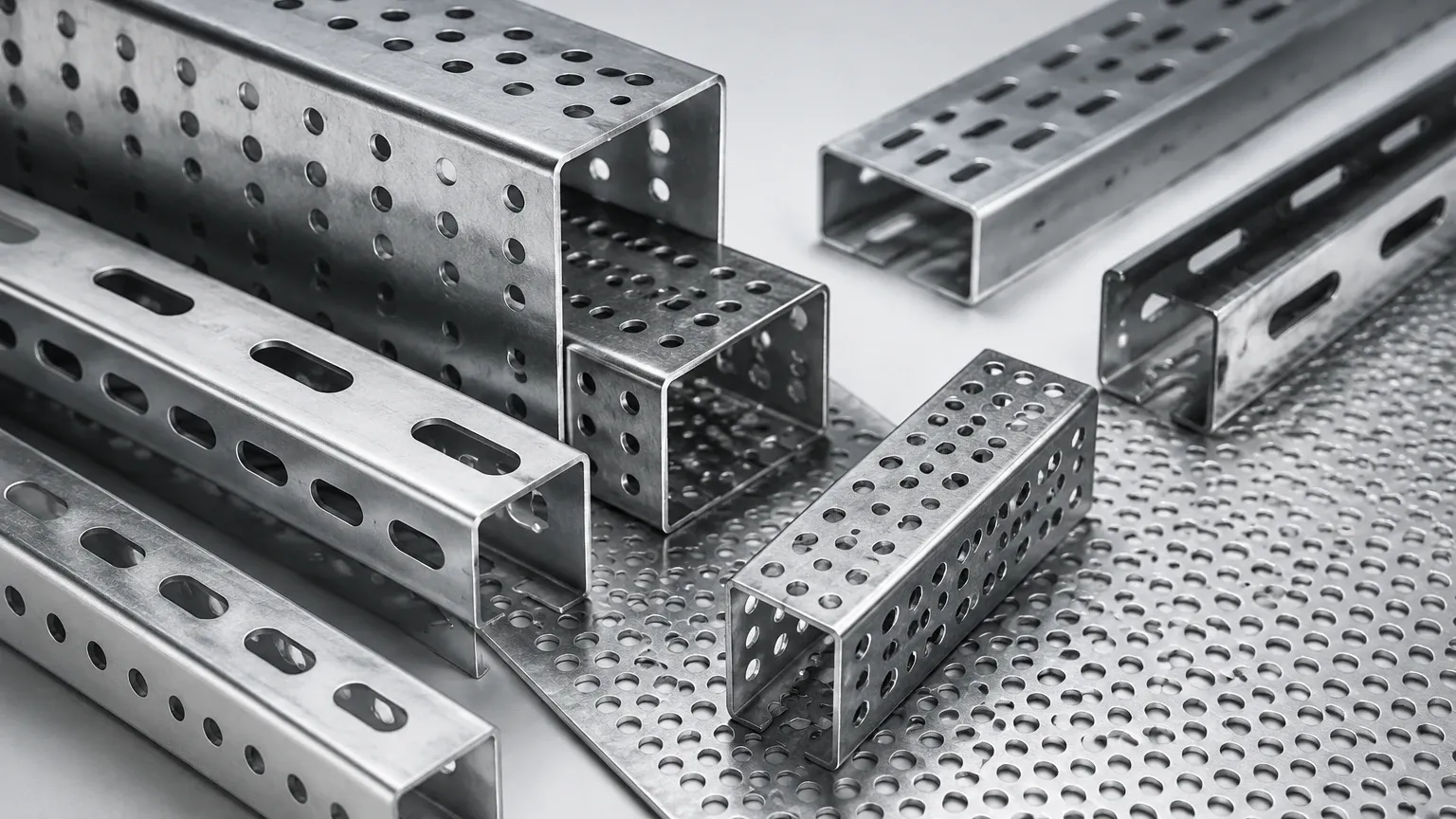
Perforated Metal Channel
In industrial filtration and structural engineering, the perforated metal channel serves as a critical component that bridges the gap between fluid dynamics and mechanical stability. Unlike standard perforated sheets, a channel configuration provides inherent rigidity, making it an ideal choice for high-pressure filtration systems, drainage assemblies, and protective housings. For engineers and procurement specialists, selecting the right perforated metal channel requires a deep understanding of material properties, hole geometry, and the specific demands of the operating environment.
Kaifil, as a specialist in custom stainless steel filtration solutions, understands that these components are rarely "off-the-shelf" items. They must be engineered to withstand chemical exposure, mechanical stress, and varying flow rates. This guide examines the technical specifications, selection criteria, and manufacturing considerations essential for integrating perforated metal channels into industrial systems.
Engineering Fundamentals of Perforated Metal Channels
A perforated metal channel is essentially a metal profile—typically a U-shape, C-shape, or custom hat-channel—that has been precision-punched with a pattern of holes. The primary advantage of this form factor is its structural integrity. While a flat perforated sheet may flex under pressure, the folded flanges of a channel provide a high strength-to-weight ratio, allowing it to support internal filter media or act as a standalone strainer in high-velocity flows.
Material Selection and Grade Importance
In the B2B industrial sector, material choice is the first line of defense against system failure. Kaifil primarily utilizes stainless steel due to its superior corrosion resistance and longevity.
* Grade 304/304L: The standard choice for general industrial applications. It offers excellent formability and welding characteristics, making it suitable for water treatment and basic chemical processing.
* Grade 316/316L: Containing molybdenum, this grade is essential for environments involving chlorides or high-salinity. It is the preferred material for pharmaceutical and marine filtration where pitting corrosion is a significant risk.
* Specialty Alloys: For extreme temperatures or highly aggressive chemical environments, alloys such as Duplex stainless steel may be employed to ensure the perforated metal channel does not suffer from stress corrosion cracking.
Hole Patterns and Open Area Calculations
The performance of a channel is dictated by its open area percentage. This is the ratio of the area of the holes to the total area of the sheet before forming. Engineers must balance the need for high flow rates (high open area) with the need for structural stiffness (lower open area).
1. Round Holes: Usually arranged in a 60-degree staggered pattern, this provides the most uniform strength and is the most common choice for industrial filtration.
2. Square Holes: These offer a higher open area but can create stress concentration points at the corners, which may lead to fatigue over time in vibrating systems.
3. Slotted Holes: Ideal for filtering elongated particles or for use in drainage channels where specific flow directions are required.
Selection Criteria for Industrial Filtration Applications
When specifying a perforated metal channel for a filtration system, the primary goal is to ensure the component can handle the system's differential pressure without deforming. In many designs, the channel acts as the "skeleton" or support core for a finer wire mesh layer. If the channel fails, the entire filter element collapses.
Filtration Accuracy and Primary Screening
In some applications, the channel itself acts as the primary filter. This is common in coarse straining for water intake or food processing. The hole size must be precisely calculated to prevent the passage of unwanted debris while maintaining a low pressure drop. If the holes are too small, the channel will clog rapidly; if they are too large, downstream equipment may be damaged.
Flow Dynamics and Pressure Drop
Every perforated metal channel introduces a degree of resistance to fluid flow. Engineers must calculate the pressure drop (ΔP) across the channel to ensure the pump system can maintain the required flow rate. Factors influencing this include fluid viscosity, velocity, and the "tortuosity" of the path through the perforations. A well-designed channel minimizes turbulence, which can otherwise lead to erosion of the metal surfaces over time.
Environmental Compatibility
Beyond the fluid being filtered, the external environment must be considered. Is the channel exposed to high-pressure wash-downs? Is it submerged in a caustic solution? For food and beverage applications, the perforated metal channel must have a surface finish that prevents bacterial growth. Kaifil provides various finishing options, including electropolishing and passivation, to ensure compliance with strict hygienic standards.
Customization and Manufacturing Capabilities
One of the most significant challenges in procurement is finding a manufacturer capable of producing a Perforated & Expanded Metal product that meets exact dimensional tolerances. A perforated metal channel involves multiple manufacturing steps that must be tightly controlled.
Precision Perforating and CNC Bending
The process begins with high-speed punching presses that create the hole pattern in a flat sheet. It is vital that the "margins" (the unperforated areas along the edges) are calculated correctly so that when the sheet is bent into a channel shape, the holes do not end up on the bend radius. Bending through a hole can weaken the metal and lead to cracking.
Welding and Assembly
For many industrial filters, the channel must be integrated into a larger assembly. This often involves TIG (Tungsten Inert Gas) or plasma welding. At Kaifil, we ensure that the weld seams are as corrosion-resistant as the base metal. In applications like hydraulic filtration, the integrity of these welds is paramount to prevent bypass—where unfiltered fluid escapes through gaps in the assembly.
OEM and Bespoke Designs
Industrial equipment often requires unique channel profiles—perhaps a tapered U-channel or a channel with integrated mounting brackets. Kaifil’s OEM capabilities allow for the development of custom tooling to meet these specific geometric requirements, ensuring that the component fits perfectly into the existing housing without the need for field modifications.
Comparing Perforated vs. Expanded Metal in Channel Form
While the term "perforated metal channel" is common, engineers often weigh the benefits of perforated metal against expanded metal. Both can be formed into channels, but they serve different mechanical purposes.
| Feature | Perforated Metal Channel | Expanded Metal Channel |
| :— | :— | :— |
| Manufacturing | Material is punched out (waste produced) | Material is slit and stretched (no waste) |
| Hole Precision | Extremely high; exact diameters possible | Variable; diamond-shaped openings |
| Structural Rigidity | High, especially with thick gauges | Excellent weight-to-strength ratio |
| Flow Characteristics | Predictable and uniform | Can be turbulent due to angled strands |
| Cost | Higher due to material waste | Generally lower for large areas |
For precision filtration where a specific micron rating or hole size is required, the perforated metal channel is almost always the superior choice. Expanded metal is more frequently used for protective grates, walkways, or very coarse debris screens where the exact shape of the opening is less critical than the overall strength of the part.
Installation, Maintenance, and Replacement Cycles
The longevity of a perforated metal channel is not solely dependent on its manufacture; installation and maintenance play equal roles. In a B2B context, downtime is the enemy of profitability. Therefore, selecting a component that is easy to maintain is a strategic decision.
Installation Best Practices
When installing a channel into a filtration vessel, it is critical to ensure proper alignment. Misalignment can lead to uneven flow distribution, causing certain areas of the channel to wear faster than others. Furthermore, if the channel is used as a support for a wire mesh, the contact surfaces must be smooth. Any burrs or sharp edges from the perforating process can puncture the delicate mesh, leading to system failure.
Cleaning and Maintenance
Stainless steel channels are favored because they support various cleaning protocols:
* CIP (Clean-in-Place): High-velocity chemical flushes can remove buildup from the perforations without disassembling the system.
* Mechanical Cleaning: Brushing or scraping may be used for heavy fouling, provided the metal gauge is thick enough to resist deformation.
* Ultrasonic Cleaning: For channels used in pharmaceutical or laboratory settings, ultrasonic baths can remove microscopic particles from the hole edges.
Identifying the Replacement Cycle
While stainless steel is durable, it is not infinite. Engineers should monitor for:
1. Erosion: Thinning of the metal around the hole edges due to high-velocity abrasive particles.
2. Deformation: Any bowing or twisting of the channel flanges, indicating that the system pressure has exceeded the design limits.
3. Chemical Etching: A dulling or pitting of the surface that suggests the material grade is no longer suitable for the evolving chemical composition of the process fluid.
Total Cost of Ownership and Procurement Considerations
When evaluating a perforated metal channel, the initial purchase price is only one part of the equation. Technical buyers must consider the Total Cost of Ownership (TCO). A cheaper channel made from lower-grade steel or with imprecise tolerances may lead to frequent replacements, higher energy costs due to pressure drops, and potential damage to downstream pumps.
Factors Influencing Cost
* Material Market Prices: Stainless steel prices fluctuate based on nickel and chromium markets.
* Complexity of Pattern: Custom hole sizes or non-standard pitches require specialized tooling.
* Secondary Operations: Requirements for degreasing, deburring, painting, or specialized packaging for cleanroom use.
Information to Confirm Before Ordering
Before moving forward with a project, the following technical details should be confirmed with the manufacturer:
* Exact Alloy Grade: Ensure it matches the chemical compatibility requirements of the fluid.
* Dimensional Tolerances: Specify the allowable variance in channel length, width, and flange height.
* Hole Specification: Define the hole diameter, center-to-center distance, and pattern orientation.
* Load Requirements: Provide the maximum expected differential pressure the channel must withstand.
By focusing on these technical boundaries, engineers can ensure that the perforated metal channel they integrate into their system will provide reliable, long-term performance in even the most demanding industrial environments. Kaifil remains committed to supporting these technical needs through precision manufacturing and engineering expertise.
For more information on material specifications and custom configurations, Review product options and application support to find the optimal solution for your filtration or structural requirements.
