


Custom Perforated Metal Panels
In industrial engineering and manufacturing, the selection of filtration and structural components often dictates the overall efficiency and longevity of a system. Custom perforated metal panels represent a versatile solution for applications requiring precise fluid control, mechanical protection, or structural support. As a specialized manufacturer, Kaifil provides engineered Perforated & Expanded Metal solutions designed to meet the rigorous demands of chemical processing, pharmaceutical production, and hydraulic systems.
Understanding the technical nuances of these components—from hole geometry and open area calculations to material compatibility—is essential for engineers and procurement teams. This guide examines the engineering principles, customization options, and selection criteria for integrating custom perforated metal panels into industrial environments.
Engineering Fundamentals of Perforated and Expanded Metal
While often grouped together, perforated and expanded metals are manufactured through distinct processes that yield different mechanical properties and performance characteristics. Choosing between them depends on the specific requirements of the application, such as weight, strength, and filtration accuracy.
Perforated Metal Panels
Perforated metal is produced by mechanically punching or laser-cutting holes into a solid sheet of metal. This process allows for high precision in hole placement and size. Engineers can specify exact margins (the unperforated areas around the edges) and complex patterns that are not possible with other methods. This makes perforated panels ideal for filter support cores, decorative architectural elements with functional airflow, and precise sorting screens.
Expanded Metal Panels
Expanded metal is created by simultaneously slitting and stretching the base material. This process results in a diamond-shaped mesh pattern. Because the metal is stretched rather than punched, there is zero material waste, making it a cost-effective alternative for structural applications. Expanded metal typically offers a higher strength-to-weight ratio and is often used for walkways, safety guards, and as a support layer in multi-stage filtration assemblies.
Technical Specifications: Hole Patterns and Open Area
The performance of custom perforated metal panels is largely determined by the configuration of the perforations. These specifications influence flow rates, pressure drop, and the size of particles retained during filtration.
Hole Shapes and Their Functions
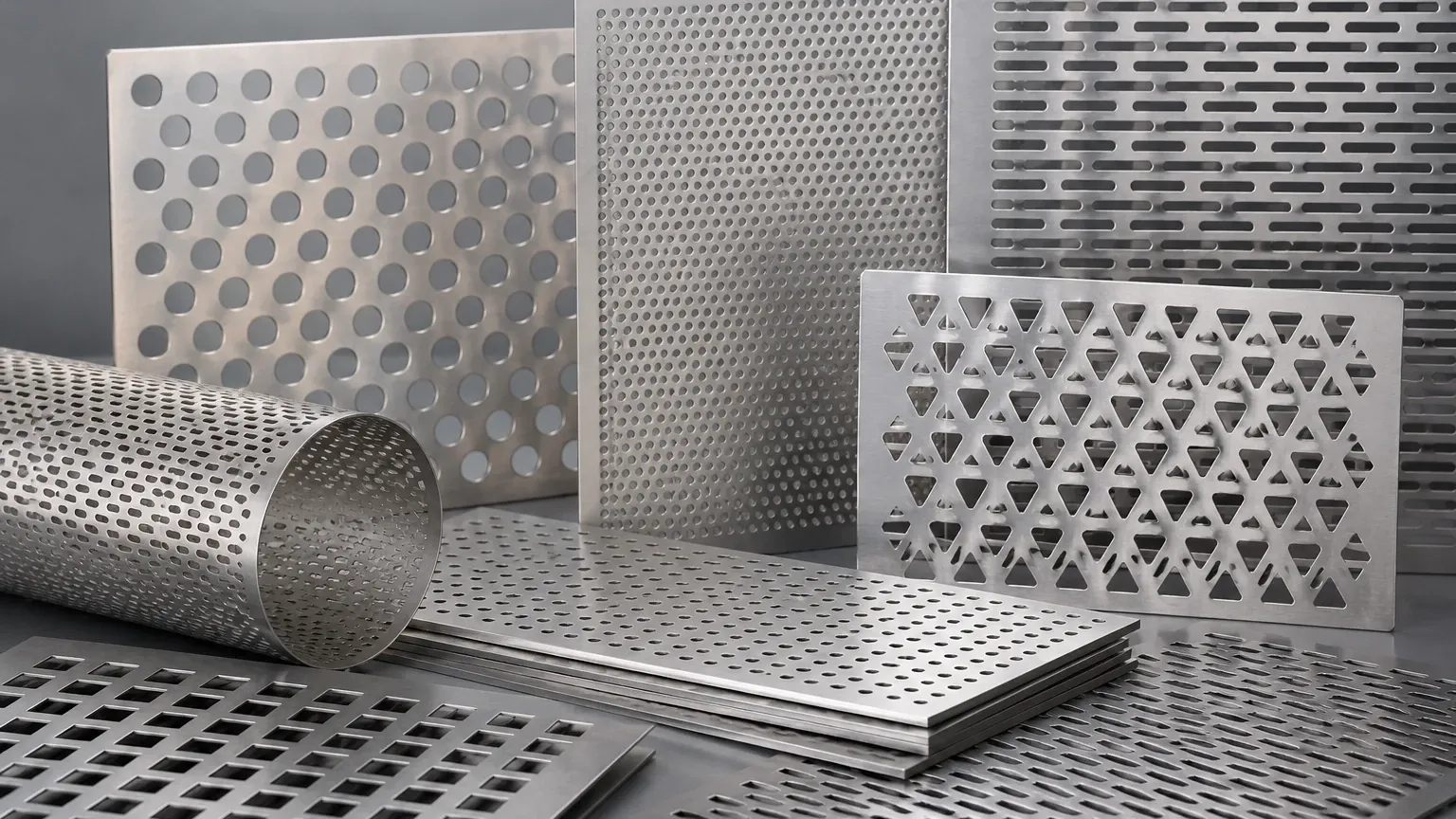
* Round Holes: The most common and efficient pattern for general filtration and structural use. Round holes offer high mechanical strength and are easier to manufacture, leading to lower costs.
* Square Holes: Often used when a higher open area is required. They provide a larger passage for air or fluid but may have lower structural integrity under high-pressure conditions compared to round holes.
* Slotted Holes: Specifically designed for sorting and filtering elongated materials. They are frequently used in the food and beverage industry for grain processing or in chemical plants for solid-liquid separation.
Calculating Open Area
The "open area" is the percentage of the panel that consists of holes. This is a critical metric for engineers calculating fluid dynamics. A higher open area reduces pressure drop but can compromise the panel's physical strength. For example, a staggered 60-degree pattern of round holes provides the best balance between high open area and structural rigidity. Calculating the exact open area is vital to ensure the panel can withstand the mechanical stresses of the operating environment without deforming.
Material Selection for Industrial Environments
Material compatibility is a primary concern in industrial filtration. Custom perforated metal panels must withstand corrosive chemicals, extreme temperatures, and mechanical wear. Kaifil specializes in stainless steel solutions, which are the industry standard for demanding applications.
Stainless Steel (304 and 316L)
* Grade 304: Suitable for general industrial use, providing excellent strength and basic corrosion resistance. It is commonly used in food processing and architectural applications.
* Grade 316L: The preferred choice for marine, pharmaceutical, and chemical environments. The addition of molybdenum and lower carbon content enhances resistance to pitting and crevice corrosion, particularly in chloride-rich environments.
Specialized Alloys and Surface Treatments
In some cases, carbon steel or aluminum may be used for weight-sensitive or cost-constrained projects. However, for industrial filtration, stainless steel remains the benchmark. Beyond the base material, surface treatments such as electropolishing, passivating, or powder coating can be applied to improve hygiene (critical in food and pharma) or further enhance corrosion resistance.
Customization and OEM Capabilities
Standard off-the-shelf panels rarely meet the specific needs of complex industrial systems. Customization allows engineers to integrate the panel seamlessly into existing machinery or new designs. Kaifil’s OEM capabilities ensure that every aspect of the Perforated & Expanded Metal component is tailored to the application.
Precision Dimensions and Tolerances
Custom panels can be manufactured to exact dimensions, eliminating the need for on-site cutting or modification, which can compromise the integrity of the material. This includes specific thicknesses (gauges) ranging from thin foils for fine filtration to heavy plates for structural support.
Secondary Operations
Customization extends beyond the perforation pattern. Panels can be further processed through:
* Forming and Bending: Creating cylindrical filter cores or U-shaped channels.
* Welding: Integrating the panels into larger assemblies or adding mounting flanges.
* Degreasing and Cleaning: Ensuring the panels are free of manufacturing oils, which is essential for pharmaceutical and food-grade applications.
Application-Specific Considerations
Custom perforated metal panels serve diverse roles across various industries. Understanding these roles helps in selecting the right specifications.
Chemical and Petrochemical Processing
In these sectors, panels are used as catalyst support grids, reactor internals, and strainers. The primary focus here is chemical compatibility and the ability to withstand high temperatures and pressures. Perforated panels provide the necessary rigidity to support heavy catalyst beds while maintaining uniform flow distribution.
Food and Beverage Industry
Hygiene and cleanability are paramount. Perforated stainless steel panels are used in drying trays, sorting screens, and pasteurization equipment. The smooth surface of punched holes prevents bacterial buildup, and the use of 304 or 316L stainless steel ensures compliance with food safety standards.
Hydraulic and Water Treatment
In hydraulic systems, perforated metal often serves as a protective outer sleeve or an inner support core for pleated filter media. It protects the delicate filter mesh from high-pressure surges. In water treatment, larger perforated panels act as intake screens to prevent debris from entering pumps and sensitive filtration stages.
Selection Criteria: A Guide for Engineers
Before finalizing a purchase order for custom perforated metal panels, technical teams should evaluate several factors to ensure optimal performance and cost-efficiency.
1. Filtration Accuracy: What is the minimum particle size that must be blocked? This dictates the hole size and pattern.
2. Pressure Drop Constraints: What is the maximum allowable resistance to flow? High open area reduces pressure drop but lowers strength.
3. Mechanical Load: Will the panel be subject to vibration, high-pressure fluid flow, or heavy weight? This determines the material thickness and the required margins.
4. Environmental Factors: Will the panel be exposed to acids, salts, or extreme heat? This guides the material selection (e.g., 316L vs. 304).
5. Installation Requirements: Does the panel need mounting holes, specific edge treatments, or complex shapes? Providing a detailed CAD drawing ensures the final product meets these needs without additional rework.
Total Cost of Ownership and Maintenance
While the initial cost of custom perforated metal panels made from high-grade stainless steel may be higher than standard alternatives, the total cost of ownership (TCO) is often lower. Durable materials and precise engineering reduce the frequency of replacement and minimize downtime caused by component failure.
Replacement Cycles
In filtration applications, the replacement cycle depends on the level of contamination and the cleaning protocols. Perforated metal is generally more robust than wire mesh and can often be cleaned using backwashing, ultrasonic cleaning, or chemical soaking, extending its service life significantly.
Quality Assurance
Working with an experienced manufacturer like Kaifil ensures that the panels meet international quality standards. This includes verifying material certifications, ensuring hole consistency across the entire sheet, and maintaining tight dimensional tolerances. For critical industrial applications, these quality checks prevent catastrophic system failures and ensure consistent process performance.
Conclusion
Custom perforated metal panels are more than just sheets with holes; they are precision-engineered components that play a vital role in industrial efficiency. By carefully considering material properties, perforation patterns, and the specific demands of the operating environment, engineers can select solutions that offer the perfect balance of flow performance and structural durability.
Whether you require support cores for hydraulic filters or specialized screens for chemical processing, Kaifil provides the technical expertise and manufacturing flexibility to deliver high-performance Perforated & Expanded Metal products. Focusing on precision and quality allows for the development of filtration components that excel in even the most demanding industrial settings.
