


Corrugated Perforated Metal
In the landscape of industrial filtration and structural engineering, corrugated perforated metal represents a sophisticated evolution of standard flat sheet components. By combining the precision of perforated patterns with the structural rigidity of corrugated profiles, this material offers a unique set of performance characteristics that are essential for demanding B2B applications. From high-pressure hydraulic systems to large-scale chemical processing units, understanding the technical nuances of these components is critical for engineers and procurement teams seeking to optimize system longevity and filtration efficiency.
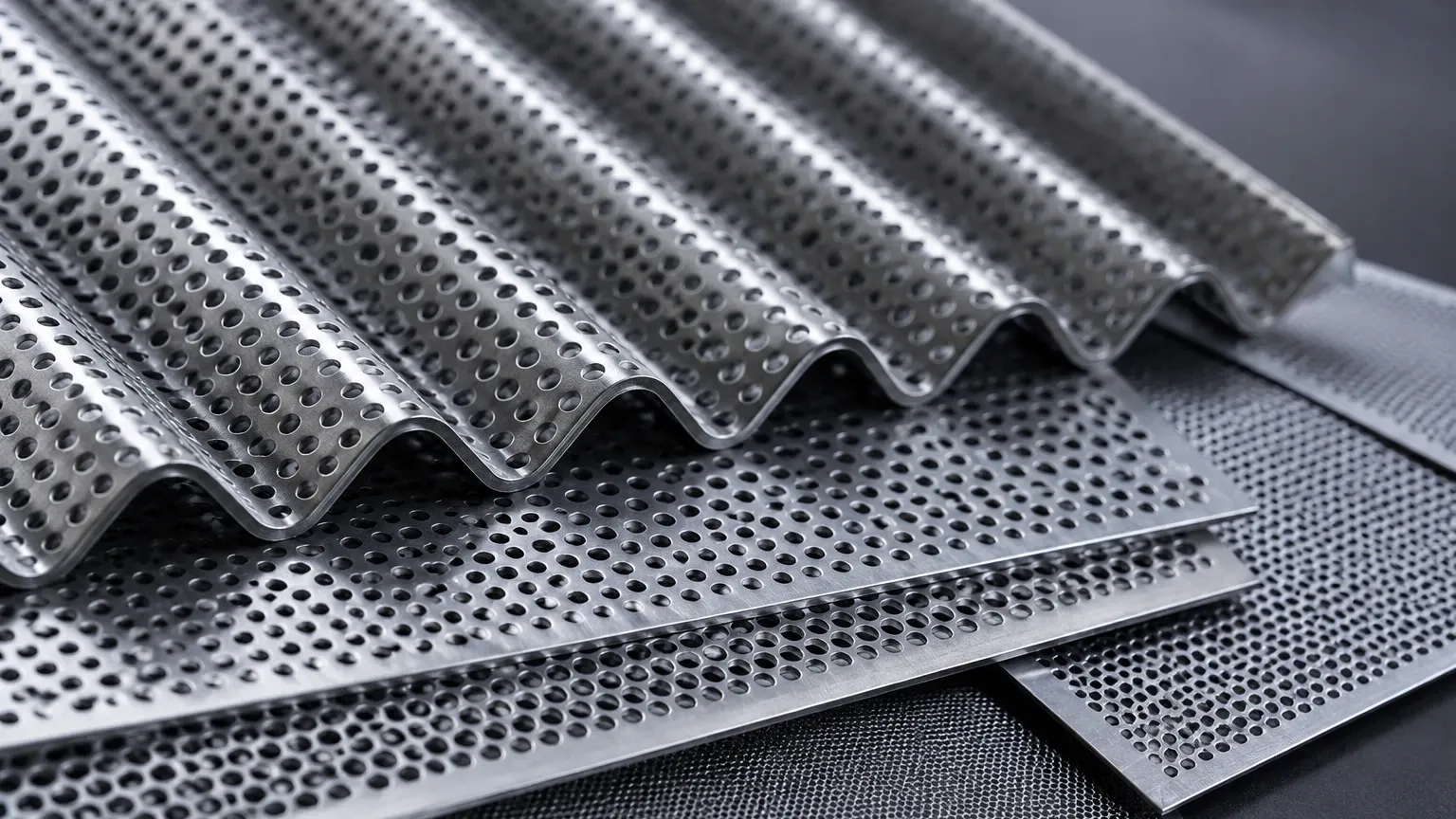
At its core, corrugated perforated metal is a metal sheet—typically stainless steel—that has undergone two distinct manufacturing processes: perforation to create a specific open area and cold-forming to create a repetitive wave-like or trapezoidal profile. This geometric transformation significantly alters the mechanical properties of the base material, allowing it to serve as both a high-performance filter medium and a robust structural support.
The Structural Mechanics of Corrugated Perforated Metal
The primary engineering advantage of corrugated perforated metal lies in its dramatically increased moment of inertia compared to flat sheets of the same thickness. In industrial environments where components are subjected to high differential pressures, flat perforated sheets often require thick gauges or heavy external reinforcement to prevent deformation or collapse. Corrugation introduces a three-dimensional stability that allows for the use of thinner, lighter materials without sacrificing structural integrity.
For engineers designing filtration housings or support cores, this strength-to-weight ratio is a decisive factor. The corrugation profile—whether sinusoidal, V-shaped, or trapezoidal—acts as a series of integral beams. These beams distribute mechanical loads across the surface, making the component highly resistant to bending and buckling. This is particularly relevant in the production of Perforated & Expanded Metal solutions where the material must maintain its shape under the weight of heavy filter cakes or the force of high-viscosity fluid flow.
Enhancing Filtration Performance through Geometry
Beyond structural benefits, the use of corrugated perforated metal fundamentally changes the fluid dynamics and filtration capacity of a system. The most immediate impact is the substantial increase in effective surface area. Within a fixed cylindrical or rectangular footprint, a corrugated sheet provides significantly more filtration area than a flat sheet.
This increased surface area translates directly into several operational advantages:
1. Lower Face Velocity: For a given flow rate, the velocity of the fluid passing through the individual perforations is reduced. This minimizes turbulence and reduces the risk of particle breakthrough or premature blinding of the filter medium.
2. Extended Service Life: A larger surface area allows for a greater volume of contaminant loading before the differential pressure reaches a critical threshold. This extends the intervals between cleaning or replacement cycles, reducing the total cost of ownership.
3. Improved Flow Distribution: The peaks and valleys of the corrugation can help to break up laminar flow and encourage more uniform distribution across the entire filter surface, preventing localized clogging.
In complex filtration assemblies, corrugated perforated metal often serves as the drainage layer or the primary support for finer wire mesh layers. In these configurations, the peaks of the corrugations provide the necessary standoff to ensure that the fluid can flow freely behind the primary filter media, maximizing the utilization of the entire available area.
Material Selection and Technical Specifications
For industrial applications, material selection is the foundation of performance. As a specialist in stainless steel filtration solutions, Kaifil emphasizes the use of alloys that can withstand the specific chemical and thermal stresses of the operating environment.
* Stainless Steel 304/304L: The standard choice for general industrial use, offering excellent formability and good corrosion resistance in non-highly acidic environments.
* Stainless Steel 316/316L: Preferred for chemical processing, pharmaceutical, and marine applications due to the addition of molybdenum, which enhances resistance to pitting and crevice corrosion in chloride-rich environments.
* High-Nickel Alloys: For extreme temperatures or highly aggressive chemical media, specialized alloys may be required to ensure the corrugated perforated metal does not suffer from stress corrosion cracking or rapid oxidation.
When specifying these components, engineers must define several critical parameters:
* Hole Pattern: Staggered patterns (typically 60 degrees) are most common as they provide the highest open area and uniform strength. Straight-row patterns are used when specific directional flow or aesthetic alignment is required.
* Open Area Percentage: This is the ratio of the area of the holes to the total area of the sheet. It must be balanced against the required mechanical strength; higher open areas improve flow but reduce the structural rigidity of the corrugation peaks.
* Corrugation Pitch and Depth: The "pitch" is the distance between peaks, while the "depth" is the height of the wave. These dimensions determine the stiffness of the sheet and the total surface area gain.
Customization and OEM Capabilities for Precision Filtration
One of the primary challenges in industrial procurement is finding filtration components that fit existing system footprints while meeting updated performance standards. This is where custom manufacturing and OEM capabilities become essential. Corrugated perforated metal is rarely an "off-the-shelf" product for high-end industrial use; it requires precise tailoring to the application.
Manufacturing custom solutions involves more than just bending a sheet. It requires careful calculation of the "stretch" that occurs during the corrugation process to ensure that the final hole alignment and dimensions remain within tolerance. Advanced CNC perforation equipment allows for the creation of margins—unperforated areas—along the edges of the sheet. These margins are critical for subsequent welding or mechanical fastening into filter housings, as they provide a solid surface for a secure, leak-proof attachment.
Furthermore, the integration of corrugated perforated metal into multi-layer filter cartridges requires expertise in specialized welding techniques, such as TIG, plasma, or resistance welding. Ensuring that the peaks of the corrugations are properly bonded to surrounding support structures prevents vibration-induced fatigue, which is a common cause of failure in high-flow hydraulic and gas filtration systems.
Applications Across Demanding Industrial Sectors
The versatility of corrugated perforated metal allows it to solve complex problems across a wide range of industries:
* Chemical and Petrochemical Processing: Used in reactor internals, catalyst support grids, and large-scale strainers. The material’s ability to resist corrosive bypass and withstand high thermal loads is paramount here.
* Food and Beverage: Employed in pasteurization equipment, centrifugal screens, and drainage systems. In these applications, the smooth finish of stainless steel and the ability to easily clean the corrugated profiles are essential for maintaining hygiene standards.
* Hydraulic and Lubrication Systems: Often used as the inner support core for high-pressure pleated filters. The corrugation prevents the pleats of the fine filter media from collapsing against each other under pressure, maintaining open flow paths.
* Power Generation: Used in intake screens and acoustic damping panels. The perforated surface combined with the corrugated shape helps in breaking up sound waves and managing debris in high-volume water intakes.
* Architectural and Industrial Shielding: Beyond filtration, the material is used for heat shields and protective guards where airflow is required but structural impact resistance is also necessary.
Selection Criteria: What Engineers Need to Confirm
Before finalizing a specification for corrugated perforated metal, technical professionals should evaluate several key factors to avoid common pitfalls in industrial filtration:
1. Differential Pressure Requirements: What is the maximum expected pressure drop across the component? This will dictate the required material thickness and the optimal corrugation profile.
2. Media Compatibility: Beyond the fluid being filtered, consider the cleaning agents used in CIP (Clean-in-Place) cycles. Ensure the stainless steel grade is resistant to all chemicals it will encounter.
3. Edge Conditions: Specify whether the edges should be sheared, hemmed, or left with unperforated margins. Proper edge treatment is vital for both safety during installation and the structural integrity of the final assembly.
4. Tolerance Levels: In precision OEM applications, tolerances on the corrugation pitch and overall dimensions are tight. Confirm that the manufacturer can meet these requirements through verified QC processes.
5. Flow Direction: Determine if the fluid will flow from the "inside-out" or "outside-in" in a cylindrical application. This affects which side of the corrugation will be under tension and which will be under compression.
By focusing on these technical boundaries, engineers can ensure that the selected corrugated perforated metal component provides the necessary balance of filtration precision and mechanical durability. As industrial systems become more complex and efficiency requirements more stringent, the role of engineered metal components like those found in the Perforated & Expanded Metal category continues to be a cornerstone of reliable industrial performance.
In conclusion, corrugated perforated metal is not merely a commodity but an engineered solution. Its successful implementation depends on a deep understanding of material science, geometric influence on fluid flow, and precision manufacturing. For B2B partners, collaborating with a manufacturer that understands these variables ensures that the final product meets the rigorous demands of the modern industrial environment.
