


Custom Perforated Metal
In industrial filtration and structural engineering, perforated metal serves as a critical component that balances mechanical strength with precise permeability. Unlike standardized off-the-shelf sheets, custom perforated metal is engineered to meet specific hydraulic, thermal, and chemical requirements. For engineers and procurement teams, selecting the right specifications involves more than choosing a hole size; it requires a deep understanding of material behavior, manufacturing tolerances, and the intended application’s environmental stressors.
Customization allows for the optimization of the open area, hole pattern, and margin configurations to ensure that the component integrates seamlessly into larger systems, such as filter cartridges, chemical reactors, or acoustic dampening panels. This guide examines the technical parameters and engineering considerations essential for specifying high-performance perforated metal solutions.
Technical Fundamentals of Perforated Metal Design
The performance of a perforated sheet is primarily determined by its geometric configuration. When specifying custom perforated metal, engineers must calculate the relationship between the hole diameter, the pitch (the distance between the centers of adjacent holes), and the resulting open area.
Hole Patterns and Geometry
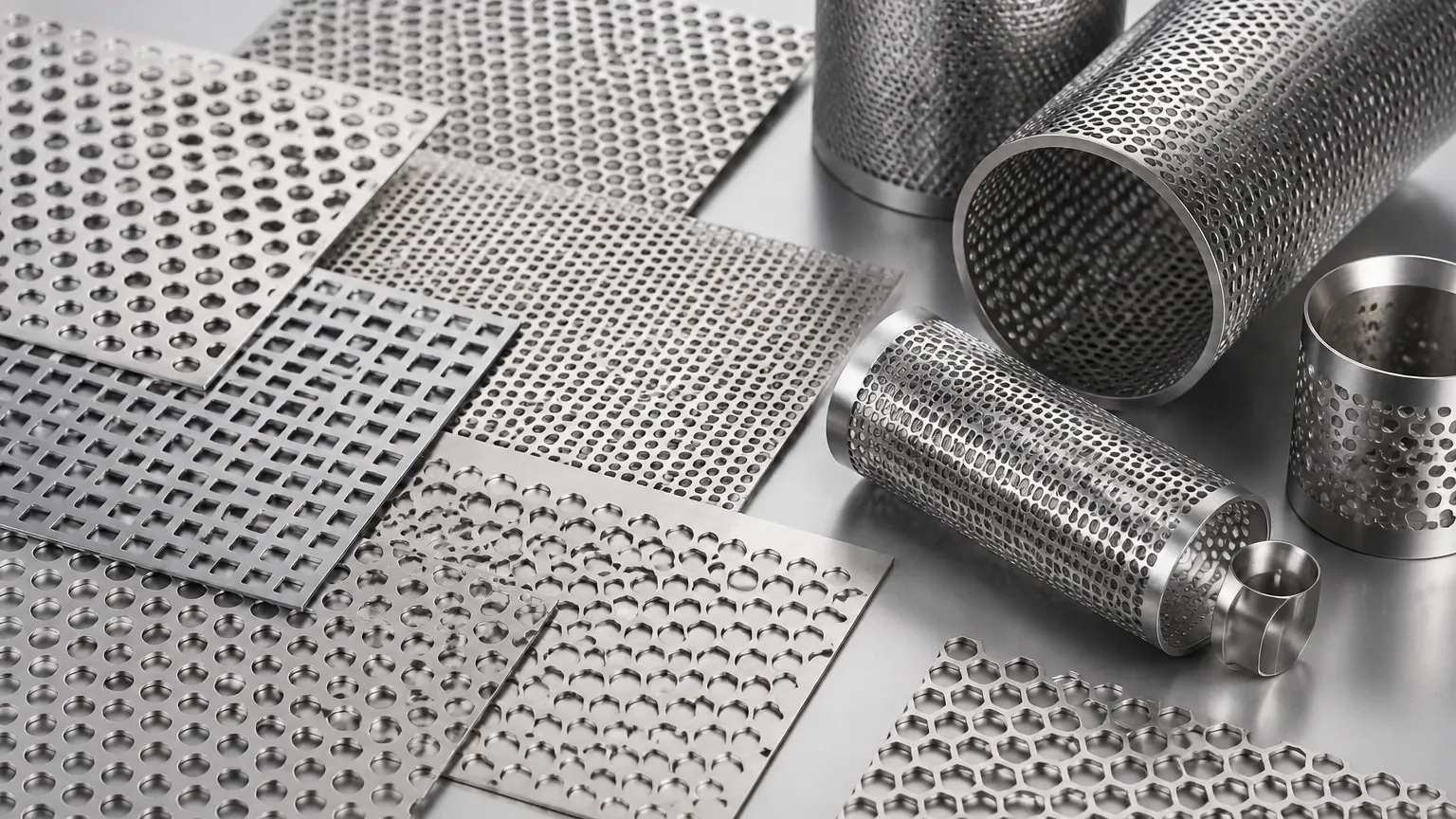
There are three primary hole arrangements used in industrial applications:
1. 60-Degree Staggered: This is the most common and efficient pattern. It provides the highest open area and uniform strength across the sheet, making it ideal for high-flow filtration applications.
2. Straight Line: Holes are aligned in both horizontal and vertical rows. While simpler to manufacture, this pattern offers lower structural integrity compared to staggered configurations and is typically reserved for aesthetic or specific sorting applications.
3. 45-Degree Staggered: An intermediate option often used for specific directional flow requirements or when a particular visual or mechanical balance is needed.
Calculating Open Area
The open area percentage is a decisive factor in pressure drop and flow rate. For a 60-degree staggered round hole pattern, the formula is:
*Percentage of Open Area = (D² × 90.69) / R²*
Where *D* is the hole diameter and *R* is the center-to-center pitch. Accurate calculation is vital; an error of even 5% in open area can significantly alter the performance of a filtration system, leading to premature clogging or insufficient throughput.
Material Considerations for Industrial Environments
The choice of substrate determines the longevity and reliability of the Perforated & Expanded Metal in demanding environments. Kaifil specializes in stainless steel solutions, which are preferred for their resistance to corrosion and high temperatures.
Stainless Steel Grades
* Type 304: The standard grade for general industrial use. It offers excellent formability and resistance to oxidation. It is widely used in food processing and general water treatment.
* Type 316/316L: Contains molybdenum, which provides superior resistance to chlorides and pitting. This is the industry standard for pharmaceutical, chemical processing, and marine applications where the metal is exposed to aggressive solvents or saline environments.
* Specialty Alloys: For extreme conditions involving high heat or highly acidic environments, alloys like Monel, Inconel, or Duplex stainless steel may be specified to prevent stress corrosion cracking.
Mechanical Properties and Work Hardening
During the perforation process, the metal undergoes significant mechanical stress. Stainless steel, in particular, is prone to work hardening. Engineers must account for the change in ductility and hardness around the perforated zones, especially if the sheet requires subsequent forming, rolling, or welding into a filter cartridge shape.
Customization Parameters: Beyond Standard Dimensions
One of the primary advantages of custom perforated metal is the ability to define non-standard margins and blank areas. Standard production often results in "unfinished" edges where holes are cut off at the border. Custom fabrication allows for:
* Safe Side Margins: Solid metal borders along the length and width of the sheet. These are essential for welding the sheet into a cylinder or mounting it into a frame without compromising the structural integrity of the edges.
* Blank Zones: Specific areas within the perforated field that remain solid. This is often required for mounting brackets, bolt holes, or to provide additional structural ribbing in large panels.
* Precision Tolerances: While standard commercial tolerances might allow for slight variances in hole alignment, custom orders can specify tighter tolerances for hole diameter and pitch, which is critical for precision filtration where particle retention must be absolute.
The Role of Perforated Metal in Filtration Systems
In the context of industrial filtration, perforated metal rarely acts as the primary filter medium for fine particles. Instead, it serves two vital roles: as a support structure and as a pre-filter.
Structural Support Cores
In high-pressure hydraulic or chemical systems, fine wire mesh or pleated media lack the mechanical strength to withstand the differential pressure. Custom perforated metal tubes are used as internal cores or external cages to provide the necessary rigidity. The perforation pattern must be designed to minimize flow resistance while maximizing the collapse strength of the tube.
Pre-Filtration and Trash Racks
For water treatment and heavy industrial processes, perforated metal acts as a primary barrier to remove large debris before the fluid reaches more sensitive downstream components. In these cases, the hole size is chosen based on the largest permissible particle that can pass without damaging pumps or secondary filters.
Quality Control and Performance Evaluation
A common challenge in perforated metal procurement is ensuring the finished product is free from manufacturing defects that could compromise the system. Quality evaluation should focus on the following:
1. Burr Removal: The punching process naturally creates burrs on the exit side of the hole. In filtration, these burrs can trap fibers, cause turbulence, or even break off and contaminate the filtrate. Custom orders should specify deburring or polishing processes.
2. Flatness: The perforation process introduces internal stresses that can cause the sheet to bow or curl. Leveling is a necessary post-perforation step to ensure the sheet meets flatness specifications for ease of installation.
3. Surface Cleanliness: For pharmaceutical and food-grade applications, the metal must be free from lubricants used during the punching process. Ultrasonic cleaning or chemical degreasing is often required to meet hygiene standards.
Common Engineering Risks in Custom Metal Fabrication
Specifying custom perforated metal involves navigating potential pitfalls that can lead to part failure or increased costs.
* Hole-to-Thickness Ratio: A fundamental rule of thumb is that the hole diameter should not be smaller than the material thickness. Attempting to punch holes smaller than the sheet thickness leads to excessive tool wear, high breakage rates, and distorted holes. If a smaller aperture is required, laser cutting or chemical etching may be necessary, though these methods change the cost profile.
* Ligament Failure: The "ligament" is the solid metal between the holes. If the ligament is too narrow (due to an excessively high open area), the sheet may lack the structural integrity to be formed or welded. It may also fail under vibration or pressure pulses in a fluid system.
* Oil Residue: Standard industrial perforation uses heavy oils to cool the punches. If the end-use is in a cleanroom or food environment, failing to specify a cleaning protocol can lead to batch contamination.
Procurement Checklist: Confirming Specifications
Before finalizing a custom perforated metal order, engineering and purchasing teams should confirm the following technical details with the manufacturer:
* Material Grade: Ensure the specific stainless steel alloy matches the chemical compatibility requirements of the fluid.
* Dimensional Accuracy: Define the length, width, and thickness, along with the required tolerances.
* Hole Specification: Confirm hole diameter, shape (round, square, etc.), and the pattern (staggered vs. straight).
* Open Area Percentage: Verify that the calculated open area meets the flow requirements of the system.
* Margin Requirements: Specify the width of the solid borders on all four sides.
* Post-Processing: Determine if the part requires deburring, leveling, degreasing, or specialized coating.
* Quantity and Lead Time: Custom tooling or setups may affect the production schedule, especially for complex blanking patterns.
By addressing these factors, engineers can ensure that the custom perforated metal components they receive will perform reliably within their specific industrial applications. Whether used as a protective screen, a structural core, or a flow diffuser, the precision of the perforation is central to the efficiency of the entire filtration or processing system.
Kaifil provides comprehensive support for the design and manufacture of these components, ensuring that every custom perforated metal product aligns with the rigorous standards of the chemical, pharmaceutical, and hydraulic industries. Through careful material selection and advanced manufacturing techniques, we help our partners achieve durable and cost-effective filtration performance.
