


Corrugated Perforated Metal Sheet
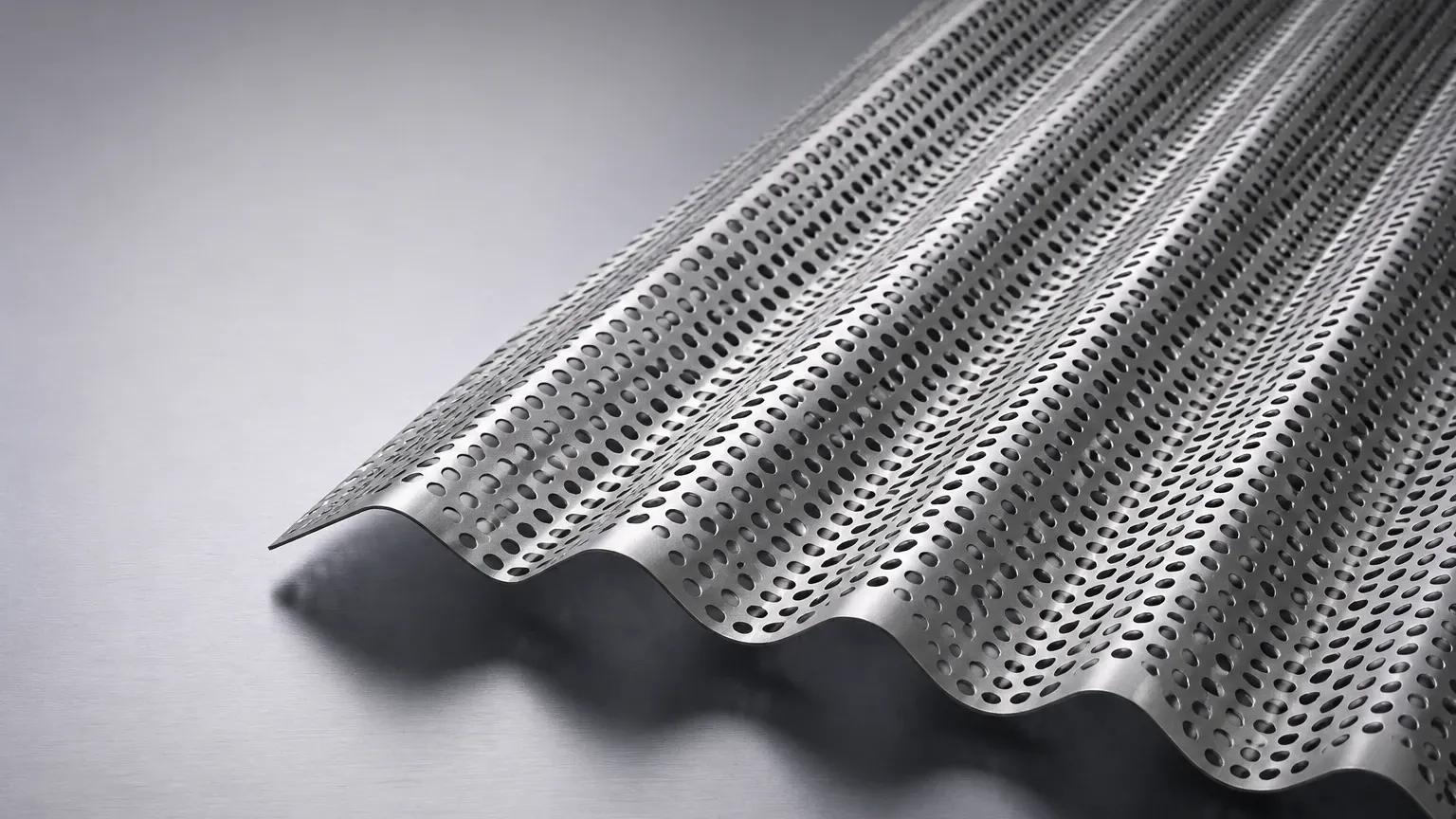
In industrial engineering and high-performance filtration, the corrugated perforated metal sheet represents a specialized evolution of standard flat metal components. By combining the precise drainage and ventilation capabilities of perforated metal with the structural rigidity of a corrugated profile, this material addresses complex challenges in chemical processing, food production, and structural engineering.
For engineers and procurement teams, selecting the right Perforated & Expanded Metal solution requires a deep understanding of how geometric manipulation affects mechanical properties, flow dynamics, and long-term durability. This guide explores the technical nuances of corrugated perforated metal, focusing on its application in demanding industrial environments.
The Engineering Logic Behind Corrugation
The primary reason for choosing a corrugated perforated metal sheet over a flat alternative is the dramatic increase in the strength-to-weight ratio. When a flat sheet is formed into a series of parallel ridges and furrows (the corrugated profile), its moment of inertia is significantly increased.
Structural Rigidity and Load Bearing
In industrial applications where the metal sheet must span large distances without intermediate support, flat sheets often fail due to deflection or buckling. Corrugation allows for thinner gauges of stainless steel to be used while maintaining the necessary stiffness to withstand high-pressure differentials or heavy mechanical loads. This is particularly critical in catalyst support grids and industrial drying trays where weight reduction is necessary for ease of maintenance, but structural integrity is non-negotiable.
Increased Surface Area
From a filtration and heat exchange perspective, the corrugated profile provides a significantly larger surface area within the same footprint as a flat sheet. Depending on the wave height and pitch, a corrugated perforated metal sheet can offer 50% to 150% more effective surface area. This translates directly to:
* Lower face velocity in air filtration systems.
* Increased contact time in chemical reactors.
* Enhanced heat dissipation in cooling applications.
Material Selection and Chemical Compatibility
Because these components are often deployed in corrosive or high-temperature environments, material selection is the most critical factor in the design phase. As a specialist in stainless steel filtration, Kaifil emphasizes the use of high-grade alloys to ensure the longevity of the corrugated perforated metal sheet.
Stainless Steel 304 vs. 316L
* Grade 304: The standard choice for general industrial use, providing excellent formability and moderate corrosion resistance. It is suitable for food and beverage applications where regular cleaning is required but exposure to chlorides is minimal.
* Grade 316L: The "L" denotes low carbon, which is essential for components that require welding during the fabrication of filter cartridges or housings. 316L contains molybdenum, making it the preferred choice for marine environments, pharmaceutical processing, and chemical filtration where resistance to pitting and crevice corrosion is paramount.
Specialty Alloys
In extreme cases involving high-temperature oxidation or highly acidic environments, materials such as Duplex stainless steel or Nickel alloys may be utilized. These materials maintain their mechanical properties even when perforated and corrugated, ensuring that the structural "waves" do not flatten or crack under thermal cycling.
Technical Specifications: Perforation Patterns and Open Area
The performance of a corrugated perforated metal sheet is defined by its perforation geometry. Engineers must balance the "open area" (the percentage of the sheet that is holes) with the remaining metal's ability to hold the corrugated shape.
Round vs. Slotted Perforations
* Round Holes: The most common and cost-effective pattern. They provide the most uniform stress distribution during the corrugation process, reducing the risk of tearing at the hole edges.
* Slotted Holes: Often used in solid-liquid separation or grain processing. When corrugating slotted sheets, the orientation of the slots relative to the ridges (parallel or perpendicular) significantly affects the final stiffness of the sheet.
Calculating Effective Open Area
It is a common misconception that the open area of a corrugated sheet is the same as the flat sheet it was made from. While the physical number of holes remains constant, the *projected* open area changes based on the angle of the corrugation. For fluid dynamics simulations, engineers must account for how the "valleys" of the corrugation might trap particles or how the "peaks" might experience higher wear rates due to localized flow acceleration.
Manufacturing Challenges and Precision Standards
Producing a high-quality corrugated perforated metal sheet is a multi-stage process that requires precision to prevent material fatigue.
1. Perforating: The flat sheet is first punched using CNC-controlled presses. Precise spacing (pitch) is vital because any irregularity will be magnified during the corrugation stage.
2. Annealing (Optional): Depending on the material thickness and the complexity of the corrugation, the sheet may undergo stress-relief annealing to prevent work-hardening cracks.
3. Corrugating: The perforated sheet is passed through specialized rollers or press brakes. The challenge here is ensuring that the holes do not deform into ovals, which would compromise the filtration accuracy (micron rating).
4. Post-Processing: This includes degreasing, pickling, and passivating. For stainless steel, passivation is essential to restore the protective oxide layer that may have been damaged during punching and forming.
Industrial Applications of Corrugated Perforated Metal
The versatility of the corrugated perforated metal sheet allows it to serve multiple functions across various sectors.
1. Industrial Filtration and Separation
In large-scale hydraulic systems and water treatment plants, these sheets are used as primary screens or support structures for finer wire mesh. The corrugation acts as a natural spacer, preventing the mesh from collapsing against the housing and ensuring that fluid can flow across the entire surface of the filter element.
2. Acoustic Dampening and Noise Control
In power plants and engine rooms, corrugated perforated metal is used in silencers and acoustic baffles. The ridges help to break up sound waves, while the perforations allow the sound to enter an insulating material (like mineral wool) behind the metal. The corrugated shape provides the structural strength needed to withstand high-velocity exhaust gases.
3. Petrochemical Catalyst Supports
In reactor vessels, corrugated sheets support beds of catalyst beads. The high open area allows for low-pressure drops, while the corrugated profile provides the immense load-bearing capacity required to support tons of catalyst material without sagging.
4. Architectural and HVAC Applications
Beyond heavy industry, these sheets are used in sunshades and ventilation grilles. The corrugation provides a 3D aesthetic while the perforations manage airflow and light transmission. In HVAC systems, they act as diffusers that can handle higher air volumes than flat grilles without rattling or whistling.
Selection Criteria for Engineers and Buyers
When specifying a corrugated perforated metal sheet for a project, providing the following data points to the manufacturer ensures an accurate quote and a functional product:
* Material Grade: (e.g., 304, 316L, Aluminum).
* Sheet Thickness: Typically measured in mm or gauge. Note that the "effective thickness" of the finished product will be the height of the corrugation.
* Hole Diameter and Pitch: The center-to-center distance between holes.
* Corrugation Profile: Specify the wave height (amplitude) and the distance between peaks (period).
* Margins: The unperforated borders required for welding or mounting.
* Quantity and Dimensions: The final cut size of the sheets.
Maintenance and Replacement Cycles
While stainless steel corrugated perforated metal sheets are designed for durability, their service life depends on the environment. In filtration applications, the "valleys" of the corrugation can become sites for sediment accumulation.
Cleaning Protocols:
For food-grade or pharmaceutical applications, Clean-in-Place (CIP) systems are effective, but the spray nozzles must be positioned to reach into the corrugation furrows. For heavy industrial use, ultrasonic cleaning or high-pressure backwashing is recommended to remove embedded particulates.
Inspection:
Regular inspections should focus on the "peaks" of the corrugations, as these are the areas most susceptible to erosion in high-velocity flow environments. If the hole edges show signs of rounding or the ridges show thinning, the structural integrity may be compromised, necessitating a replacement.
Why Choose Custom Solutions?
Off-the-shelf perforated metal rarely meets the specific pressure and flow requirements of advanced industrial systems. Custom manufacturing allows for the optimization of the corrugated perforated metal sheet to the exact specifications of the housing or the fluid being processed.
By adjusting the corrugation depth, a designer can tune the pressure drop across a filter, or by varying the perforation pattern, they can create zones of different flow rates across a single sheet. This level of customization is what distinguishes high-performance filtration components from standard hardware.
Conclusion
The corrugated perforated metal sheet is more than a simple piece of hardware; it is an engineered component that balances fluid dynamics with structural mechanics. Whether it is used to support a catalyst bed in a refinery or to provide durable filtration in a food processing plant, its performance is rooted in the precision of its manufacture and the appropriateness of its material.
For technical teams looking to optimize their filtration systems or structural components, understanding these variables is the first step toward achieving long-term operational efficiency. For detailed specifications and custom design support, engineers are encouraged to Review product options and application support to find the ideal configuration for their specific industrial requirements.
