


Custom Perforated Metal Sheet
In industrial filtration and mechanical engineering, the custom perforated metal sheet serves as a foundational component that dictates the efficiency, structural integrity, and longevity of a filtration system. Unlike standard off-the-shelf products, a custom-engineered perforated sheet is designed to meet specific hydraulic and mechanical requirements, ensuring that the media it supports or the fluid it filters behaves predictably under operational stress.
For engineers and purchasing teams, selecting the right Perforated & Expanded Metal involves a deep dive into material science, geometric configurations, and manufacturing tolerances. This article explores the technical nuances of custom perforated metal sheets, providing the factual data necessary to optimize filtration performance in demanding B2B environments.
The Role of Perforated Metal in Industrial Filtration
While often viewed as a simple barrier, the custom perforated metal sheet performs several critical functions in industrial processes. It is most frequently utilized in one of two roles: as the primary filtration medium for coarse particles or as a high-strength support structure for finer wire mesh or synthetic filter media.
In high-pressure hydraulic systems or heavy-duty chemical processing, the perforated sheet acts as the "skeleton" of a filter cartridge. It must withstand significant differential pressures (ΔP) without deforming, which would otherwise lead to the failure of the delicate inner filter layers. Conversely, in applications like intake strainers or food processing screens, the perforated sheet itself is the primary filter. In these cases, the precision of the hole size and the consistency of the pattern are paramount to ensuring that no oversized contaminants pass through the system.
Engineering Specifications: Hole Patterns and Geometry
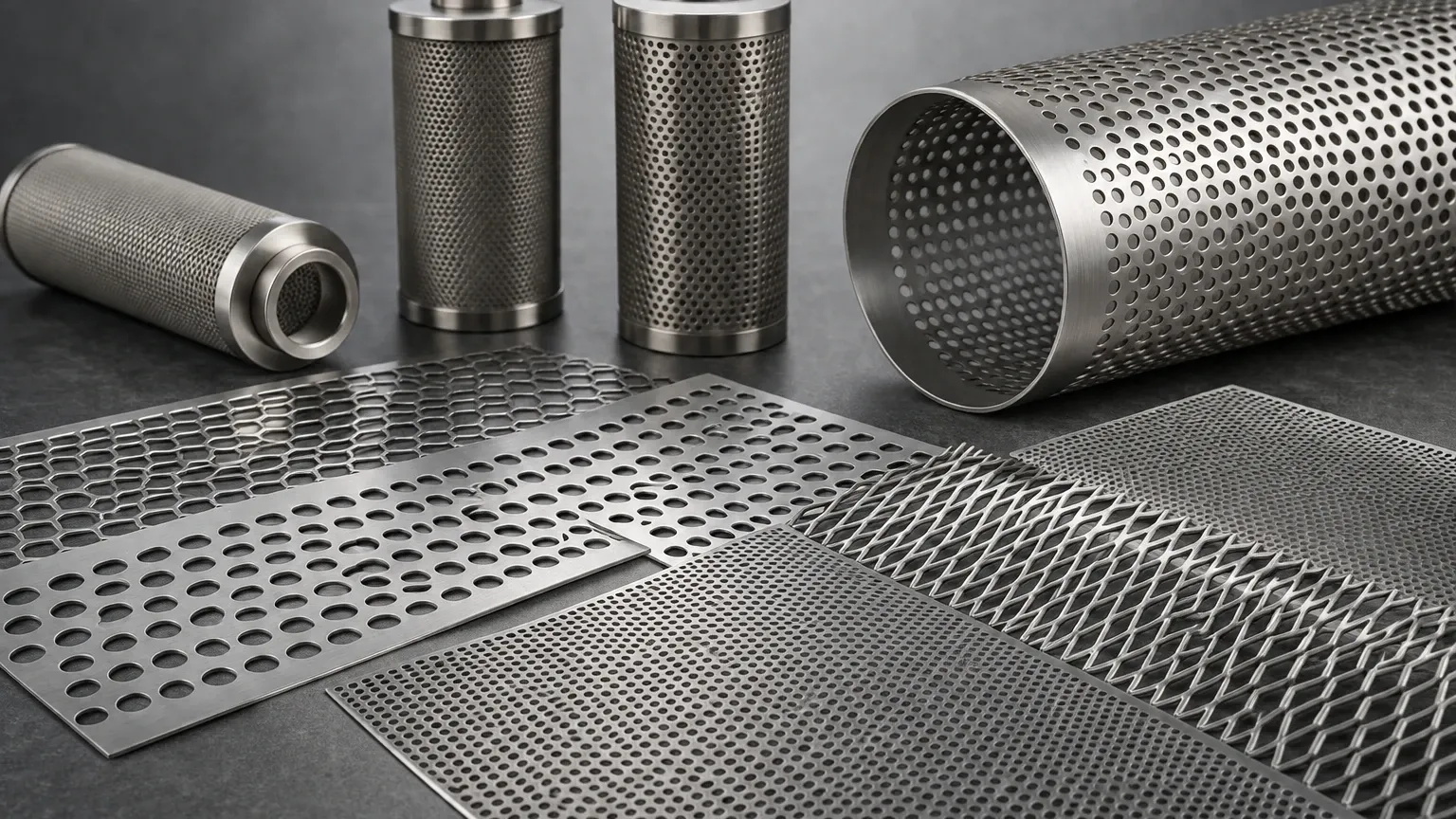
The performance of a custom perforated metal sheet is largely defined by its hole geometry. The choice of pattern affects not only the filtration accuracy but also the mechanical strength and the flow characteristics of the fluid.
Round Hole Patterns
Round holes are the industrial standard due to their versatility and inherent structural strength. They are easier to manufacture with high precision and offer the most consistent stress distribution across the sheet.
* 60-Degree Staggered: This is the most popular configuration for industrial filtration. It provides the highest open area for a given hole size and maintains excellent structural integrity. The staggered arrangement ensures that there are no straight lines of weakness, which prevents the sheet from buckling under pressure.
* Straight Row: In this configuration, holes are aligned both horizontally and vertically. While easier to align with certain mechanical components, straight patterns generally offer lower structural strength and a lower percentage of open area compared to staggered designs.
Square and Slotted Holes
Square holes offer a higher open area than round holes but at the cost of reduced mechanical strength, particularly at the corners where stress concentrations occur. Slotted holes are frequently used in applications involving elongated particles or where high-viscosity fluids require a specific flow orientation to prevent clogging.
Calculating and Optimizing Open Area
The "Open Area" is perhaps the most critical specification for any engineer designing a filtration system. It refers to the percentage of the sheet that is comprised of holes, directly influencing the flow rate and the pressure drop across the filter.
For a 60-degree staggered round hole pattern, the formula for calculating the open area percentage is:
Open Area % = (D² × 90.69) / P²
*(Where D = Hole Diameter and P = Center-to-Center Pitch)*
Achieving the optimal balance is an engineering challenge. A higher open area reduces the initial pressure drop and allows for higher flow velocities, which is desirable for system efficiency. However, increasing the open area necessitates reducing the "bridge" (the metal remaining between the holes). If the bridge is too narrow, the custom perforated metal sheet may lose its ability to withstand the mechanical loads of the application, leading to premature fatigue or collapse.
Material Selection for Demanding Environments
Industrial filtration often occurs in environments characterized by corrosive chemicals, extreme temperatures, or high-pressure steam cleaning. Consequently, material selection is a non-negotiable factor in the procurement process.
Stainless Steel 304 and 304L
Grade 304 is the standard for general industrial use. It offers good corrosion resistance and is suitable for most water treatment and food processing applications. The "L" (low carbon) variant is preferred when the sheet must be welded, as it prevents carbide precipitation that can lead to intergranular corrosion.
Stainless Steel 316 and 316L
For chemical processing, pharmaceutical manufacturing, and marine environments, Grade 316 is the preferred choice. The addition of molybdenum provides superior resistance to chlorides and pitting. In high-precision filtration, 316L is often specified to ensure the longevity of the custom perforated metal sheet when exposed to aggressive cleaning agents or acidic process fluids.
Specialty Alloys
In extreme cases involving high-temperature oxidation or highly concentrated acids, manufacturers may utilize Duplex stainless steels or nickel-based alloys. These materials provide the necessary mechanical properties where standard austenitic steels would fail.
Manufacturing Considerations and Quality Control
The method used to create a custom perforated metal sheet significantly impacts its final quality and suitability for filtration.
Precision Punching
High-speed CNC punching is the most common method for producing perforated sheets. It is cost-effective for large production runs and offers high dimensional accuracy. However, punching can introduce internal stresses and burrs. In filtration applications, burrs are a major concern as they can trap particles, cause turbulence, or even break off and contaminate the downstream fluid. Professional manufacturers like Kaifil employ secondary processes such as deburring and leveling to ensure the sheet is perfectly flat and smooth.
Laser Cutting
For thicker plates or complex, non-repetitive patterns, laser cutting is utilized. While slower than punching, it provides extreme precision and eliminates the risk of mechanical deformation associated with physical dies. This is often the preferred method for heavy-duty support cylinders used in high-pressure hydraulic filters.
Tolerances and Margins
When ordering a custom perforated metal sheet, engineers must specify the required margins—the unperforated areas along the edges of the sheet. Margins are essential for welding the sheet into a cylindrical shape or bolting it into a housing. Standard commercial tolerances may not be sufficient for precision filtration components; therefore, confirming exact dimensional tolerances for hole diameter, pitch, and sheet flatness is a critical step in the B2B procurement cycle.
Evaluating Total Cost of Ownership (TCO)
While the initial purchase price is a factor, the total cost of ownership for a custom perforated metal sheet is determined by its durability and maintenance requirements. A poorly designed sheet that saves costs upfront may lead to:
1. Increased Energy Costs: A lower-than-optimal open area increases the pressure drop, forcing pumps to work harder and consume more electricity.
2. Frequent Replacements: If the material grade or bridge thickness is insufficient, the filter may fail under pressure spikes, leading to costly downtime.
3. Cleaning Inefficiency: Rough surfaces or inconsistent hole geometries can make backwashing or chemical cleaning less effective, shortening the service life of the filter element.
Investing in a precision-engineered solution ensures that the filtration system operates at peak efficiency for its intended lifespan, ultimately reducing the long-term operational expenditure.
Technical Checklist for Purchasing and Engineering Teams
Before finalizing a specification for a Perforated & Expanded Metal project, the following technical data points should be confirmed with the manufacturer:
* Material Grade: Does the alloy match the chemical compatibility requirements of the process fluid?
* Hole Diameter and Pitch: Have these been calculated to provide the necessary filtration rating and open area?
* Sheet Thickness (Gauge): Is the metal thick enough to handle the maximum expected differential pressure?
* Margin Requirements: Are the unperforated borders clearly defined for subsequent fabrication (welding/forming)?
* Surface Finish: Is deburring, passivation, or electropolishing required to prevent contamination or improve corrosion resistance?
* Flatness and Camber: Are there specific requirements for the sheet’s flatness to ensure it fits into the filter housing correctly?
Conclusion
The custom perforated metal sheet is a vital component in the industrial filtration landscape. By moving beyond standard specifications and focusing on the precise engineering of hole patterns, material properties, and manufacturing tolerances, B2B buyers can significantly enhance the performance of their filtration systems. Partnering with a manufacturer that understands these technical boundaries—such as Kaifil—allows for the development of filtration solutions that are not only effective but also durable and cost-efficient over the long term.
