


Galvanized Perforated Metal Sheet
In industrial filtration and structural engineering, the selection of materials often dictates the long-term viability and efficiency of a system. A galvanized perforated metal sheet represents a critical component for engineers seeking a balance between mechanical strength, corrosion resistance, and cost-effectiveness. While stainless steel is often the default for highly corrosive environments, galvanized steel provides a robust alternative for applications where atmospheric moisture or mild chemical exposure is present, but the extreme cost of high-nickel alloys is not justified.
As a specialized manufacturer, Kaifil provides precision-engineered Perforated & Expanded Metal solutions that meet the rigorous demands of industrial sectors. Understanding the technical nuances of galvanized perforated metal—from manufacturing processes to open-area calculations—is essential for procurement teams and engineers tasked with optimizing filtration and screening performance.
Understanding the Role of Galvanized Perforated Metal in Industrial Applications
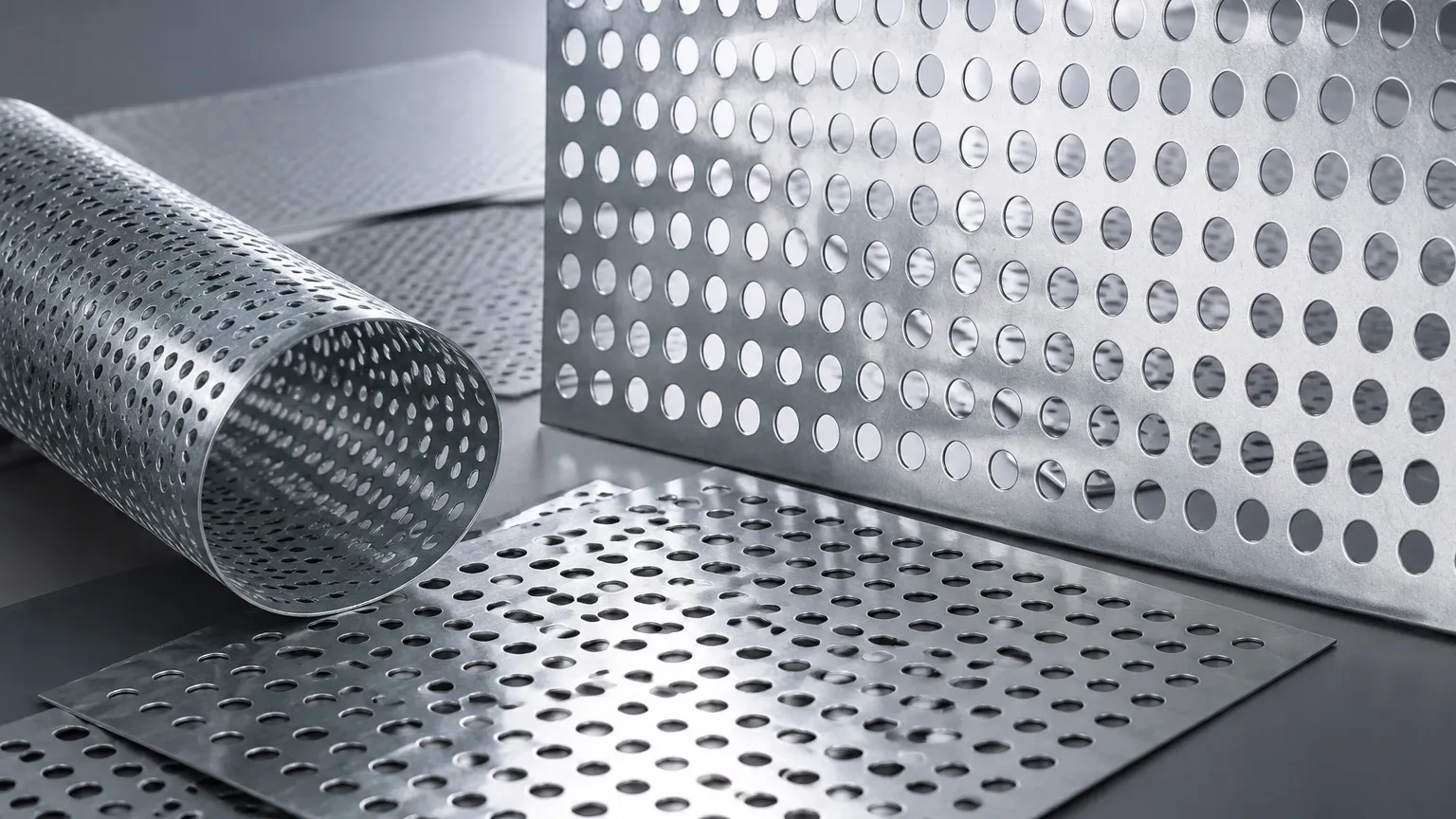
Galvanized perforated metal is essentially a carbon steel sheet that has been coated with a layer of zinc. This zinc layer acts as a sacrificial anode, protecting the underlying steel from oxidation. In the context of industrial filtration, these sheets serve multiple roles: as primary filter media for coarse particles, as support structures for finer wire mesh, or as protective guards for sensitive equipment.
Engineers specify galvanized perforated metal when the application requires higher rigidity than wire mesh can provide. Because the sheet is a single, solid piece of metal with punched holes, it maintains its dimensional stability under high pressure or mechanical stress. This makes it an ideal choice for hydraulic filter cores, industrial strainers, and architectural ventilation panels where structural integrity is as important as flow rate.
Manufacturing Methods: Pre-Galvanized vs. Hot-Dip Galvanized
One of the most critical technical decisions during the specification phase is choosing between pre-galvanized and post-galvanized (hot-dip) production methods. Each has distinct implications for the performance and lifespan of the galvanized perforated metal sheet.
Pre-Galvanized Perforated Metal
Pre-galvanized sheets are manufactured using steel that has already been galvanized at the mill. The perforation process occurs after the coating is applied.
* Pros: The finish is exceptionally smooth and uniform, making it aesthetically pleasing and easy to handle. It is generally more cost-effective for high-volume production.
* Cons: The primary engineering concern is the "exposed edge." When the punch hits the metal to create the hole, it shears through the zinc coating, leaving the raw carbon steel interior of the hole exposed to the environment. While the surrounding zinc provides some cathodic protection, these edges are more susceptible to localized corrosion over time.
Hot-Dip Galvanized (Post-Perforation)
In this process, the carbon steel is first perforated to the required specifications and then submerged in a bath of molten zinc.
* Pros: This method ensures that every surface—including the interior edges of the punched holes—is completely encapsulated in zinc. This provides superior corrosion resistance in outdoor or high-moisture environments.
* Cons: The coating is typically thicker and less uniform than pre-galvanized sheets. The molten zinc can occasionally clog smaller perforations or leave "spikes" (dross) that may require secondary finishing if the sheet is used in sensitive filtration applications.
Technical Specifications and Engineering Parameters
When specifying a galvanized perforated metal sheet, engineers must define several geometric and material parameters to ensure the component performs as intended.
1. Hole Patterns and Orientation
* Round Holes: The most common pattern, offering the best balance of strength and open area. They are typically arranged in a 60-degree staggered pattern, which maximizes the number of holes per square inch while maintaining structural rigidity.
* Square Holes: Often used for high open-area requirements, though they can introduce stress concentrators at the corners, potentially leading to fatigue under cyclic loading.
* Slotted Holes: Ideal for sorting or filtering elongated particles. These are frequently used in agricultural processing and vibrating screens.
2. The Open Area Calculation
For filtration applications, the percentage of open area determines the flow rate and pressure drop across the screen. For a standard 60-degree staggered round hole pattern, the formula is:
Open Area % = (D² × 90.69) / P²
*Where D is the hole diameter and P is the center-to-center pitch.*
An engineer must balance a high open area (for low pressure drop) against the remaining "bridge" of metal (for structural strength). If the bridge is too narrow, the sheet may deform under the weight of the filter cake or hydraulic pressure.
3. Gauge and Thickness
Industrial galvanized sheets typically range from 26 gauge (thin, flexible) to 1/4 inch or thicker (heavy-duty structural). The choice of gauge depends on the span of the support and the expected pressure differential. In hydraulic applications, the gauge must be sufficient to prevent the collapse of the filter core during cold starts or high-viscosity flow conditions.
Performance Evaluation: Filtration Efficiency and Structural Integrity
In a B2B procurement context, performance is evaluated based on how well the galvanized perforated metal sheet facilitates the primary industrial process.
Filtration Accuracy
Unlike woven wire mesh, which can have varying pore sizes due to wire shifting, perforated metal offers absolute hole sizes. This makes it a reliable choice for "trash strainers" or primary filtration stages where the goal is to remove particles larger than a specific micron rating. However, because the smallest practical punched hole is usually limited by the thickness of the material (the 1:1 ratio rule), perforated metal is rarely used for fine filtration below 500 microns without a secondary mesh layer.
Mechanical Durability
Galvanized steel offers excellent tensile strength. In systems where the filter is subject to vibration or high-velocity fluid impingement, the perforated sheet acts as a baffle, protecting more delicate internal components. Engineers should confirm the yield strength of the base carbon steel (typically Grade 33 or Grade 50) to ensure it meets the safety factors required for the specific pressure vessel or housing.
Common Risks and Selection Pitfalls in Industrial Procurement
Procuring industrial filtration components requires a rigorous assessment of potential failure points. When sourcing galvanized perforated metal, several risks must be mitigated:
1. Zinc Flaking: In high-velocity air or fluid streams, poorly adhered zinc (particularly in low-quality pre-galvanized sheets) can flake off and contaminate the downstream process. This is a critical concern in food and beverage or pharmaceutical applications.
2. Dimensional Inaccuracy: If the perforation equipment is not properly calibrated, the "pitch" can drift across a large sheet. This leads to misalignment when the sheet is rolled into a cylinder or welded into a frame.
3. Burrs and Sharp Edges: For filtration media, internal burrs can trap fibers or cause turbulence. Specifying a "deburred" finish is essential for high-performance fluid systems.
4. Incompatible Chemical Environments: While galvanized steel resists water, it performs poorly in highly acidic or highly alkaline environments (pH outside the 6–12 range). In these cases, the zinc layer will rapidly strip away, leading to catastrophic failure of the base steel.
Applications and Industry-Specific Use Cases
Chemical Processing and Petrochemicals
Galvanized perforated sheets are frequently used as support grids for catalyst beds or as protective outer shrouds for stainless steel filter cartridges. The galvanization provides enough protection against atmospheric corrosion in coastal or outdoor refinery settings without the cost of full stainless construction.
HVAC and Air Filtration
In large-scale air handling units, these sheets serve as pre-filters or diffusers. The galvanized coating prevents rust from forming due to condensation, ensuring that the air remains free of oxidation particles.
Food and Beverage (Non-Contact)
While stainless steel is required for direct food contact, galvanized perforated metal is widely used in the peripheral infrastructure of food plants, such as safety guards, ventilation panels, and drainage covers, where durability and wash-down resistance are required.
Hydraulic Systems
In heavy machinery, galvanized perforated tubes serve as the inner core of hydraulic filters. They provide the necessary collapse strength to support the pleated paper or synthetic media under high-pressure return lines.
Maintenance, Replacement Cycles, and Total Cost Considerations
A common question for maintenance engineers is the expected lifecycle of a galvanized perforated metal sheet. Unlike stainless steel, which can often be cleaned and reused indefinitely, galvanized steel has a finite lifespan dictated by the rate of zinc consumption.
Replacement Indicators
* Visible Red Rust: Once the zinc has been sacrificed, the appearance of red rust indicates that the structural integrity of the sheet is beginning to degrade. In filtration, this can lead to hole enlargement or the release of metallic debris.
* Scaling: In water treatment applications, mineral scale can build up on the zinc surface, reducing the open area and increasing pressure drop.
Cleaning Protocols
Cleaning should be performed with pH-neutral detergents. Acidic descalers or high-pressure abrasive cleaning can strip the zinc coating, significantly shortening the component's life. If the application requires frequent aggressive cleaning, transitioning to a stainless steel Perforated & Expanded Metal solution is often more cost-effective in the long run.
Total Cost of Ownership (TCO)
While the initial purchase price of galvanized perforated metal is lower than stainless steel (often by 40-60%), the TCO must account for the replacement frequency. In mild environments, a galvanized sheet can last 15–20 years, making it the most economical choice. In more aggressive environments, the labor costs associated with frequent replacements may justify an upgrade to a more corrosion-resistant material.
Customization and OEM Support
At Kaifil, we recognize that industrial filtration is rarely a one-size-fits-all endeavor. Customization options for galvanized perforated metal sheets include:
* Custom Margins: Leaving unperforated borders on the sheet to facilitate easier welding or mounting into frames.
* Specialty Shapes: Beyond flat sheets, we provide rolled cylinders, conical strainers, and fabricated baskets tailored to specific equipment dimensions.
* Variable Pitch: Adjusting the hole spacing to provide extra strength in high-stress areas of the component.
Before finalizing a purchase, engineers should confirm the specific environmental conditions, required flow rates, and mechanical load requirements. By partnering with a manufacturer that understands both the metallurgy and the application, procurement teams can ensure they receive a galvanized perforated metal sheet that delivers reliable, long-term performance in demanding industrial environments.
