


Jenis Perforated Metal
In the landscape of industrial filtration and structural engineering, selecting the appropriate material is a decision that impacts the longevity, efficiency, and safety of a system. Perforated metal, a sheet product that has been mechanically or laser-punched to create a specific pattern of holes, slots, or decorative shapes, serves as a cornerstone in these sectors. Understanding the various jenis perforated metal (types of perforated metal) is essential for engineers and procurement specialists who must balance mechanical strength with precise filtration requirements.
From a manufacturing perspective, perforated metal is not a singular product but a versatile category of engineered components. At Kaifil, we specialize in custom stainless steel filtration solutions where perforated materials often serve as the structural backbone for wire mesh filters or as primary filtration media themselves. This guide explores the technical classifications, material considerations, and selection criteria necessary for industrial applications.
Understanding the Primary Categories of Perforated Metal
The term jenis perforated metal refers to the classification of these materials based on their hole geometry, manufacturing process, and intended application. Each type offers distinct advantages regarding flow rate, pressure drop, and structural integrity.
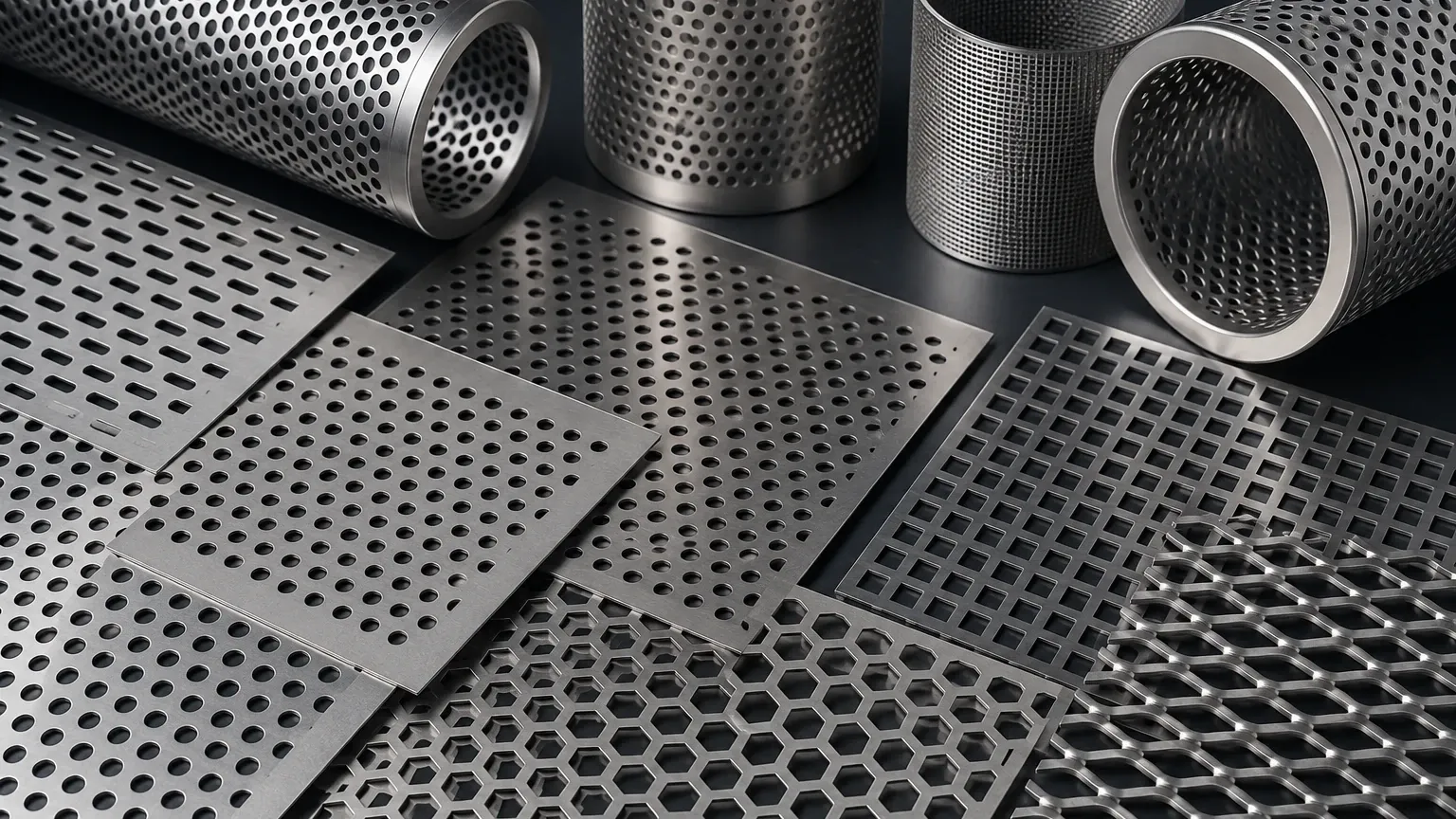
1. Round Hole Perforated Metal
Round hole patterns are the most common and efficient for industrial use. They provide the best balance between open area and sheet strength. Typically, these are arranged in a 60-degree staggered pattern, which maximizes the number of holes per square inch while maintaining the structural rigidity of the metal bridge between holes.
2. Square Hole Perforated Metal
Square holes offer a higher open area compared to round holes of the same diameter/width. This makes them ideal for applications requiring high airflow or visibility. However, square holes create sharp corners that can act as stress concentration points, making them slightly less durable under high-pressure mechanical loads than round holes.
3. Slotted Perforated Metal
Slotted patterns involve elongated holes with either round or square ends. These are frequently used in sorting and sieving applications, particularly in the food and beverage industry or for agricultural processing, where the shape of the particles being filtered requires a specific orientation.
4. Hexagonal (Honeycomb) Perforated Metal
Hexagonal patterns provide the highest possible open area (up to 80% or more). This is critical for high-volume ventilation or filtration systems where minimal resistance to flow is the primary design objective. The honeycomb structure also offers a high strength-to-weight ratio.
Material Selection: Stainless Steel vs. Alternative Alloys
The performance of any jenis perforated metal is inextricably linked to its base material. In industrial filtration, where exposure to corrosive chemicals, high temperatures, and high pressures is common, material selection is the most critical engineering decision.
Stainless Steel (304 and 316L)
Stainless steel is the industry standard for filtration components. Grade 304 provides excellent corrosion resistance for most general-purpose applications, such as food processing and water treatment. However, for more demanding environments—such as chemical processing or marine applications—Grade 316L is preferred due to its molybdenum content, which offers superior resistance to pitting and chloride-induced stress corrosion cracking.
Aluminum and Carbon Steel
Aluminum is utilized in applications where weight reduction is a priority, though it lacks the mechanical strength and chemical resistance of stainless steel. Carbon steel is a cost-effective option for structural components that are not exposed to moisture or corrosive agents, though it typically requires galvanizing or coating to prevent oxidation.
For specialized industrial needs, exploring high-quality Perforated & Expanded Metal options ensures that the material properties align with the operational environment, particularly when dealing with custom filtration cartridges and precision metal components.
Technical Parameters: Open Area and Pitch Calculations
When specifying a type of perforated metal, engineers must define several technical parameters that dictate the performance of the filter or screen.
Open Area Percentage
The open area is the ratio of the total area of the holes to the total area of the sheet. This percentage determines the flow capacity and the pressure drop across the filter. A higher open area reduces the pressure drop but may compromise the structural integrity of the sheet if the "bridges" (the metal between the holes) become too thin.
Hole Diameter and Pitch
The "pitch" is the distance from the center of one hole to the center of the adjacent hole. In a staggered pattern, the pitch and the hole diameter are used to calculate the open area using the formula:
* Open Area % = (D² × 90.69) / P² (for 60-degree staggered round holes)
Precision in these measurements is vital for OEM applications where the perforated metal must fit into a larger assembly, such as a stainless steel filter cartridge or a hydraulic strainer.
Comparing Perforated & Expanded Metal for Industrial Use
While often discussed together, perforated metal and expanded metal are manufactured differently and serve different mechanical purposes. Understanding the distinction is key to selecting the right jenis perforated metal or its expanded counterpart.
Perforated Metal is created by punching holes into a solid sheet. This process allows for extreme precision in hole size and placement. It is the preferred choice for fine filtration and applications requiring a smooth surface on both sides of the material.
Expanded Metal is produced by slitting and stretching the metal sheet simultaneously. This creates diamond-shaped openings. Because no material is lost during the expansion process, it is often more cost-effective and provides a higher strength-to-weight ratio. However, expanded metal has a raised profile and is less suited for precision filtration compared to perforated sheets.
In many industrial filtration systems, a combination of both is used: expanded metal may serve as an outer protective cage, while a perforated metal sheet provides the internal structural support for a fine wire mesh layer.
Manufacturing Considerations: CNC Punching vs. Laser Cutting
The method used to create the perforations affects the cost and the quality of the final product.
* CNC Punching: This is the most common method for high-volume production. It is fast and cost-effective for standard patterns. However, it can sometimes leave small burrs on the exit side of the hole, which may need to be removed through de-burring processes to ensure the filter does not trap unwanted particles or damage sensitive mesh layers.
* Laser Cutting: This method offers the highest level of precision and is ideal for complex patterns or very thick materials. It produces a clean, burr-free edge. While generally more expensive than punching, it is the preferred method for low-volume, highly customized filtration components where accuracy is paramount.
Applications in Industrial Filtration
Different jenis perforated metal are deployed across various industries based on their specific filtration and separation needs:
1. Chemical Processing: Used as support baskets for bag filters or as internal cores for filter cartridges. Stainless steel 316L is typically required to withstand aggressive solvents and acids.
2. Food and Beverage: Perforated screens are used in juice extraction, grain drying, and dairy processing. Smooth, easy-to-clean surfaces are mandatory to meet sanitary standards.
3. Pharmaceuticals: Precision-perforated components are used in centrifuges and fluid bed dryers, where contamination control and material purity are essential.
4. Water Treatment: Large-scale perforated screens serve as the first line of defense in intake systems, removing large debris before the water enters finer filtration stages.
Selection Criteria: What Engineers Should Confirm
Before finalizing a purchase or design for perforated metal components, engineers should confirm the following technical details to ensure the total cost of ownership is optimized and the product performs as expected:
* Filtration Accuracy: Does the hole size provide the necessary retention rate? If the required filtration is finer than what can be achieved with perforation alone, the perforated metal should be designed as a support for a wire mesh layer.
* Pressure Load: Will the material withstand the operational pressure? The thickness of the sheet and the width of the bridges must be calculated to prevent deformation under load.
* Compatibility: Is the alloy compatible with the fluid or gas being filtered? Consider both chemical corrosion and thermal expansion.
* Replacement Cycles: What is the expected lifespan of the component? High-quality stainless steel may have a higher upfront cost but significantly lower replacement costs over the life of the system.
* Customization Options: Does the application require specific margins (unperforated areas) or unique bolt-hole patterns for installation?
By carefully evaluating the jenis perforated metal available and the specific engineering requirements of the application, procurement teams can ensure they receive a component that offers reliable, long-term performance. For those seeking high-performance, customized filtration solutions, focusing on precision-manufactured Perforated & Expanded Metal is the most effective path to achieving industrial efficiency.
