


Juso Perforated Metal
In the landscape of industrial filtration and structural engineering, the term "juso perforated metal" represents a standard of precision and reliability often sought by engineers in the chemical processing, pharmaceutical, and food and beverage sectors. Perforated metal serves as a foundational component in many filtration systems, acting either as the primary screening medium or as a robust support structure for finer wire mesh layers.
When selecting Perforated & Expanded Metal for demanding industrial environments, technical professionals must look beyond basic dimensions. Understanding the relationship between hole geometry, material properties, and manufacturing tolerances is essential for ensuring the long-term efficiency and structural integrity of the filtration system. This guide examines the technical specifications, engineering considerations, and procurement criteria essential for integrating high-quality perforated metal into industrial applications.
Understanding the Technical Requirements of Juso Perforated Metal
Precision is the defining characteristic of industrial-grade perforated metal. In applications where juso perforated metal is specified, the focus is typically on the uniformity of the perforation pattern and the consistency of the material thickness. Unlike decorative or architectural metal, industrial perforated sheets are engineered to meet strict tolerances that ensure predictable flow dynamics and mechanical strength.
Hole Patterns and Geometry
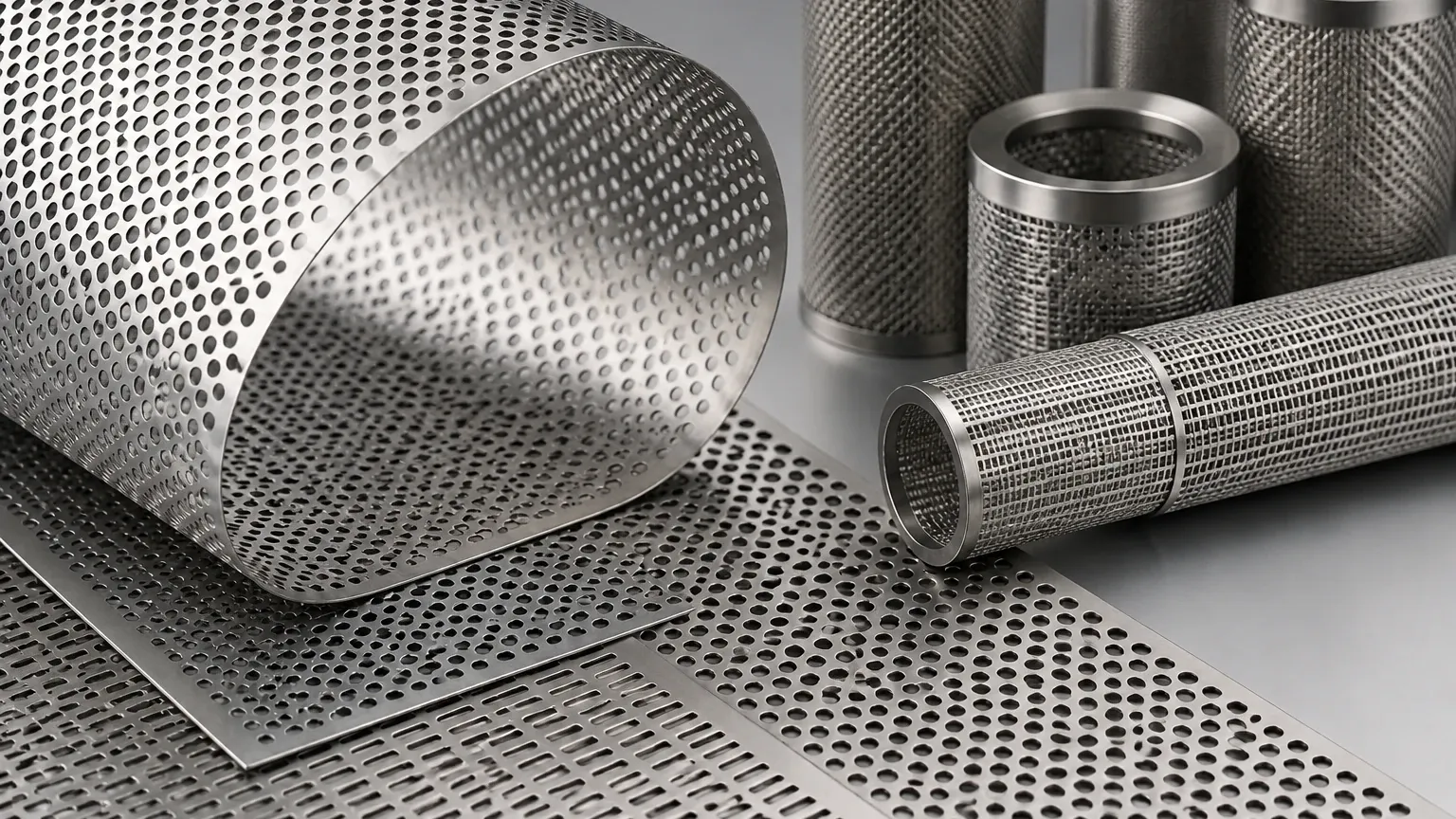
The most common configuration is the 60-degree staggered round hole pattern. This layout is preferred in industrial filtration because it provides the highest open area and the greatest structural strength relative to the weight of the material. Other configurations include:
* Straight Row Round Holes: Used when specific alignment with internal components is required, though it typically offers lower structural rigidity than staggered patterns.
* Square Holes: Often selected for high open-area requirements where flow volume is prioritized over the filtration of spherical particles.
* Slotted Holes: Ideal for the separation of elongated particles or for use in drainage and vibrating screens where clogging (blinding) must be minimized.
Dimensional Tolerances
For engineers, the tolerance on hole diameter and pitch (the distance between the centers of adjacent holes) is critical. In high-precision manufacturing, tolerances are often held within +/- 0.05mm to 0.1mm, depending on the thickness of the sheet. Variations outside these limits can lead to uneven pressure distribution across a filter cartridge, potentially causing premature fatigue or bypass issues.
Engineering Considerations: Open Area and Flow Dynamics
The "Open Area" percentage is perhaps the most critical calculation in the design of a filtration system. It determines the flow capacity and the pressure drop across the metal screen.
Calculating Open Area
For a standard 60-degree staggered round hole pattern, the formula for open area (OA) is:
OA% = (D² × 90.69) / R²
Where:
* D = Hole Diameter
* R = Center-to-center distance (Pitch)
A higher open area reduces the initial pressure drop ($ΔP$) and allows for higher flow rates. However, there is an engineering trade-off: as the open area increases, the mechanical strength of the sheet decreases. In high-pressure hydraulic or chemical processing environments, the perforated metal must be thick enough to resist deformation under the force of the fluid, which may necessitate a lower open area or the use of higher-strength alloys.
Impact on Filtration Efficiency
When used as a support for fine wire mesh, the perforated metal must provide a smooth surface to prevent the mesh from tearing under pressure. The alignment of the holes in the juso perforated metal must be designed to maximize the effective filtration area of the overlying mesh. If the "bridges" (the solid metal between holes) are too wide, they can create "dead zones" where particles accumulate, reducing the overall efficiency of the filter element.
Material Selection for Industrial Filtration Environments
Material compatibility is a non-negotiable factor in industrial B2B procurement. The choice of alloy determines the filter's resistance to corrosion, temperature fluctuations, and mechanical wear.
Stainless Steel 304 and 304L
Grade 304 is the standard for general industrial applications. It offers excellent formability and good corrosion resistance. However, in applications involving welding, 304L (low carbon) is often preferred to prevent intergranular corrosion in the heat-affected zone.
Stainless Steel 316 and 316L
For chemical processing and marine environments, Grade 316 is the industry benchmark. The addition of molybdenum provides superior resistance to chlorides and pitting. In pharmaceutical and food-grade applications, 316L is frequently mandated to ensure the highest levels of hygiene and resistance to aggressive cleaning agents (CIP – Clean-in-Place cycles).
Specialized Alloys
In extreme environments, such as high-temperature petrochemical refining or highly acidic chemical production, specialized materials like Duplex stainless steel, Monel, or Inconel may be required. These materials offer enhanced yield strength and oxidation resistance that standard austenitic stainless steels cannot match.
Manufacturing Processes and Customization Options
The production of juso perforated metal involves more than just punching holes. To meet industrial standards, several secondary processes are often necessary.
Precision Punching and Laser Cutting
While high-speed punching is the most cost-effective method for large production runs, laser cutting is utilized for thicker materials or complex geometries where mechanical stress on the sheet must be avoided. Laser cutting also allows for the creation of "blank areas" or margins on the sheet, which are essential for welding the perforated metal into cylindrical filter cartridges or square frames.
Leveling and Degreasing
The perforation process naturally introduces internal stresses into the metal, which can cause the sheet to curl or bow. Industrial-grade sheets must undergo a leveling process to ensure flatness. Furthermore, in pharmaceutical and food applications, degreasing is mandatory to remove residual lubricants used during the punching process, ensuring the final component meets high-purity standards.
Custom Fabrication
Manufacturers like Kaifil provide OEM services that include rolling, welding, and flanging. For engineers, receiving a pre-formed perforated cylinder that is ready for assembly into a housing is often more cost-effective than sourcing flat sheets and performing secondary fabrication in-house. This ensures that the weld seams are professionally managed to maintain the structural integrity of the perforation pattern.
Performance Evaluation: Durability and Maintenance
The total cost of ownership (TCO) of a filtration component is heavily influenced by its durability and the ease with which it can be maintained.
Structural Integrity and Burst Pressure
In hydraulic systems or high-flow liquid filtration, the perforated metal must withstand significant differential pressures. Engineers must calculate the "burst pressure" of the perforated tube. This involves analyzing the material's yield strength and the minimum bridge width of the perforation pattern. A well-engineered juso perforated metal component will maintain its shape even during pressure surges, protecting the delicate internal filter media.
Cleaning and Reuse
Unlike disposable synthetic filters, stainless steel perforated metal is designed for long-term use. Its smooth surface allows for effective backwashing or ultrasonic cleaning. When evaluating a supplier, it is important to confirm that the holes are free of burrs. Burrs can trap contaminants, making the filter difficult to clean and potentially leading to batch contamination in pharmaceutical or food production.
Procurement and Quality Control: What Engineers Should Confirm
When sourcing perforated metal for critical applications, purchasing teams and engineers should verify several key parameters to avoid operational risks.
1. Certification of Analysis (COA): Ensure the raw material meets the specified ASTM or ISO standards for chemical composition and mechanical properties.
2. Burr Height and Surface Finish: Specify the maximum allowable burr height. For many industrial applications, a "commercial clean" finish is insufficient, and electropolishing or mechanical deburring may be required.
3. Flatness and Camber: Define the acceptable limits for flatness, especially if the sheets are to be used in automated assembly lines.
4. Hole Count and Distribution: Verify that the open area is consistent across the entire sheet. Inconsistent perforation density can lead to flow channeling, which reduces the effective life of the filter.
Conclusion: Selecting the Right Partner for Filtration Solutions
Juso perforated metal is a critical component that demands a high degree of technical expertise in both material science and manufacturing. Whether it is used as a primary screen in a water treatment plant or as a support cage in a high-pressure hydraulic filter, the quality of the perforation directly impacts the performance of the entire system.
By focusing on precise hole geometries, appropriate material selection, and rigorous quality control, engineers can optimize their filtration processes for better efficiency and longer service life. For organizations requiring specialized designs or high-performance materials, partnering with a manufacturer that understands the nuances of Perforated & Expanded Metal is essential for achieving reliable, industrial-grade results.
