


Perforated Metal Meaning
In the context of industrial manufacturing and filtration engineering, understanding the perforated metal meaning extends far beyond a simple dictionary definition of "metal with holes." For engineers and procurement specialists, perforated metal represents a precision-engineered component designed to manage flow, provide structural support, and offer specific mechanical properties within a system.
At its core, perforated metal refers to sheet metal—typically stainless steel, carbon steel, or aluminum—that has been mechanically stamped or punched using CNC technology or high-speed die presses. This process creates a consistent pattern of holes, slots, or decorative shapes. In B2B sectors such as chemical processing, food and beverage production, and water treatment, these components are critical for separating solids from liquids, protecting sensitive equipment, and ensuring the structural integrity of filter cartridges.
Defining Perforated Metal in an Industrial Context
When discussing the perforated metal meaning in a technical environment, it is essential to focus on the manufacturing methodology and the resulting physical characteristics. Unlike woven wire mesh, which is created by interlacing wires, perforated metal starts as a solid flat sheet. The punching process removes material to create apertures, which means the final product maintains much of the original sheet's rigidity while gaining permeability.
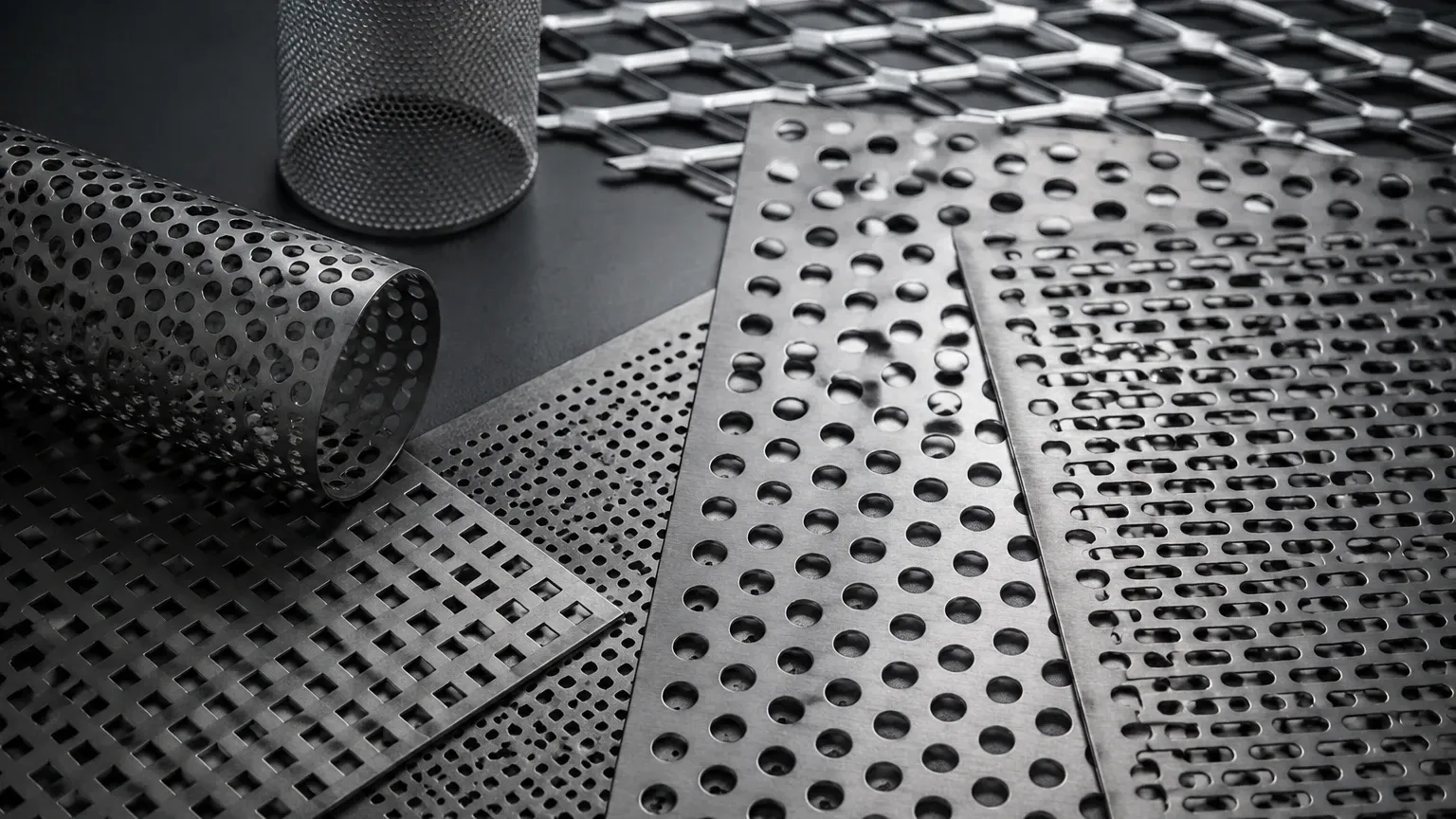
For industrial filtration, the "meaning" of a specific perforated sheet is defined by its geometric configuration. This includes the hole shape (round, square, hexagonal, or slotted), the hole size (diameter), and the arrangement (staggered or straight rows). These factors dictate the "open area" percentage, which is the primary metric used to determine the flow rate and pressure drop across the medium.
Key Technical Specifications and Engineering Formulas
To accurately specify Perforated & Expanded Metal for a project, engineers must look past the visual appearance and calculate performance metrics. The most critical calculation is the Open Area Percentage, which determines how much of the sheet is comprised of holes versus solid material.
Calculating Open Area
For a standard 60-degree staggered round hole pattern—the most common configuration for industrial filters—the formula is:
Open Area % = (D² × 90.69) / R²
Where:
* D = Hole Diameter
* R = Center-to-center distance (Pitch)
Understanding this formula is vital because it allows engineers to balance filtration efficiency with structural strength. A higher open area increases flow but reduces the sheet's ability to withstand high-pressure differentials. Conversely, a low open area may cause excessive backpressure, potentially damaging pumps or upstream components.
Pitch and Margins
The "pitch" is the distance from the center of one hole to the center of the adjacent hole. The "margins" refer to the unperforated areas along the edges of the sheet. In custom filtration solutions, specifying the exact margin width is necessary to ensure the component can be welded into a filter housing or rolled into a cylindrical cartridge without compromising the pattern or the structural seam.
Comparing Perforated Metal and Expanded Metal
While often grouped together, there is a distinct difference between perforated and expanded metal. Understanding this distinction is part of the broader perforated metal meaning in professional procurement.
1. Manufacturing Process: Perforated metal is produced by punching holes out of a sheet, resulting in "slugs" or waste material. Expanded metal is produced by simultaneously slitting and stretching the metal. This stretching process creates diamond-shaped openings without any material waste.
2. Structural Integrity: Perforated metal typically offers more predictable mechanical properties and a smoother surface finish, which is often preferred in food-grade or pharmaceutical applications where "cleanability" is paramount. Expanded metal, due to its truss-like structure, provides an excellent strength-to-weight ratio and is frequently used for safety guards or as a coarse primary filter stage.
3. Flow Characteristics: Perforated metal allows for more precise control over the aperture size. In high-precision filtration, where a specific micron rating or particle retention size is required, perforated stainless steel is the standard choice.
Material Selection: The Role of Stainless Steel in Filtration
In the industrial filtration sector, the material used for perforation is as important as the hole pattern. Stainless steel is the preferred choice for most B2B applications due to its corrosion resistance and durability.
* Grade 304 Stainless Steel: Suitable for general industrial use, providing good resistance to oxidation and many organic chemicals. It is commonly used in food processing and architectural applications.
* Grade 316/316L Stainless Steel: Contains molybdenum, which significantly enhances resistance to chlorides and pitting. This is the standard for marine environments, chemical processing plants, and pharmaceutical manufacturing where aggressive cleaning agents are used.
* Specialty Alloys: In high-temperature or highly corrosive environments (such as desalinization or petrochemical refining), materials like Monel or Inconel may be perforated to provide the necessary longevity.
Selecting the right material ensures that the filter component does not leach contaminants into the process stream and can withstand the chemical stresses of Clean-in-Place (CIP) cycles.
Critical Performance Factors for Industrial Applications
When integrating perforated metal into a filtration system, several performance factors must be evaluated to ensure long-term reliability.
Pressure Drop and Flow Rate
Every perforated sheet acts as a restriction in the flow path. Engineers must verify that the selected hole size and open area percentage align with the system’s pump capacity. If the perforated metal is being used as a support core for a finer wire mesh, it must be robust enough to prevent the mesh from collapsing under the pressure of the fluid flow.
Particle Retention and Sieve Analysis
While perforated metal is often used for "coarse" filtration (retaining particles in the millimeter range), it also serves as the primary sieve in many industrial processes. The accuracy of the punching process is critical; even a slight deviation in hole diameter can allow oversized particles to pass through, potentially contaminating the final product or damaging downstream equipment like high-pressure nozzles.
Surface Finish and Burrs
In a professional manufacturing environment, the "meaning" of quality perforated metal includes the absence of burrs. During the punching process, the exit side of the hole can develop sharp metal edges. For filtration applications, these burrs must be removed through degreasing, sanding, or electropolishing. This is especially important in the pharmaceutical and food industries to prevent bacterial growth and ensure the safety of the process.
Procurement Considerations: What Engineers Must Confirm
Before placing an order for custom perforated components, purchasing teams and engineers should confirm several technical details with the manufacturer to avoid costly errors and project delays.
1. Hole Pattern Orientation: Should the holes be staggered in the direction of the flow or perpendicular to it? Staggered patterns generally offer better strength and more holes per square inch.
2. Flatness Requirements: The perforation process can introduce internal stresses into the metal, causing it to curl or buckle. Specifying a flatness tolerance is essential if the sheet is to be used in precision machinery.
3. Edge Configurations: Do you require "safe sides" (unperforated borders) for handling and welding, or do you need the pattern to be "perforated to the edge" (finished ends)?
4. Secondary Operations: Will the perforated sheet need to be rolled into a cylinder, flanged, or powder-coated? Knowing the end-use allows the manufacturer to select a material temper that can withstand forming without cracking.
Maintenance and Replacement Cycles
Industrial filters made from perforated metal are designed for durability, but they are not permanent. The lifespan of a perforated component depends on the abrasiveness of the media and the frequency of cleaning. In hydraulic systems, perforated strainers should be inspected for "blinding" (clogging of the holes) and mechanical fatigue.
Because perforated metal is a rigid structure, it is often easier to clean than woven mesh. High-pressure backwashing or ultrasonic cleaning is usually effective at removing trapped debris. However, if the holes show signs of erosion or if the sheet has deformed, the component should be replaced to maintain the integrity of the filtration system.
Conclusion
Understanding the perforated metal meaning is the first step in selecting the right filtration medium for demanding industrial environments. By focusing on technical specifications like open area, material grade, and hole geometry, engineers can optimize their systems for efficiency and longevity. Whether used as a standalone strainer or as a structural support for fine wire mesh, perforated metal remains a cornerstone of modern industrial separation technology.
For organizations requiring high-performance filtration components tailored to specific operational needs, collaborating with an experienced manufacturer is essential. Review product options and application support to determine the optimal configuration for your next project.
