


Perforated Metal Panel Fence
In industrial and commercial infrastructure, the selection of perimeter solutions requires a balance between security, airflow, and structural longevity. A perforated metal panel fence offers a specialized alternative to traditional chain-link or solid wall systems, providing a rigid barrier that can be engineered to meet specific environmental and security requirements. For engineers and facility managers, understanding the technical nuances of Perforated & Expanded Metal is essential for ensuring that the chosen fencing system performs reliably over its intended service life.
As a manufacturer specializing in precision metal components, Kaifil provides high-performance metal panels designed for demanding applications. This guide examines the engineering considerations, material science, and performance metrics relevant to the implementation of perforated metal fencing in industrial environments.
Engineering Fundamentals of Perforated Panels
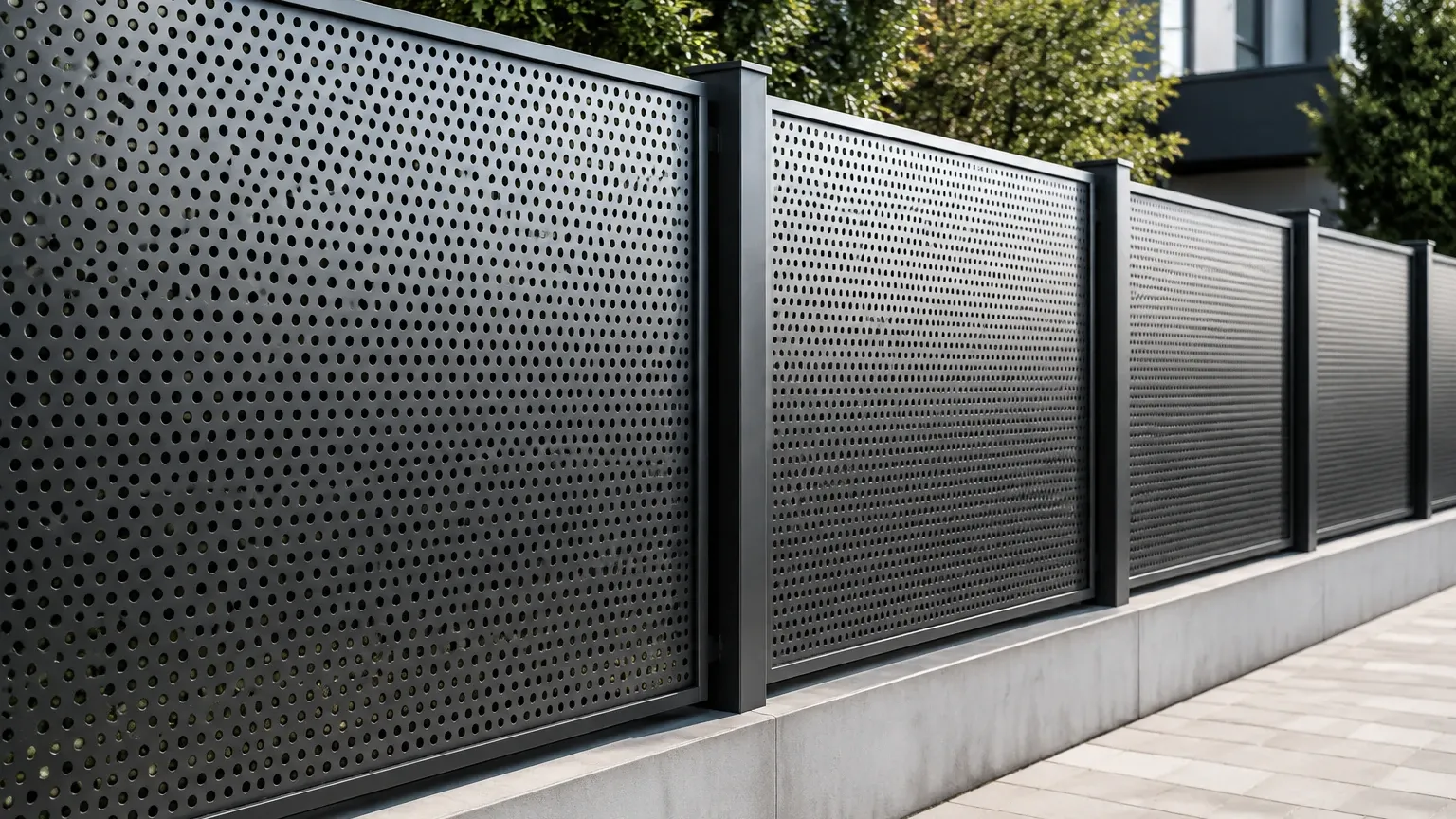
The performance of a perforated metal panel fence is primarily determined by its geometric configuration. Unlike solid sheets, perforated panels are defined by their hole pattern, hole size, and the distance between centers (pitch). These factors dictate the "open area" percentage, which is the most critical variable in fencing design.
Hole Patterns and Structural Integrity
Industrial perforated panels typically utilize three main patterns:
1. Round Holes: The most common and versatile configuration. Round holes offer the highest structural strength and are the most cost-effective to manufacture. They provide a uniform distribution of stress across the panel.
2. Square Holes: Often selected for high visibility and a high open-area percentage. However, square holes can create stress concentrations at the corners, which may lead to fatigue if the panel is subjected to high vibration or wind-induced oscillation.
3. Slotted Holes: Useful for applications requiring directional airflow or specific aesthetic qualities. Slotted patterns are often used in security fencing to prevent climbing while maintaining visibility.
The orientation of these holes—whether staggered or straight—also impacts the panel's shear strength. A 60-degree staggered pattern is the industry standard because it maximizes the strength of the "bridges" (the metal between the holes) in multiple directions.
Material Selection for Industrial Environments
The longevity of a perforated metal panel fence depends heavily on the base material and its resistance to localized environmental stressors. While carbon steel is an option for indoor or temporary use, industrial outdoor applications usually demand more robust alloys.
Stainless Steel (304 and 316)
Stainless steel is the preferred material for high-durability fencing. Grade 304 provides excellent corrosion resistance for most general industrial settings. However, in coastal environments or facilities processing corrosive chemicals, Grade 316 is recommended due to its molybdenum content, which prevents pitting corrosion from chlorides.
Aluminum Alloys
Aluminum is frequently specified where weight is a primary concern, such as on rooftop enclosures or bridge walkways. While aluminum offers inherent corrosion resistance through its oxide layer, it has a lower modulus of elasticity than steel, requiring thicker gauges or more frequent structural supports to prevent bowing under wind loads.
Galvanized Steel
For large-scale perimeters where budget is a constraint, hot-dipped galvanized steel provides a sacrificial zinc coating that protects the underlying metal. However, when a panel is perforated after galvanization, the edges of the holes are left exposed. For maximum durability, panels should be galvanized after the perforation process, or manufactured from pre-galvanized coils with treated edges.
Understanding Open Area and Aerodynamics
One of the primary technical advantages of a perforated metal panel fence is its ability to manage wind loads. In engineering terms, a solid fence acts as a sail, transferring 100% of the wind's force to the posts and footings. A perforated panel allows a calculated percentage of air to pass through, significantly reducing the drag coefficient.
Calculating Open Area
The open area is expressed as a percentage of the total sheet area. For a standard round hole staggered pattern, the formula is:
Open Area % = (D² × 90.69) / P²
*(Where D = Hole Diameter and P = Pitch)*
For most industrial fencing applications, an open area between 30% and 50% is ideal. This range provides a sufficient visual barrier and physical security while allowing enough airflow to prevent structural failure during high-wind events. Engineers must perform wind load calculations based on local building codes to determine the maximum allowable panel size and the required gauge of the Perforated & Expanded Metal.
Comparing Perforated vs. Expanded Metal Structures
While often used interchangeably in casual conversation, perforated and expanded metals are manufactured through different processes and offer distinct mechanical properties for fencing.
Perforated Metal
Perforated metal is produced by punching holes into a solid sheet. This process allows for extreme precision in hole placement and size. It maintains a flat surface profile, making it easier to clean and coat. It also allows for "blank margins"—solid borders around the edges of the panel—which simplify the welding and bolting process during installation.
Expanded Metal
Expanded metal is created by slitting and stretching a sheet simultaneously. This results in a diamond-shaped mesh. Because no material is lost during production, it is often a more economical choice. However, the stretching process creates a three-dimensional texture (unless flattened). While this texture can provide extra rigidity, it also creates more surface area for debris to collect and can be more difficult to paint or powder coat uniformly.
For high-security areas, perforated metal is generally preferred because the hole size can be specified to be "finger-proof" or "anti-climb," whereas expanded metal can sometimes provide toe-holds for climbing if the diamond size is large enough.
Installation and Structural Integration
The method of mounting a perforated metal panel fence is as important as the panel itself. Improper installation can lead to galvanic corrosion, noise from vibration, or structural fatigue.
Framing and Attachment
Panels are typically secured using one of three methods:
1. Angle Iron Frames: The perforated sheet is welded or bolted into a perimeter frame of angle iron or U-edging. This provides the most rigid assembly.
2. Spider Clips and Stand-offs: Frequently used in architectural or ventilated facades, these allow the panel to sit away from the structural posts, creating a modern aesthetic and allowing for thermal expansion.
3. Direct Bolting: If the panel has wide enough margins, it can be bolted directly to the support posts. This requires precise alignment during the manufacturing phase.
Thermal Expansion
Metal panels expand and contract with temperature fluctuations. In long runs of fencing, installers must include slotted mounting holes or expansion joints to prevent the panels from buckling or shearing the mounting bolts. This is particularly important for aluminum panels, which have a higher coefficient of thermal expansion than steel.
Customization for Industrial Applications
Every industrial site has unique requirements that standard off-the-shelf fencing cannot always meet. Customization is where the technical capabilities of a manufacturer like Kaifil become vital.
* Variable Perforation: Panels can be manufactured with varying hole densities—for example, a solid bottom section for impact resistance and a highly perforated top section for visibility.
* Custom Margins: Specifying exact solid borders around the holes ensures that the panel fits perfectly into its frame without cutting through holes, which can leave sharp edges and weaken the structure.
* Precision Forming: Beyond flat panels, perforated metal can be corrugated or folded to increase its moment of inertia, allowing for longer spans between support posts without sagging.
Maintenance and Longevity in Demanding Environments
A well-specified perforated metal panel fence is a low-maintenance asset, but it is not maintenance-free. The total cost of ownership (TCO) is influenced by the cleaning cycle and the environment.
1. Cleaning: In environments with high particulate matter (such as near mines or cement plants), the perforations can accumulate dust. Regular pressure washing is usually sufficient to maintain airflow and prevent the buildup of corrosive agents.
2. Inspection: Periodic checks of the attachment points are necessary to ensure that vibration hasn't loosened bolts or caused stress cracks in the welds.
3. Coating Integrity: For powder-coated or painted panels, any chips or scratches should be touched up immediately to prevent sub-film corrosion, which can spread quickly under the coating.
When purchasing industrial filters or metal components, engineers must look beyond the initial purchase price. The durability of stainless steel and the precision of the perforation process ensure that the fence remains functional for decades, reducing the need for costly replacements and ensuring the security of the facility.
Conclusion
The implementation of a perforated metal panel fence requires a deep understanding of material properties, aerodynamic loads, and manufacturing techniques. By selecting the appropriate Perforated & Expanded Metal specifications, engineering teams can create a perimeter solution that offers superior security, structural integrity, and aesthetic value.
Whether the goal is to provide ventilation for heavy machinery, create a secure boundary for a chemical plant, or design a durable architectural screen, the technical precision offered by Kaifil ensures that every panel meets the rigorous demands of the industrial sector. For more information on custom configurations and material compatibility, reviewing specific product options is the next logical step in the procurement process.
