


Pattern Perforated Metal Sheet
In the landscape of industrial filtration and structural engineering, the pattern perforated metal sheet serves as a foundational component for managing fluid dynamics, mechanical support, and particle separation. Unlike standard industrial materials, these sheets are engineered with precise hole geometries and arrangements to meet the rigorous demands of chemical processing, pharmaceutical manufacturing, and food production. For engineers and procurement specialists, selecting the correct perforation pattern is not merely an aesthetic choice but a critical technical decision that influences flow rates, pressure drops, and the structural integrity of the entire filtration system.
As a specialized manufacturer, Kaifil provides high-performance Perforated & Expanded Metal solutions designed to withstand the harsh environments of industrial applications. Understanding the nuances of material science and geometric configuration is essential for optimizing the performance of these components in diverse operational settings.
Understanding the Role of Pattern Perforated Metal Sheets in Industrial Filtration
A pattern perforated metal sheet is created through a mechanical punching or laser-cutting process that introduces a series of holes into a solid metal substrate. In industrial filtration, these sheets typically serve one of two roles: as the primary filtration medium for coarse particles or as a robust support structure (a "backup tube" or cage) for finer wire mesh layers.
The effectiveness of a perforated sheet is defined by its ability to balance open area with mechanical strength. In high-pressure hydraulic systems or deep-sea water treatment, the sheet must resist deformation under significant differential pressure while allowing the process fluid to pass with minimal resistance. By customizing the pattern, engineers can dictate the specific flow characteristics required for their equipment.
Material Selection and Chemical Compatibility
The environment in which a pattern perforated metal sheet operates dictates the choice of material. Because industrial filtration often involves corrosive chemicals, high temperatures, or strict hygiene requirements, stainless steel is the industry standard.
Stainless Steel Grades
* Grade 304: The most common choice for general industrial use, providing excellent corrosion resistance and formability. It is widely used in food and beverage applications where regular cleaning is required.
* Grade 316/316L: Contains molybdenum, which significantly enhances resistance to chlorides and acids. This grade is essential for marine environments, chemical processing plants, and pharmaceutical cleanrooms where the risk of pitting corrosion is high.
* Specialty Alloys: For extreme conditions involving high-temperature oxidation or highly aggressive chemical solvents, alloys such as Monel, Inconel, or Hastelloy may be utilized to ensure the longevity of the filtration component.
Selecting the wrong material can lead to premature failure through stress corrosion cracking or chemical erosion, resulting in costly downtime and potential contamination of the process stream.
Geometric Configurations: Hole Patterns and Open Area Calculations
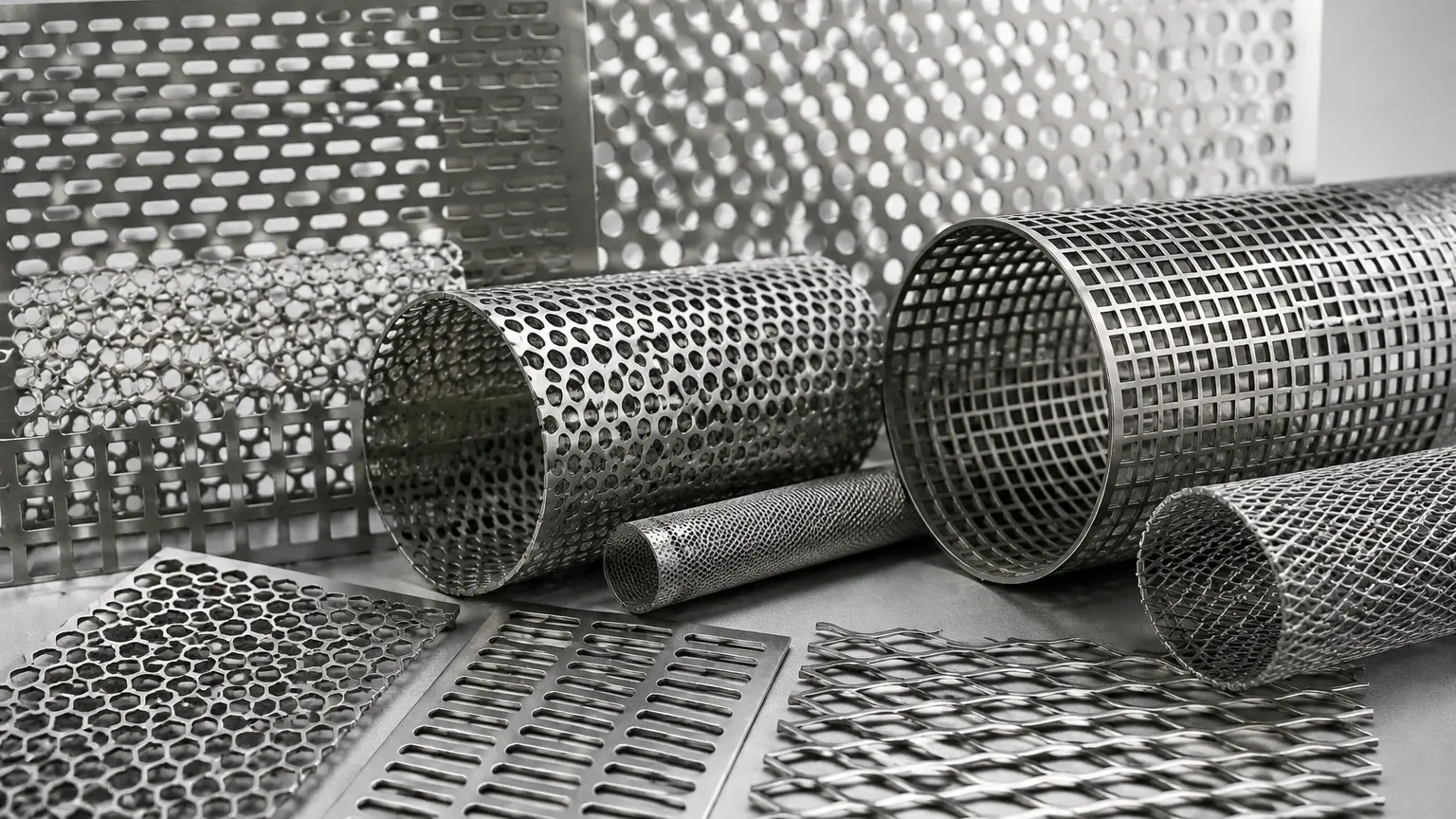
The "pattern" in a pattern perforated metal sheet refers to the arrangement and shape of the apertures. Each configuration offers distinct advantages regarding flow efficiency and structural rigidity.
Common Hole Shapes
1. Round Holes: The most versatile and widely used pattern. Round holes offer the best balance of strength-to-open-area ratio and are the easiest to manufacture with high precision.
2. Square Holes: Provide a higher open area than round holes, which is beneficial when high flow rates are prioritized over maximum structural strength.
3. Slotted/Oblong Holes: Often used for filtering elongated particles or in applications involving viscous fluids where round holes might clog more easily.
4. Hexagonal Patterns: Offer the highest possible open area (up to 80% or more), used primarily when weight reduction and maximum throughput are the primary goals.
Staggered vs. Straight Centers
Hole arrangement is equally important. A staggered pattern (usually at 60 degrees) is the industry standard because it provides uniform strength across the sheet and maximizes the number of holes per square inch. A straight pattern, where holes are aligned in both horizontal and vertical rows, is less common in high-pressure filtration because it creates "weak lines" in the metal that are more susceptible to bending or tearing.
Calculating Open Area
The open area percentage is a vital metric for engineers. It is calculated based on the hole diameter (D) and the pitch (P)—the distance from the center of one hole to the center of the adjacent hole. For a 60-degree staggered round hole pattern, the formula is:
* Open Area % = (D² × 90.69) / P²
This calculation allows engineers to predict the initial pressure drop across the filter and ensure the system's pump capacity is sufficient for the intended flow rate.
Manufacturing Precision and Customization Capabilities
Manufacturing a pattern perforated metal sheet for industrial use requires advanced CNC (Computer Numerical Control) technology to ensure consistency across large production runs. Precision is particularly critical when the sheet is destined to be rolled and welded into filter cartridges or cylinders.
Tolerance and Margins
In B2B procurement, specifying "margins" is essential. Margins are the unperforated areas along the edges of the sheet. For filtration components, "finished margins" (where the pattern stops exactly before the edge) are often required to facilitate clean welding and assembly into end caps. Without precise margins, the structural integrity of the weld may be compromised, leading to bypass leaks in the filtration system.
Secondary Processing
Beyond simple perforation, industrial applications often require secondary services such as:
* Leveling: Ensuring the sheet is perfectly flat after the stress of the punching process.
* Degreasing: Removing manufacturing lubricants, which is mandatory for oxygen-service or food-grade applications.
* Deburring: Removing sharp edges from the holes to prevent turbulence and ensure safe handling during maintenance.
Engineering Performance: Flow Dynamics and Structural Integrity
When integrating a pattern perforated metal sheet into a filtration system, engineers must evaluate how the component interacts with the fluid. The geometry of the holes can influence turbulence; for example, smaller, more frequent holes generally create a more laminar flow compared to fewer, larger holes with the same total open area.
Pressure Drop Considerations
Every filter media introduces a resistance to flow, known as pressure drop. As the open area of the perforated sheet decreases, the velocity of the fluid through each hole increases, which can lead to higher energy consumption for pumps and potential shearing of sensitive fluids (such as certain polymers or biological products). By optimizing the pattern, Kaifil helps engineers achieve the lowest possible pressure drop while maintaining the necessary mechanical support for the filter media.
Fatigue Resistance
In systems with pulsating flows—such as reciprocating pumps or hydraulic actuators—the perforated metal is subject to cyclic loading. A well-engineered pattern distributes these stresses evenly. Engineers must consider the "bridge" (the metal remaining between the holes); if the bridge is too narrow, the sheet may fail due to metal fatigue over time.
Selection Criteria for Industrial Procurement
To ensure the procurement of a pattern perforated metal sheet that meets specific application requirements, purchasing teams should confirm the following technical specifications with the manufacturer:
1. Hole Size and Shape: Defined by the particle size that needs to be retained or the support requirements of the secondary mesh.
2. Pitch and Orientation: Staggered patterns are generally preferred for industrial durability.
3. Sheet Thickness (Gauge): Must be sufficient to handle the maximum expected differential pressure without permanent deformation.
4. Material Grade: Must be compatible with the chemical composition and temperature of the process fluid.
5. Dimensional Tolerances: Critical for components that must fit into existing housings or be welded into larger assemblies.
By focusing on these factual boundaries, engineers can avoid the common risks of bypass, media migration, or structural collapse.
Maintenance and Total Cost of Ownership
While the initial cost of a pattern perforated metal sheet is a factor, the total cost of ownership is determined by its durability and ease of maintenance. Stainless steel perforated sheets are highly valued in industrial sectors because they are cleanable and reusable.
Cleaning Protocols
Unlike disposable synthetic filters, metal perforated sheets can be cleaned using various methods:
* Backwashing: Reversing the flow to dislodge accumulated solids.
* Chemical Cleaning: Using solvents or acids to dissolve scale or organic buildup (provided the metal grade is compatible).
* Ultrasonic Cleaning: Using high-frequency sound waves in a liquid bath to remove fine particles from the hole edges.
Replacement Cycles
The lifespan of a perforated metal component depends on the erosive nature of the fluid and the frequency of cleaning. In non-corrosive environments with proper maintenance, these components can last for years, significantly reducing the long-term operational costs compared to frequent replacements of less durable materials.
Conclusion
The pattern perforated metal sheet is an indispensable tool in the engineer's arsenal, providing the necessary structure and flow control for modern industrial processes. Whether used as a standalone strainer or as a support for high-precision wire mesh, the quality of the perforation determines the efficiency and safety of the filtration system.
By partnering with a manufacturer that understands the technical demands of material selection, geometric precision, and industrial application, organizations can ensure their filtration systems operate at peak performance. For detailed specifications and engineering support regarding customized filtration components, professionals are encouraged to Review product options and application support to find the ideal solution for their specific operational challenges.
