


Perforated Metal Revit
In the modern landscape of industrial engineering and architectural design, Building Information Modeling (BIM) has become the standard for project coordination and technical specification. For engineers and procurement teams sourcing components for chemical processing, water treatment, or food and beverage facilities, understanding how to integrate physical manufacturing requirements into digital models like perforated metal revit families is essential. This integration ensures that the transition from a digital design to a physical Perforated & Expanded Metal component is seamless, cost-effective, and performance-optimized.
Industrial filtration and structural components made from stainless steel require high precision. When these elements are modeled in Revit, the objective is not just visual representation but the communication of critical engineering data, including material grade, hole patterns, open area percentages, and structural integrity. This guide explores the technical considerations of perforated metal within a BIM framework and how these digital specifications translate into high-performance industrial filtration solutions.
The Role of Perforated Metal Revit in Industrial Design
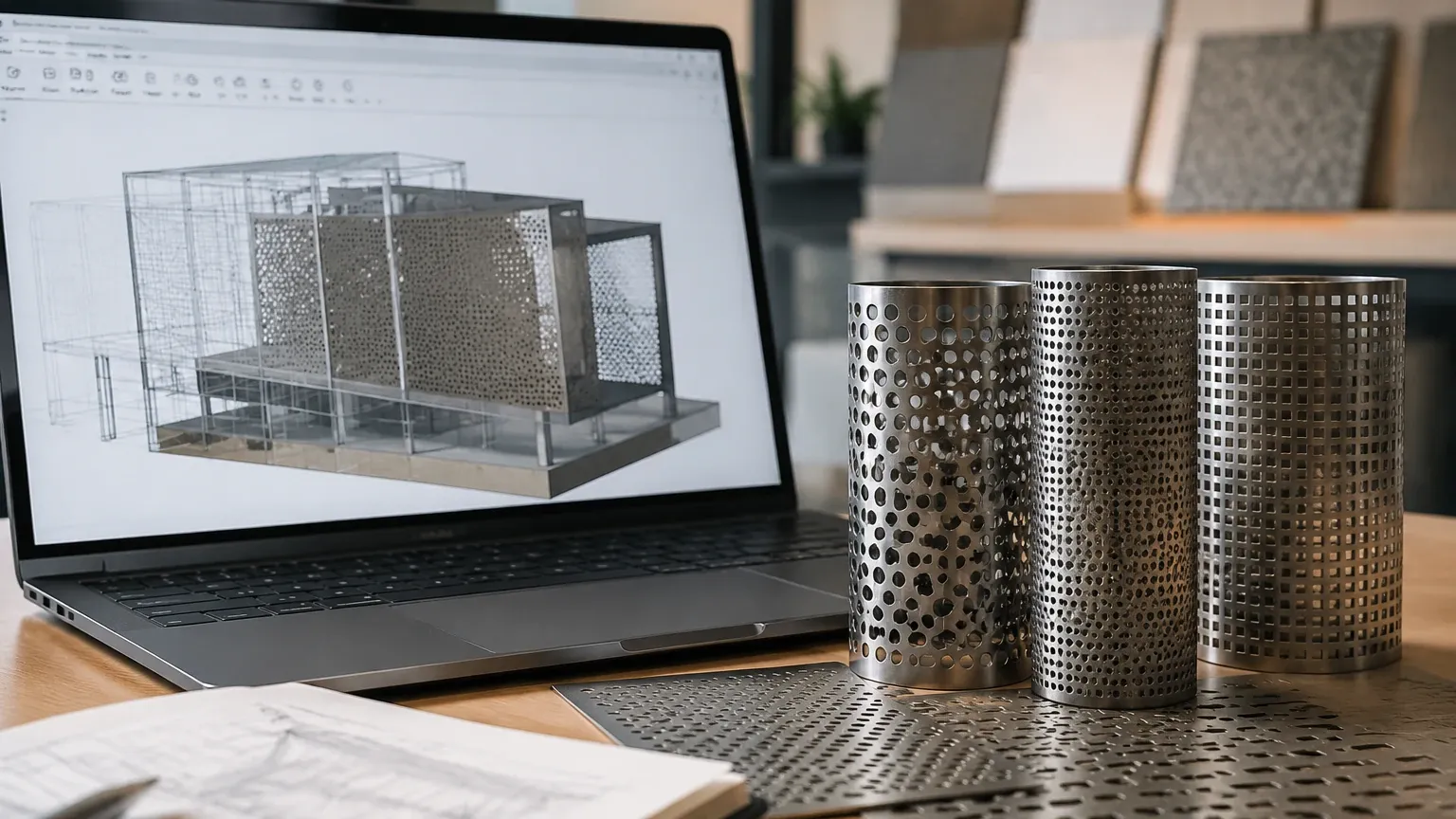
Revit is a powerful tool for managing complex industrial projects. When specifying perforated metal, designers often face a challenge: how to represent thousands of small holes without compromising the performance of the software. A "perforated metal revit" family must strike a balance between visual accuracy and computational efficiency.
Geometry vs. Appearance
In Revit, there are two primary ways to handle perforated metal. The first is through physical geometry, where every hole is modeled as a void. While this provides the most accurate physical model, it can significantly slow down the BIM environment due to the high polygon count. For industrial filtration applications—such as large-scale intake screens or secondary containment filters—modeling every perforation is often unnecessary for the overall project file.
The second, more efficient method involves using a "cutout map" or procedural texture within the Revit material editor. This approach uses an image or a pattern to simulate the perforations during rendering while treating the object as a solid sheet for calculation purposes. However, the metadata attached to that material must still contain the precise engineering specifications required by the manufacturer.
Parameter-Driven Specifications
To make a Revit family useful for procurement, it should include parameters that define the physical properties of the metal. These include:
- Hole Diameter: The exact size of the punched opening.
- Pitch: The distance between the centers of adjacent holes.
- Pattern Type: Whether the holes are staggered (60-degree or 45-degree) or in a straight line.
- Open Area Percentage: A critical calculation for flow rate and pressure drop in filtration systems.
- Material Thickness: The gauge of the stainless steel or metal sheet.
Engineering Considerations for Perforated & Expanded Metal
Choosing between perforated and expanded metal is a fundamental decision in industrial design. While both provide open area for flow, their manufacturing processes and physical characteristics differ significantly.
Perforated Metal Characteristics
Perforated metal is created by punching a series of holes into a solid sheet. This process allows for extreme precision in hole placement and size. For filtration applications, perforated metal often serves as the structural support for finer wire mesh or as a primary coarse filter. The ability to leave "solid margins" or unperforated borders makes it easier to weld these components into filter cartridges or frames.
Expanded Metal Characteristics
Expanded metal is manufactured by simultaneously slitting and stretching the material. This process creates a diamond-shaped opening and results in no material waste, making it a highly cost-effective option. In a Revit environment, expanded metal is often modeled using specific expanded patterns that account for the "strand width" and "opening size." In industrial settings, expanded metal is frequently used for safety grates, walkways, and heavy-duty filter reinforcement where high rigidity-to-weight ratios are required.
Material Selection and Performance Expectations
When specifying perforated metal through a Revit-based workflow, material selection is the most critical factor for longevity and performance, especially in demanding environments like chemical processing or pharmaceutical manufacturing.
Stainless Steel (SS304 and SS316)
Kaifil specializes in stainless steel filtration solutions because of the material’s inherent resistance to corrosion and high temperatures.
- SS304: Suitable for general industrial applications, food processing, and environments where moisture is present but chemical exposure is moderate.
- SS316: Contains molybdenum, which provides superior resistance to chlorides and acids. This is the standard for marine environments, pharmaceutical production, and aggressive chemical filtration.
Filtration Performance and Open Area
The "Open Area" is the percentage of the sheet that is comprised of holes. In Revit, this can be calculated using a formulaic parameter. For engineers, this value determines the flow velocity and the potential for pressure drop across the filter. A higher open area typically reduces pressure drop but may decrease the structural strength of the component. Manufacturers like Kaifil work with engineers to find the "sweet spot" where the metal provides sufficient support without impeding the efficiency of the filtration system.
Bridging the Gap: From Revit Model to Manufacturing
A common risk in industrial procurement is the "design-to-manufacturing gap." A Revit model might show a perfectly uniform pattern across a complex curved surface, but the physical punching process has limitations.
Manufacturing Constraints to Confirm
Before finalizing a specification based on a perforated metal revit model, engineers should confirm the following with the manufacturer:
1. Tooling Availability: Standard hole sizes (e.g., 1mm, 2mm, 5mm) are more cost-effective. Custom hole shapes may require bespoke tooling.
2. Margin Requirements: Punched sheets usually require a solid border for handling and welding. If the Revit model shows perforations extending to the very edge, it may lead to structural weakness during the welding of a filter cartridge.
3. Flatness and Stress: The punching process can introduce internal stresses into the metal, causing it to curl. For high-precision filter components, secondary leveling processes may be required to ensure the part fits perfectly within a housing.
4. Minimum Hole Size vs. Thickness: A general rule in perforation is that the hole diameter should not be smaller than the material thickness. For example, punching a 1mm hole in 2mm thick stainless steel is technically challenging and can lead to frequent tool breakage.
Customization and OEM Capabilities
In many industrial applications, off-the-shelf perforated sheets are insufficient. Customization is often required to meet specific filtration accuracies or to fit unique equipment geometries. Kaifil provides extensive OEM capabilities, allowing engineers to submit their technical drawings and BIM-derived specifications for custom fabrication.
Customization options include:
- Variable Hole Patterns: Creating zones with different perforation densities on a single sheet to control flow distribution.
- Custom Shapes: Laser cutting or waterjet cutting perforated sheets into specific shapes before they are rolled or welded into filter cartridges.
- Surface Treatments: Options such as electropolishing for pharmaceutical applications to ensure a burr-free, ultra-smooth surface that prevents bacterial growth.
Total Cost of Ownership and Maintenance
While the initial cost of a stainless steel perforated filter component may be higher than plastic or lower-grade metal alternatives, the total cost of ownership (TCO) is significantly lower. Stainless steel components are durable, cleanable, and recyclable.
Cleaning and Replacement Cycles
In industrial filtration, the ability to clean and reuse a filter is a major operational advantage. Perforated metal supports can withstand high-pressure backwashing and chemical cleaning cycles that would destroy lesser materials. When specifying these parts in Revit, engineers should consider the access required for maintenance and the expected lifespan of the component in the specific operating environment.
Quality Assurance
Reliable manufacturers follow strict quality control protocols to ensure that the final product matches the digital specification. This includes verifying hole dimensions, material grade (via MTR – Material Test Reports), and ensuring the absence of burrs or sharp edges that could contaminate a production line.
Conclusion: Best Practices for Specifying Perforated Metal
Integrating perforated metal revit data into your project is more than a drafting exercise; it is a critical step in the engineering of efficient industrial systems. By focusing on parameter-driven models that account for material properties, open area calculations, and manufacturing constraints, procurement teams can ensure they receive components that perform exactly as intended.
When moving from the design phase to the purchasing phase, always verify that your digital model aligns with the physical realities of stainless steel fabrication. For those seeking reliable, high-precision Perforated & Expanded Metal solutions, partnering with a manufacturer that understands the technical nuances of industrial filtration is essential. By confirming material compatibility, tooling limits, and finishing requirements early in the design process, you can optimize both the performance and the cost-effectiveness of your filtration infrastructure.
