


Perforated Metal Rainscreen
In modern industrial and commercial architecture, the building envelope serves as more than just a physical barrier; it is a complex system designed to manage thermal performance, moisture ingress, and structural integrity. A perforated metal rainscreen is a critical component of this system, functioning as a back-ventilated cladding solution that balances aesthetic requirements with rigorous engineering standards. For technical professionals and purchasing teams, selecting the right material and perforation pattern is essential to ensure long-term durability and system efficiency.
Kaifil, as a specialist in precision metal components, provides the technical expertise required to manufacture Perforated & Expanded Metal solutions that meet the demanding specifications of rainscreen applications. This guide explores the engineering principles, material considerations, and evaluation criteria necessary for implementing a successful perforated metal rainscreen system.
Engineering Principles of Perforated Metal Rainscreens
The primary function of a rainscreen is to protect the building’s air and water barrier from the elements. Unlike traditional sealed cladding, a perforated metal rainscreen operates on the principle of pressure equalization and back-ventilation.
Moisture Management and Ventilation
The "screen" itself is the first line of defense, shedding the majority of rainwater. However, because the system is perforated, some moisture will inevitably pass through. The air cavity behind the perforated panels allows for continuous airflow, which facilitates the evaporation of any moisture that reaches the drainage plane. This ventilation prevents the buildup of mold, mildew, and rot within the wall assembly, significantly extending the lifecycle of the building structure.
Pressure Equalization
Wind hitting a solid wall creates a pressure differential that can force water into small cracks or joints. A perforated metal rainscreen helps mitigate this by allowing air to move through the perforations, equalizing the pressure between the exterior environment and the internal air cavity. This reduction in pressure differential minimizes the kinetic energy of wind-driven rain, causing water to drop out of the air stream before it can penetrate the secondary weather barrier.
Material Selection for Industrial Environments
Selecting the appropriate alloy is perhaps the most critical decision in the procurement of a perforated metal rainscreen. The choice of material dictates the system's resistance to corrosion, structural capacity, and maintenance requirements.
Stainless Steel (Grades 304 and 316)
For industrial facilities, coastal regions, or environments with high chemical exposure, stainless steel is the preferred choice.
- Grade 304: Offers excellent corrosion resistance and structural strength for most standard industrial applications.
- Grade 316: Contains molybdenum, providing superior resistance to chlorides and pitting, making it essential for marine environments or heavy industrial zones where chemical runoff is a concern.
Aluminum
Aluminum is frequently used due to its high strength-to-weight ratio and natural resistance to atmospheric corrosion. While it is lighter than stainless steel, it may require thicker gauges to achieve the same structural rigidity, especially in high-wind zones.
Weathering Steel and Specialty Alloys
In specific architectural contexts, weathering steel (Corten) or copper alloys may be specified. However, these materials require careful consideration regarding runoff staining and galvanic corrosion when in contact with dissimilar metals in the support substructure.
Technical Specifications: Perforation Patterns and Open Area
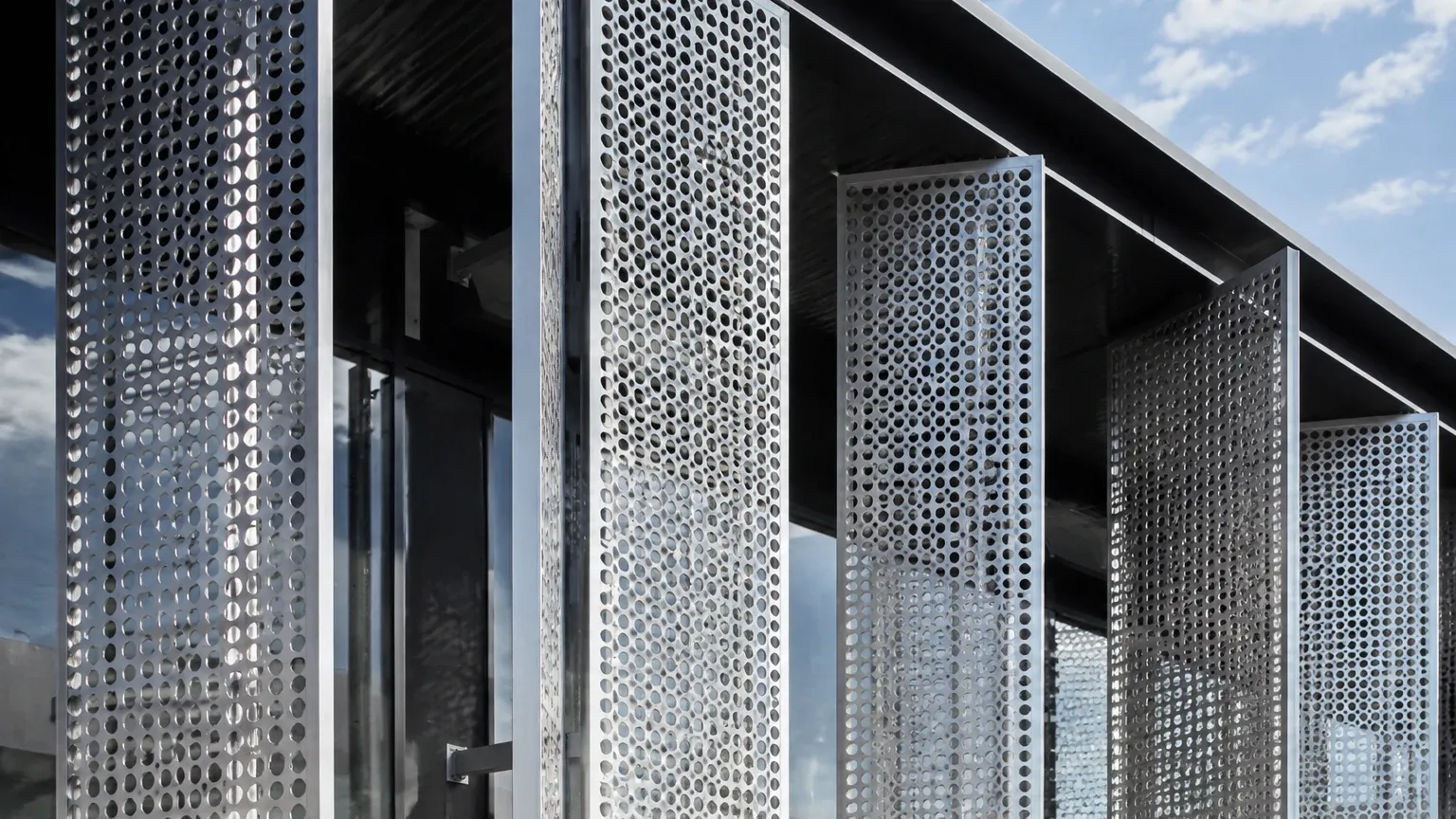
The performance of a perforated metal rainscreen is largely defined by its geometric configuration. Engineers must calculate the "open area" percentage to balance three competing factors: airflow, visual transparency, and structural load.
Calculating Open Area
The open area is the ratio of the total area of the holes to the total area of the panel. For rainscreen applications, an open area of 20% to 40% is common.
- High Open Area (>50%): Provides maximum ventilation and transparency but may require heavier gauges or more frequent support points to prevent panel deflection.
- Low Open Area (<15%): Offers better protection against wind-driven rain and increased structural stiffness but may limit the evaporative capacity of the air cavity.
Hole Geometry and Arrangement
- Round Holes: The most common and cost-effective pattern. Staggered round holes provide high strength in multiple directions.
- Square Holes: Offer a high open area and a modern aesthetic but can be more prone to stress concentrations at the corners.
- Slotted Holes: Useful for applications requiring directional airflow or specific visual effects.
Kaifil’s manufacturing capabilities allow for precise control over hole diameter, pitch (the distance between hole centers), and margins (the solid borders around the perforated area), ensuring that each panel meets the specific load-bearing requirements of the project.
Structural Considerations and Wind Loads
Engineers must treat perforated panels as structural elements subject to wind loading. Because the panels are not solid, wind does not act on them in the same way it does on a flat plate.
Drag Coefficients and Wind Pressure
The drag coefficient of a perforated metal rainscreen varies based on the open area and the shape of the perforations. As wind passes through the holes, it creates turbulence. Engineering teams must calculate the net pressure coefficients to determine the appropriate panel thickness and the spacing of the sub-framing system. Failure to account for these loads can lead to "oil-canning" (visible waviness in the metal) or, in extreme cases, mechanical failure of the fasteners.
Thermal Expansion and Contraction
Metal panels expand and contract with temperature fluctuations. In a rainscreen system, the fastening method must allow for this movement. Slotted holes in the support clips or floating attachment points are typically used to prevent the panels from buckling or shearing the fasteners during thermal cycles.
Mitigating Common Risks
While perforated metal rainscreens offer numerous benefits, there are technical risks that must be addressed during the design and specification phase.
Aeolian Tones (Wind Noise)
One of the most overlooked issues in perforated cladding is the potential for wind-induced noise. Under certain wind speeds and angles, the perforations can act like a flute, creating a whistling or humming sound. This is known as the Aeolian effect. To mitigate this risk, engineers should avoid uniform hole patterns across extremely large surface areas or vary the hole sizes to disrupt the harmonic frequency.
Galvanic Corrosion
When a perforated metal rainscreen (e.g., stainless steel) is attached to a different metal (e.g., aluminum sub-framing), galvanic corrosion can occur in the presence of moisture. This is prevented by using non-conductive isolators, such as EPDM gaskets or nylon washers, to separate the dissimilar metals.
Debris Accumulation
In industrial environments, particulate matter or biological growth can sometimes clog small perforations. Selecting a hole size that is large enough to be "self-cleaning" via rainfall, or specifying a surface finish that resists adhesion, can reduce long-term maintenance costs.
Customization and OEM Solutions
Every industrial project has unique requirements regarding filtration, airflow, and structural spans. Kaifil provides customized Perforated & Expanded Metal components tailored to these specific needs.
When requesting a quote or technical consultation for a rainscreen project, purchasing teams should confirm the following data points:
1. Material Grade: (e.g., 304 vs 316 Stainless Steel).
2. Panel Thickness: Typically ranging from 1.5mm to 4.0mm depending on span and wind load.
3. Perforation Pattern: Hole shape, size, and pitch.
4. Open Area Percentage: Calculated based on ventilation requirements.
5. Margin Requirements: Specific solid areas for fastening or aesthetic borders.
6. Surface Finish: Mill finish, powder coating, or anodizing (for aluminum).
Conclusion
A perforated metal rainscreen is a sophisticated engineering solution that enhances building longevity through superior moisture management and pressure equalization. By understanding the technical nuances of material selection, open area calculations, and structural loading, engineers can specify systems that perform reliably in even the harshest industrial environments.
Kaifil’s commitment to quality and precision manufacturing ensures that our perforated metal products provide the durability and performance expected by global industrial leaders. Whether you are designing a new facility or retrofitting an existing envelope, selecting a partner with deep expertise in metal fabrication is the first step toward a successful installation.
