


Stainless Steel Perforated Metal Sheet
In industrial filtration and structural engineering, the stainless steel perforated metal sheet serves as a foundational component known for its mechanical strength, chemical resistance, and precise geometric accuracy. Unlike woven wire mesh, which relies on the interlacing of wires, perforated metal is manufactured by punching a series of holes into a solid metal sheet. This process results in a rigid, one-piece structure that maintains its dimensional stability under high-pressure conditions and mechanical stress.
For engineers and procurement professionals, selecting the correct specification of a stainless steel perforated metal sheet requires a deep understanding of material grades, hole patterns, and the relationship between open area and structural integrity. This guide examines the technical variables that influence performance in demanding industrial environments.
Material Selection for Industrial Environments
The performance of a perforated sheet is primarily dictated by the alloy from which it is fabricated. In industrial filtration, stainless steel is the standard due to its ability to withstand corrosive fluids and extreme temperatures.
Grade 304 Stainless Steel
Grade 304 is the most common choice for general industrial applications. It offers excellent formability and weldability, making it suitable for standard filtration housings, architectural panels, and protective guards. It provides adequate resistance to atmospheric corrosion and many organic and inorganic chemicals. However, in environments with high chloride concentrations, it may be susceptible to pitting.
Grade 316 and 316L
For chemical processing, pharmaceutical manufacturing, and marine applications, Grade 316 is the preferred material. The addition of molybdenum enhances its resistance to chloride-induced corrosion and acetic acid. Grade 316L, the low-carbon version, is used when extensive welding is required, as it prevents carbide precipitation that can lead to intergranular corrosion in the heat-affected zones.
High-Temperature and Specialty Alloys
In applications involving extreme heat, such as exhaust systems or high-temperature catalytic reactors, grades like 310 or 321 may be specified. These alloys maintain their mechanical properties and oxidation resistance at temperatures where standard 304 or 316 would fail.
Technical Specifications and Geometry
The functionality of a stainless steel perforated metal sheet is defined by its hole pattern, hole size, and pitch. These factors determine the filtration efficiency, flow rate, and pressure drop across the media.
Hole Patterns
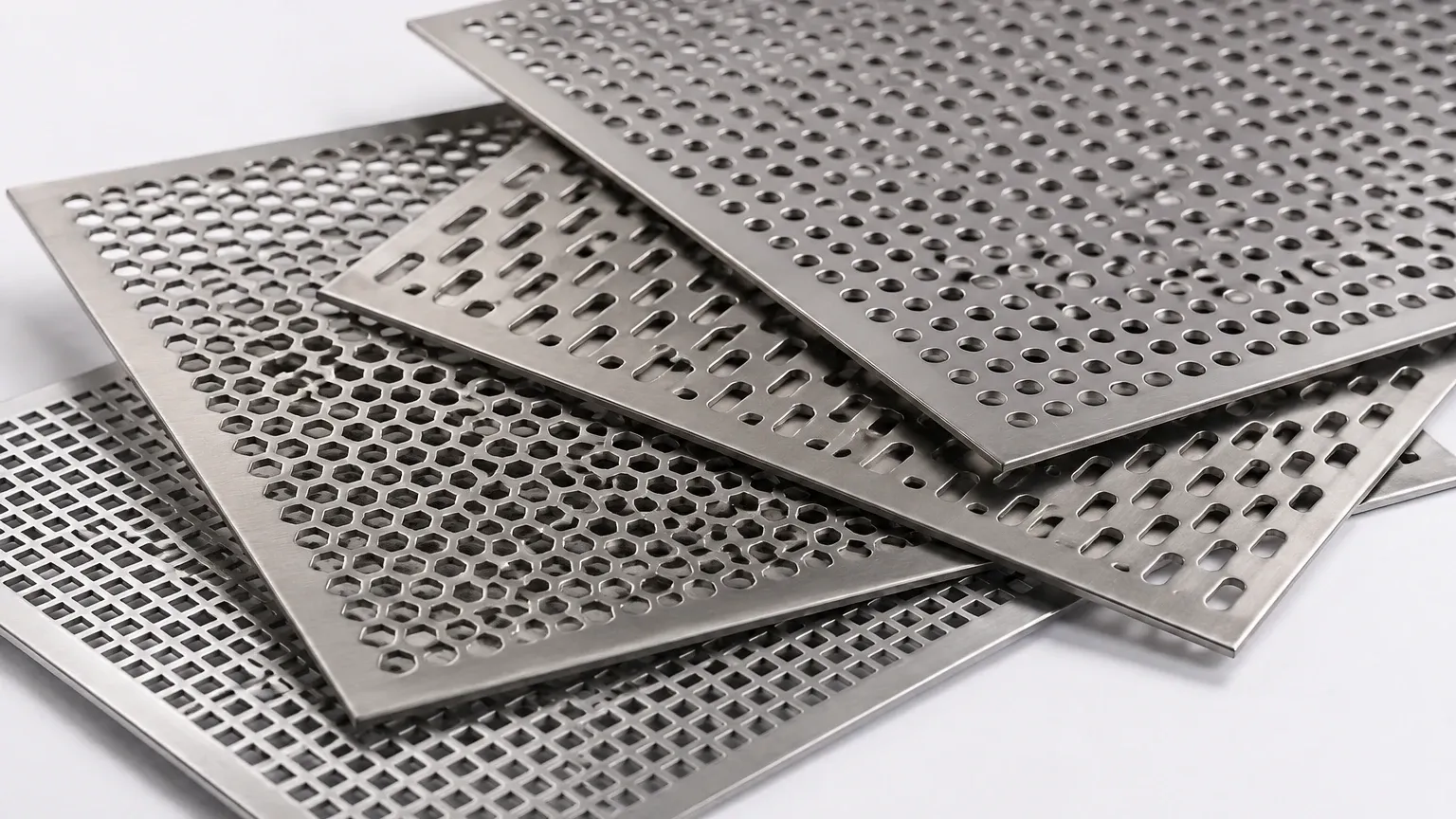
* Round Holes: The most common and efficient pattern. Round holes offer the greatest structural strength and a wide range of open area percentages. They are typically arranged in a 60-degree staggered pattern, which provides the highest degree of uniformity.
* Square Holes: Often used when a higher open area is required. While they provide excellent visibility and flow, square holes have higher stress concentrations at the corners, which can affect the sheet’s longevity in high-vibration environments.
* Slotted Holes: Ideal for sorting and grading applications where elongated materials need to be separated. Slotted patterns can be oriented side-staggered or end-staggered depending on the flow requirements.
Calculating Open Area
The "Open Area" is the percentage of the sheet that consists of holes. This is a critical metric for engineers calculating the flow capacity of a filter. For a standard 60-degree staggered round hole pattern, the formula is:
Open Area % = (D² × 90.69) / P²
Where:
* D = Hole Diameter
* P = Pitch (the distance from the center of one hole to the center of the adjacent hole)
An open area that is too high may compromise the structural integrity of the sheet, while an open area that is too low will result in excessive pressure drop and reduced throughput.
Structural Integrity and Mechanical Properties
When designing a filtration system, the mechanical limits of the Perforated & Expanded Metal must be considered. A common engineering rule of thumb is the "1:1 Ratio," which suggests that the hole diameter should not be smaller than the sheet thickness. Punching holes smaller than the material thickness increases internal stress and risks tool breakage during manufacturing.
Sheet Thickness and Margins
The thickness of the sheet (gauge) directly impacts the burst strength of the filter. In high-pressure hydraulic or steam applications, thicker sheets are required to prevent deformation. Additionally, "margins"—the unperforated areas along the edges of the sheet—are essential for providing stability and facilitating welding or mounting into a frame.
Flatness and Tolerances
Industrial-grade perforated sheets must adhere to strict flatness tolerances. During the punching process, the metal can undergo significant stress, leading to curling or warping. High-quality manufacturers utilize leveling rollers to ensure the finished product meets the precise flatness required for automated assembly or integration into complex filter cartridges.
Applications in Filtration and Processing
Stainless steel perforated metal sheets are versatile components used across various stages of industrial processing. Their primary roles include:
Primary Filtration and Strainers
In water treatment and chemical processing, perforated sheets act as primary strainers to remove large particulates before the fluid reaches finer filtration stages. Their rigid structure allows them to be cleaned via backwashing or mechanical scraping without damaging the media.
Support Structures for Fine Mesh
Thin, flexible wire mesh often lacks the structural strength to withstand high differential pressures. In these cases, a perforated metal sheet is used as a "support core" or "outer cage." The perforated sheet provides the mechanical backbone, while the fine mesh handles the precision filtration.
Centrifuge Baskets and Drying Trays
In the food and beverage industry, perforated stainless steel is used in centrifuge baskets for dewatering and in drying trays for heat processing. The material's ability to withstand frequent sterilization (CIP – Clean-In-Place) and its resistance to food acids make it an ideal choice for hygienic applications.
Customization and Manufacturing Precision
Off-the-shelf perforated sheets rarely meet the specific needs of specialized industrial equipment. Customization is often necessary to optimize performance and reduce waste. Kaifil specializes in providing tailored solutions that address specific engineering challenges.
Precision Perforating
Advanced CNC punching equipment allows for the creation of complex hole patterns and variable margins. This precision ensures that the perforated component fits perfectly into the intended housing, reducing the need for secondary trimming or adjustment on-site.
Secondary Processing
Beyond simple punching, industrial applications often require secondary operations such as:
* Rolling and Welding: Forming the perforated sheet into cylinders or cones for filter cartridges.
* Electropolishing: Removing surface imperfections and enhancing corrosion resistance, which is critical for pharmaceutical and semiconductor applications.
* Degreasing: Ensuring the metal is free from manufacturing oils, essential for oxygen service or food-grade environments.
Evaluating Total Cost of Ownership
When purchasing a stainless steel perforated metal sheet, the initial purchase price is only one component of the total cost. Engineers must also consider the life cycle and maintenance requirements of the material.
Durability and Replacement Cycles
While carbon steel or plastic alternatives may have a lower upfront cost, they often fail prematurely due to corrosion or mechanical fatigue. Stainless steel’s longevity ensures fewer system shutdowns and lower labor costs associated with frequent replacements. In many industrial settings, the cost of a single hour of downtime far exceeds the price difference between standard and high-performance perforated metal.
Cleaning and Reusability
Unlike disposable synthetic filters, stainless steel perforated components are highly cleanable. Whether through ultrasonic cleaning, chemical baths, or high-pressure steam, these sheets can be restored to their original performance levels multiple times, significantly reducing the environmental impact and long-term procurement costs.
Conclusion: Selecting the Right Specification
Choosing the optimal stainless steel perforated metal sheet involves balancing filtration requirements with mechanical constraints. By defining the chemical environment (304 vs. 316), calculating the necessary open area for flow efficiency, and ensuring the hole-to-thickness ratio is technically sound, engineers can specify a product that enhances system reliability.
For organizations requiring precision-engineered filtration components, partnering with a manufacturer that understands the nuances of material science and industrial application is vital. Kaifil provides the technical expertise and manufacturing capabilities necessary to deliver high-performance perforated solutions tailored to the most demanding industrial environments.
