


Triangle Perforated Metal
In the landscape of industrial filtration and structural design, the selection of hole geometry is a critical engineering decision. While round and square perforations are ubiquitous, triangle perforated metal offers a unique combination of structural rigidity, aesthetic appeal, and specific flow characteristics that are essential for demanding B2B applications. As a specialized component within the broader category of Perforated & Expanded Metal, triangle patterns are increasingly utilized in sectors ranging from chemical processing to high-end architectural acoustics.
For engineers and procurement specialists, understanding the technical nuances of triangle perforated metal is vital for optimizing system performance and ensuring long-term durability. This guide examines the technical specifications, material considerations, and industrial applications that define this specialized filtration and support medium.
Understanding Triangle Perforated Metal Geometry
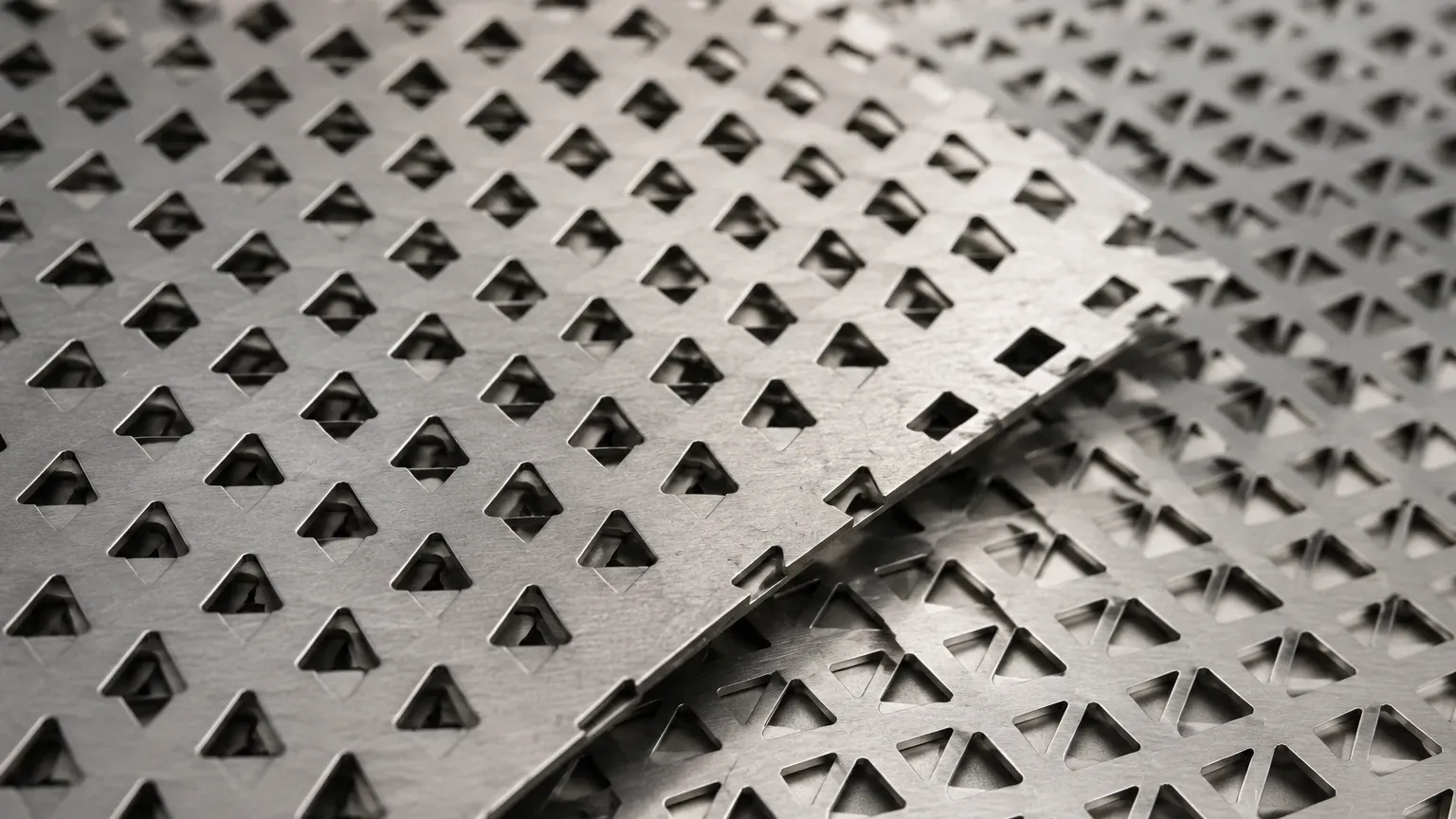
Triangle perforated metal is defined by a series of triangular holes punched into a metal sheet, typically using high-precision CNC machinery or specialized die sets. Unlike standard round holes, the geometry of a triangle introduces directional mechanical properties and specific open-area ratios that can be tailored to the application.
Hole Configurations
The most common configurations include equilateral, isosceles, and right-angle triangles.
* Equilateral Triangles: These provide the most uniform stress distribution across the sheet. They are often arranged in staggered patterns to maximize the number of holes per square inch while maintaining the structural integrity of the bridges (the metal remaining between the holes).
* Isosceles and Custom Triangles: These are frequently used when a specific directional flow or a particular visual effect is required. In filtration, the orientation of the triangle vertex can influence how particles interact with the surface.
Pitch and Arrangement
The "pitch" refers to the distance between the centers of two adjacent holes. In triangle patterns, the pitch determines the "bridge" width. If the bridges are too narrow, the sheet may warp during the punching process or fail under high-pressure loads. Conversely, bridges that are too wide significantly reduce the open area, leading to higher pressure drops in filtration systems.
Material Selection for Industrial Environments
At Kaifil, the emphasis is on durability and precision, which begins with selecting the appropriate alloy. The choice of material for triangle perforated metal is dictated by the chemical, thermal, and mechanical stresses of the operating environment.
Stainless Steel (304 and 316L)
Stainless steel is the industry standard for most industrial filtration applications.
* Grade 304: Offers excellent formability and general corrosion resistance, making it suitable for food processing and standard industrial machinery.
* Grade 316L: Contains molybdenum, providing superior resistance to chlorides and pitting. This is the preferred choice for pharmaceutical, marine, and chemical processing environments where aggressive cleaning agents or corrosive fluids are present.
Carbon Steel and Galvanized Steel
For structural applications where corrosion is less of a concern or where the component will be coated/painted, carbon steel provides a cost-effective solution with high tensile strength. Galvanized steel offers a middle ground, providing a protective zinc coating that prevents oxidation in outdoor or humid environments.
Aluminum and Specialized Alloys
Aluminum is selected for applications requiring a high strength-to-weight ratio, such as in aerospace or mobile filtration units. For extreme environments involving high temperatures or highly acidic media, specialized alloys like Monel, Inconel, or Hastelloy may be required, though these involve significantly higher material costs and specific manufacturing considerations.
Calculating Open Area and Flow Performance
One of the most critical factors for engineers is the percentage of open area. This value directly impacts the flow rate, pressure drop, and filtration efficiency of the perforated sheet.
The Open Area Formula
For a staggered triangle pattern, the calculation of open area is more complex than for simple square patterns. It involves the area of the triangular hole divided by the area of the repeating unit cell.
Mathematically, the open area (OA%) for equilateral triangles in a staggered pattern is generally calculated as:
OA% = (Area of Hole / Area of Pattern Unit) x 100
Because triangles can be packed tightly, they can achieve high open-area percentages (often between 30% and 60%) while retaining more structural stiffness than round holes with the same open area. This makes triangle perforated metal an excellent candidate for high-flow applications where the media must also withstand mechanical vibration or high differential pressures.
Impact on Pressure Drop
In hydraulic and pneumatic systems, the sharp corners of the triangle can induce minor turbulence compared to the smooth radius of a round hole. While this is often negligible in low-viscosity fluids, it must be accounted for in high-precision fluid dynamics modeling. Engineers must balance the need for a high open area with the mechanical requirement to prevent the "blinding" or clogging of the holes.
Engineering Advantages: Structural Rigidity and Efficiency
Triangle perforated metal is often selected over other shapes due to its inherent mechanical advantages. The geometry of a triangle is naturally stable, a principle used extensively in truss bridges and architectural frames.
Resistance to Deformation
Under load, triangle patterns distribute stress differently than round or square holes. The angular nature of the bridges creates a "web" that resists stretching and shearing. This is particularly beneficial when the perforated metal is used as a support structure for finer wire mesh filters. In these "pleated" or multi-layer filter cartridges, the triangle perforated core provides the necessary collapse strength to withstand high-pressure spikes without deforming.
Sorting and Sieving Precision
In the processing of solids, such as in the agricultural or mining industries, the shape of the perforation acts as a functional gauge. Triangle holes are effective for sorting elongated or non-spherical particles that might pass through a round hole but get caught or oriented differently by the vertices of a triangle. This improves the accuracy of the separation process.
Industrial Applications of Triangle Perforated Metal
The versatility of this product allows it to function in both heavy-duty industrial roles and high-spec technical environments.
1. Industrial Filtration and Support
As mentioned, triangle perforated metal serves as a robust inner or outer support core for stainless steel filter cartridges. It protects delicate filter media from hydraulic shock and ensures the cartridge maintains its cylindrical shape under vacuum or high-pressure conditions.
2. Acoustic Damping and Sound Insulation
In power generation and HVAC systems, perforated metal is used in silencers and acoustic panels. The triangle pattern can be engineered to disrupt sound waves effectively, especially when backed by sound-absorbing materials. The specific open area allows sound to enter the insulation while the metal sheet provides a durable, fire-resistant facing.
3. Heat Dissipation and Ventilation
For electronic enclosures and industrial ovens, triangle perforated sheets allow for high-volume airflow to dissipate heat. The structural integrity of the triangle pattern allows for larger sheets with higher open areas without the sagging that might occur with other hole shapes.
4. Architectural and Aesthetic Functionalism
In B2B architectural projects—such as parking garage screens, sunshades, or interior partitions—triangle perforated metal offers a modern, geometric aesthetic. Beyond looks, these screens provide functional benefits like solar shading and natural ventilation while maintaining security.
Manufacturing Tolerances and Customization Options
When sourcing triangle perforated metal, precision is paramount. Minor deviations in hole size or pitch can lead to significant issues in assembly or filtration performance.
Punching and Laser Cutting
Most triangle patterns are produced via CNC punching, which is cost-effective for high-volume production. However, for very thick materials or extremely intricate designs, fiber laser cutting may be used. Laser cutting eliminates the mechanical stress of the punch but is generally slower and more expensive.
Key Tolerances to Confirm
* Flatness: The punching process introduces internal stresses that can cause the sheet to curl. Specifying a flatness tolerance (e.g., within 5mm over a 2-meter sheet) is essential for subsequent welding or framing.
* Margins: Engineers must define the "unperforated" borders. Standard sheets may have random margins, but custom components usually require specific solid borders for welding to end caps or frames.
* Hole Burrs: In filtration, burrs can trap contaminants or damage secondary filter layers. Specifying "deburred" or "polished" finishes ensures the smooth operation of the component.
Selection Criteria for Purchasing Teams
To ensure the successful procurement of triangle perforated metal, purchasing teams and engineers should collaborate to confirm the following technical details before placing an order:
1. Material Grade: Is 304 sufficient, or does the environment demand 316L or a high-nickel alloy?
2. Dimensions: Specify sheet thickness (gauge), width, and length. For cylindrical components, specify the diameter and height.
3. Hole Specifications: Define the triangle type (equilateral/isosceles), hole size (side length), and pitch.
4. Open Area Requirement: Ensure the calculated open area meets the flow requirements of the system.
5. End-Use Environment: Communicate if the part will be exposed to high temperatures, vibrating loads, or corrosive chemicals.
6. Secondary Processing: Will the part require rolling, welding, pickling, or passivating? Kaifil provides integrated manufacturing to handle these steps, ensuring the final component is ready for installation.
Triangle perforated metal represents a sophisticated intersection of geometry and material science. By leveraging its unique structural and flow properties, industrial operators can achieve higher efficiency and longer service lives for their filtration and structural systems. Whether used as a decorative facade or a critical high-pressure filter core, the precision of the perforation remains the foundation of its performance.
For more information on custom configurations and technical support, Perforated & Expanded Metal solutions offer the versatility required for today’s demanding industrial standards.
