


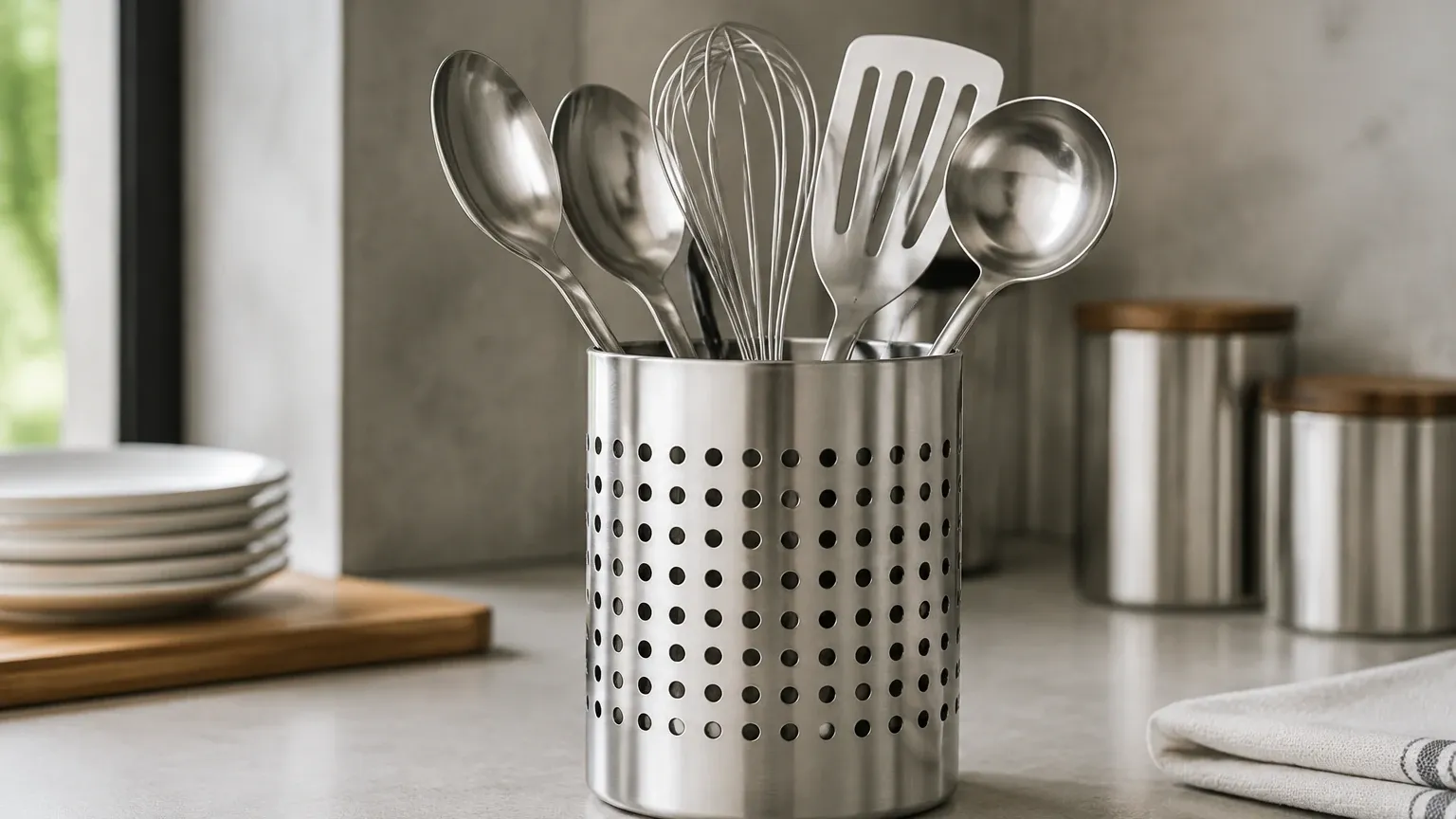
Perforated Metal Utensil Holder
In industrial food processing, commercial catering, and pharmaceutical environments, the management of tools and instruments requires more than simple storage. It demands a solution that facilitates rapid drying, ensures high levels of hygiene, and withstands rigorous cleaning cycles. A perforated metal utensil holder serves as a critical component in these settings, leveraging the mechanical advantages of precision-engineered metal sheets to provide structural integrity and functional efficiency.
For engineers and procurement specialists, selecting the right holder involves understanding the interplay between material science, perforation patterns, and manufacturing finishes. As a fundamental application of Perforated & Expanded Metal, these components are designed to meet specific industrial standards for drainage, airflow, and durability.
The Engineering Role of Perforated Metal in Food Service
The primary function of a perforated metal utensil holder in an industrial context is to provide a controlled environment for sanitized tools. Unlike solid-walled containers, perforated structures allow for multi-directional airflow. This is essential for the evaporation of residual moisture after high-temperature washing or chemical sanitization.
From a technical perspective, the perforation serves several roles:
1. Fluid Dynamics: It allows wash water and sanitizing agents to pass through the container completely, preventing the pooling of liquids that could harbor microbial growth.
2. Thermal Conductivity: In drying tunnels or heat-based sterilization units, the open area of the metal allows for uniform heat distribution around the utensils.
3. Weight Reduction: By removing a calculated percentage of the metal sheet, manufacturers can reduce the overall weight of large-scale utensil racks without compromising the structural rigidity required for heavy industrial use.
When specifying these components, engineers must balance the "open area" percentage with the mechanical load requirements. A higher open area improves drainage but may reduce the basket's resistance to impact or heavy loads of stainless steel utensils.
Material Properties and Food Safety Standards
In the production of a perforated metal utensil holder, material selection is the most significant factor affecting longevity and compliance. Given the frequent exposure to water, detergents, and varying temperatures, stainless steel is the industry standard.
Grade 304 Stainless Steel
Most commercial and industrial utensil holders utilize Type 304 stainless steel. It offers excellent corrosion resistance and is easy to fabricate. It is suitable for standard food processing environments where it will encounter organic acids and general cleaning chemicals.
Grade 316 Stainless Steel
For environments involving high salinity (such as seafood processing) or aggressive chemical sanitizers (like those used in pharmaceutical cleanrooms), Grade 316 is preferred. The addition of molybdenum enhances its resistance to pitting and crevice corrosion, particularly in chloride-rich environments.
Surface Passivation
Regardless of the grade, the metal must undergo passivation. This process removes free iron from the surface of the perforated sheet, enhancing the protective chromium oxide layer. For a B2B buyer, confirming that the manufacturer performs proper passivation is essential to ensure the holder does not develop rust spots at the edges of the perforations over time.
Optimizing Airflow and Drainage: Hole Patterns and Open Area
The performance of a perforated metal utensil holder is largely dictated by the geometry of its openings. The choice of hole pattern affects both the drying efficiency and the types of utensils the holder can safely contain.
Round Hole Patterns
Round holes are the most common specification for industrial holders. They provide the best balance of structural strength and ease of cleaning. Staggered round hole patterns (usually at 60 degrees) maximize the open area while maintaining the uniform tension of the metal sheet. This prevents the holder from warping under the thermal stress of industrial dishwashers.
Square and Slotted Holes
Square holes offer a higher open area percentage, which can accelerate drying times. However, they can also lead to "stress risers" at the corners, making the holder more susceptible to cracking if subjected to heavy vibrations or mechanical shocks. Slotted holes are often used when the holder must accommodate specific flatware or thin instruments, ensuring they do not slip through the openings while still allowing for lateral drainage.
Calculating Open Area
Engineers must specify the required open area. For example, a 40% open area might be sufficient for general storage, but a 60% open area may be required for high-speed drying lines. The formula for a 60-degree staggered round hole pattern is:
* Open Area % = (D² × 90.69) / P²
*(Where D is hole diameter and P is center-to-center pitch)*
Precise calculation ensures that the holder meets the specific ventilation requirements of the facility's HVAC or drying systems.
Manufacturing Considerations: Precision Punching and Finishing
The quality of a perforated metal utensil holder is determined during the fabrication process. Because these items are handled frequently and come into contact with sensitive equipment, the finish must be flawless.
Deburring and Edge Treatment
When metal is punched to create perforations, it often leaves a "burr" or a sharp edge on the exit side of the punch. In an industrial utensil holder, these burrs are unacceptable as they can snag gloves, cut operators, or trap food particles. High-quality holders undergo mechanical deburring or vibratory finishing to ensure all edges are smooth.
Forming and Welding
After the Perforated & Expanded Metal sheet is prepared, it is formed into the final shape. For B2B applications, TIG (Tungsten Inert Gas) welding is often preferred over spot welding for its strength and sanitary properties. A continuous TIG weld eliminates crevices where bacteria could multiply, a critical requirement for HACCP (Hazard Analysis and Critical Control Points) compliance.
Electropolishing
To achieve a "mirror" finish that is easy to sterilize, many industrial holders undergo electropolishing. This electrochemical process removes a microscopic layer of material, smoothing out surface irregularities and leaving a high-luster, ultra-hygienic surface that resists the adhesion of biofilms.
Comparing Perforated and Expanded Metal Structures
While perforated metal is the standard for utensil holders, expanded metal is sometimes considered for specific heavy-duty or low-cost applications. Understanding the difference is vital for correct procurement.
* Perforated Metal: Created by punching holes in a solid sheet. It offers precise hole sizes, smooth surfaces, and high structural integrity. It is the superior choice for utensil holders where hygiene and tool protection are priorities.
* Expanded Metal: Created by shearing and stretching a sheet simultaneously. This results in a diamond-shaped mesh. While cost-effective and providing excellent open area, expanded metal has more "nooks and crannies" and sharper edges, making it harder to clean to food-grade standards. It is generally reserved for large-scale industrial drying racks rather than individual utensil holders.
For most professional environments, the precision and cleanability of perforated metal make it the preferred specification.
Technical Procurement Guide for Industrial Utensil Holders
When sourcing a perforated metal utensil holder for a large-scale project or OEM integration, purchasing teams should confirm several technical parameters with the manufacturer to ensure the product is fit for purpose.
1. Gauge Thickness
Industrial holders typically require a thickness between 18-gauge (1.2mm) and 14-gauge (2.0mm). Thinner gauges may save cost but can vibrate excessively in industrial machinery or dent under the weight of heavy metal tools.
2. Margin Specifications
Specify whether the perforations should go all the way to the edge (finished to the edge) or if there should be a solid metal border (margins). A solid margin increases the strength of the rim and the base, providing better points for welding or mounting handles.
3. Hole Diameter vs. Utensil Size
The hole diameter must be smaller than the narrowest part of the utensils being stored. For standard kitchen utensils, a hole diameter of 3mm to 5mm is common. If the holes are too large, utensil handles can get stuck, leading to breakage or injury during rapid unloading.
4. Customization for Integration
In automated food processing lines, utensil holders may need to interface with conveyor systems or robotic arms. Customizations such as reinforced bases, specialized mounting brackets, or specific dimensions are often necessary. Working with a manufacturer that can provide custom Perforated & Expanded Metal solutions allows for seamless integration into existing workflows.
Maintenance, Longevity, and Total Cost of Ownership
Investing in high-quality perforated metal utensil holders is a strategy to reduce the Total Cost of Ownership (TCO). While plastic or low-grade mesh alternatives may have a lower initial price, they fail more frequently due to heat deformation, cracking, or corrosion.
Cleaning Cycles
Stainless steel perforated holders are compatible with aggressive CIP (Clean-in-Place) cycles and high-pressure washing. They do not absorb odors or stains and can withstand temperatures exceeding 200°C, making them suitable for autoclave sterilization if required.
Inspection Protocols
Facility managers should implement regular inspections of the holders. They should look for signs of "tea staining" (light surface oxidation), which can usually be removed with a mild acid cleaner, and check for any broken welds that could compromise the safety of the unit.
By selecting the correct grade of Perforated & Expanded Metal and ensuring precision manufacturing, industrial facilities can secure a utensil management system that supports both operational efficiency and stringent safety standards. Whether for a commercial kitchen or a pharmaceutical laboratory, the perforated metal utensil holder remains an indispensable tool for maintaining an organized and hygienic workspace.
