


Perforated Metal Ukuran
In industrial filtration and structural engineering, the term "ukuran"—referring to the specific dimensions and measurements of a component—is the most critical factor in determining the performance, durability, and compatibility of metal components. When specifying Perforated & Expanded Metal, engineers must look beyond simple aesthetics to evaluate how hole size, pitch, thickness, and open area percentages interact with the intended medium.
As a specialized manufacturer, Kaifil understands that precise dimensioning is not merely a manufacturing requirement but a functional necessity. Whether used in chemical processing, food and beverage production, or hydraulic systems, the "ukuran" of perforated metal dictates the flow rate, pressure drop, and mechanical strength of the filtration system. This guide provides a technical overview of how to evaluate and specify these dimensions for industrial applications.
Understanding the Core Parameters of Perforated Metal Ukuran
Specifying the dimensions of perforated metal involves several interconnected variables. A change in one parameter often necessitates an adjustment in another to maintain structural integrity. The primary measurements include:
1. Hole Size and Shape
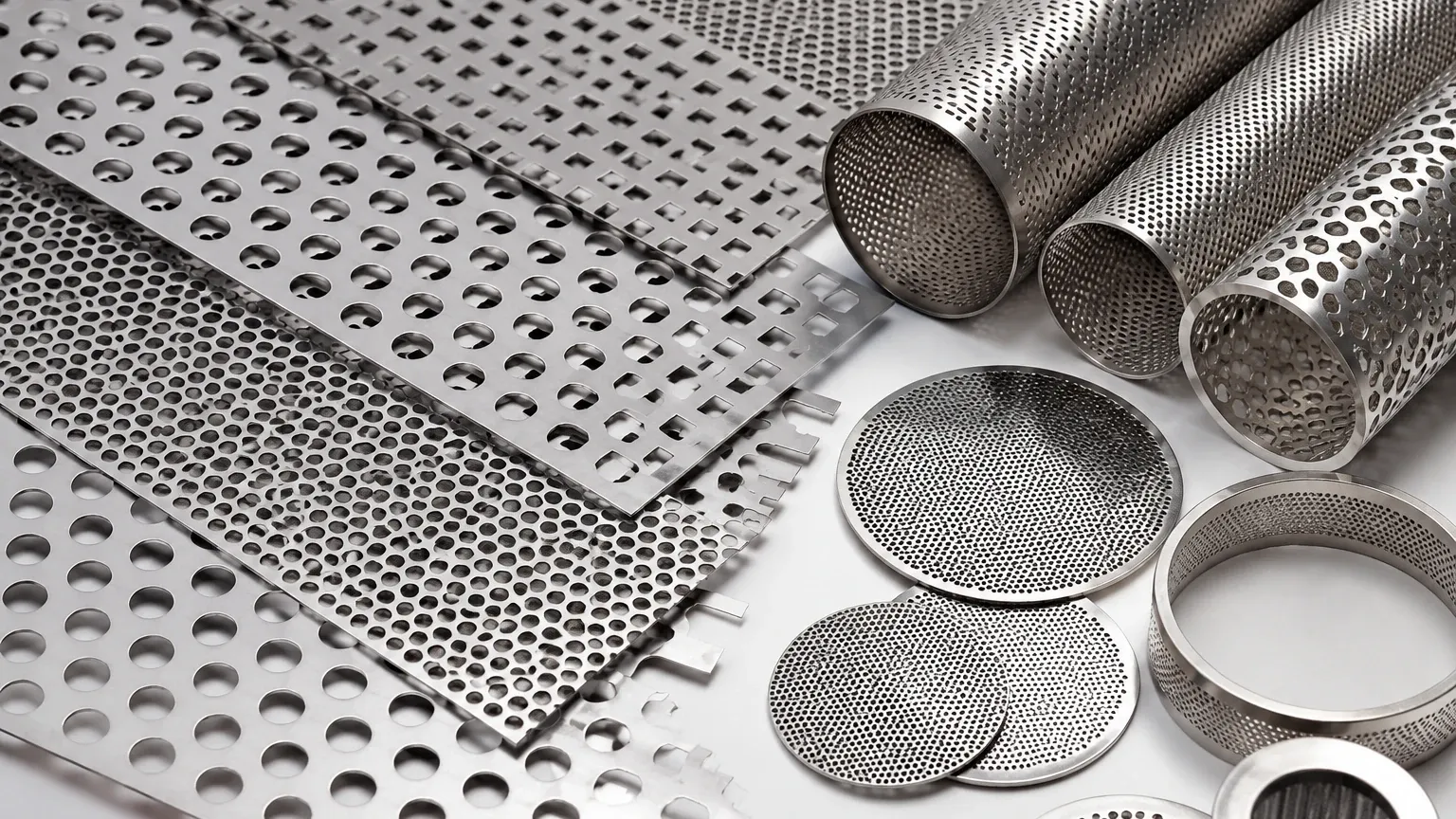
The hole size (often denoted as 'D' for diameter in round holes) is the most fundamental dimension. In filtration, this determines the maximum particle size that can pass through the media. While round holes are the industry standard due to their structural stability and ease of manufacturing, square, slotted, and hexagonal patterns are also utilized for specific flow characteristics. For precision filtration, tolerances must be strictly controlled to ensure consistent performance across the entire sheet.
2. Pitch (Center-to-Center Distance)
The pitch is the distance from the center of one hole to the center of the adjacent hole. This measurement is vital because it determines the "bridge" or the amount of solid metal remaining between the perforations. A smaller pitch increases the number of holes per square inch but reduces the mechanical strength of the sheet.
3. Open Area Percentage
The open area is the ratio of the total area of the holes to the total area of the sheet, expressed as a percentage. This is a critical "ukuran" for engineers calculating flow rates and pressure drops. A higher open area allows for faster throughput but can lead to material deformation under high-pressure conditions. The formula for calculating the open area of a 60-degree staggered round hole pattern is:
Open Area % = (D² × 90.69) / P²
*(Where D = Hole Diameter and P = Pitch)*
Material Thickness and Structural Engineering
The thickness of the metal sheet (the gauge) is a decisive factor in the longevity of the filter component. In industrial environments where perforated metal is subjected to high-pressure fluids or abrasive materials, selecting the correct thickness is essential for preventing "blinding" or structural failure.
The Relationship Between Hole Size and Thickness
A general engineering rule for Perforated & Expanded Metal is that the hole diameter should not be smaller than the material thickness. For example, if you are using a 2mm thick stainless steel sheet, the hole diameter should ideally be 2mm or larger. Attempting to perforate holes smaller than the material thickness increases the risk of tool breakage and can result in uneven hole edges, which negatively impacts filtration accuracy.
Load-Bearing Considerations
In many applications, perforated metal serves a dual purpose: it acts as a filter media and a structural support for finer mesh layers. In these cases, the "ukuran" must account for the mechanical load. Stainless steel 304 and 316L are the preferred materials due to their high tensile strength and resistance to corrosion in chemical and pharmaceutical processing.
Pattern Configurations: Staggered vs. Straight
The arrangement of the holes—the pattern—significantly influences the efficiency of the filtration process. There are two primary configurations:
* Staggered Pattern (60-Degree): This is the most popular configuration for industrial filters. It provides the highest open area and the most uniform distribution of stress across the metal sheet. It is ideal for high-flow applications where maximizing throughput is the priority.
* Straight Pattern: In this configuration, holes are aligned in both vertical and horizontal rows. While easier to align for certain architectural or aesthetic purposes, straight patterns offer lower open area and reduced structural strength compared to staggered patterns.
When confirming the perforated metal ukuran, engineers must specify the direction of the stagger relative to the sheet dimensions, as this can affect how the material is rolled or welded into filter cartridges.
Customization and OEM Specification Requirements
For many industrial applications, standard off-the-shelf dimensions are insufficient. Customization allows for the optimization of the filtration process based on specific fluid viscosities, particle loads, and operating temperatures. When working with a manufacturer like Kaifil, providing a detailed specification sheet is necessary to ensure the final product meets performance expectations.
Defining Margins and Unperforated Areas
One often overlooked aspect of perforated metal dimensions is the margin. Margins are the unperforated areas along the edges of the sheet. Precise margins are necessary for welding the perforated sheet into a cylinder or for fitting it into a housing frame. Engineers should specify:
* Side Margins: The solid metal area along the length of the sheet.
* End Margins: The solid metal area along the width of the sheet.
* Finished vs. Unfinished Ends: Whether the pattern should be broken or continuous at the edges.
Secondary Processing
Beyond the initial perforation, the "ukuran" can be further refined through secondary processes such as leveling (to ensure flatness), shearing (to exact dimensions), and forming (rolling into tubes or bending into channels). For Perforated & Expanded Metal used in filter cartridges, the precision of the rolling process is vital for maintaining the integrity of the longitudinal weld.
Evaluating Performance: Pressure Drop and Filtration Efficiency
In a B2B procurement context, the choice of perforated metal ukuran is driven by the need to balance filtration efficiency with energy consumption.
Pressure Drop (ΔP)
Every filter media introduces a resistance to flow. A perforated sheet with an insufficient open area will cause a significant pressure drop, forcing pumps to work harder and increasing energy costs. By optimizing the hole size and pitch, engineers can achieve the required filtration rating while maintaining a manageable ΔP.
Filtration Accuracy
In pharmaceutical and food processing, the consistency of the hole size is paramount. If a perforated sheet specified with a 1mm hole size actually contains holes measuring 1.2mm due to poor manufacturing tolerances, the entire filtration system is compromised. High-quality manufacturing ensures that the "ukuran" remains consistent across the entire surface area of the metal.
Common Risks in Specifying Perforated Metal Dimensions
Inaccurate specification can lead to costly downtime or equipment damage. When ordering perforated metal, technical teams should be aware of the following risks:
1. Work Hardening: Stainless steel tends to harden during the perforation process. If the pitch is too small (the bridge is too narrow), the material may become brittle, leading to cracks during subsequent forming or in high-vibration environments.
2. Burr Formation: In high-speed perforation, small burrs can form on the underside of the sheet. For food-grade applications, these burrs must be removed through electropolishing or mechanical deburring to prevent contamination and ensure the "ukuran" of the hole remains unobstructed.
3. Oil and Contamination: Manufacturing perforated metal involves lubricants. For oxygen-service or pharmaceutical applications, the material must be degreased and cleaned to meet industry standards.
Conclusion: Selecting the Right Partner for Precision Filtration
Selecting the correct perforated metal ukuran is a complex engineering task that requires a deep understanding of fluid dynamics, material science, and manufacturing constraints. By focusing on precise hole sizing, optimized open areas, and appropriate material gauges, industrial operators can ensure their filtration systems perform reliably over long service life cycles.
Kaifil provides comprehensive support for engineers and purchasing teams seeking high-performance filtration solutions. With advanced manufacturing capabilities and a commitment to quality, we help you navigate the technical nuances of perforated and expanded metal to find the exact configuration for your application.
To ensure your project meets its technical requirements, it is recommended to Review product options and application support and consult with our engineering team regarding specific dimensional tolerances and material compatibility. Precise measurements today prevent operational failures tomorrow.
