


1 16 Perforated Metal
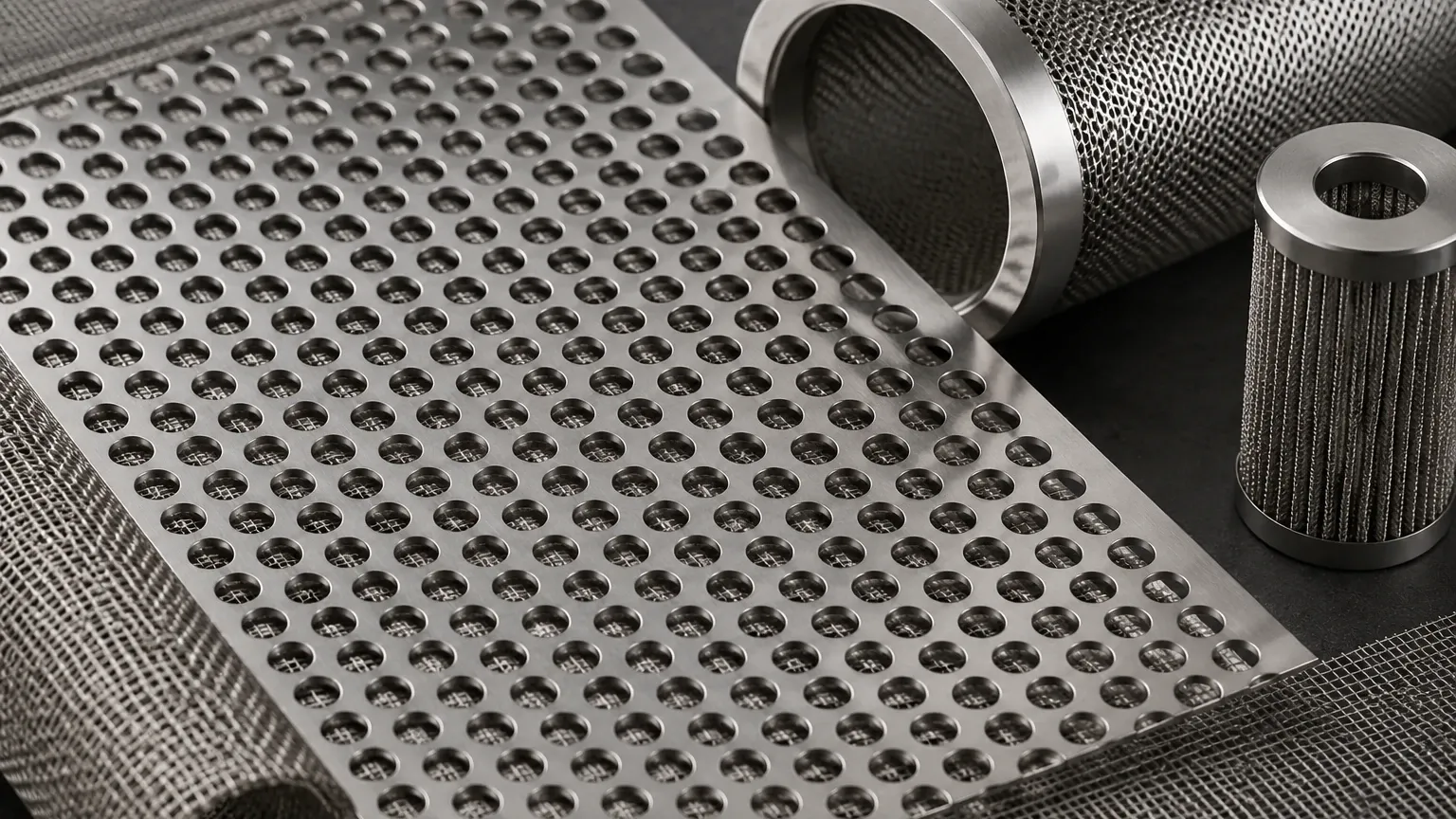
In the landscape of industrial filtration and precision engineering, the specification of a 1/16-inch hole diameter represents a critical threshold. Often referred to as 1 16 perforated metal, this specific aperture size—approximately 1.5875 millimeters—is a staple in applications requiring a balance between high structural integrity and fine particle retention. For engineers and procurement specialists, selecting the right perforated media involves more than just choosing a hole size; it requires a deep understanding of material properties, open area percentages, and manufacturing tolerances to ensure long-term performance in demanding environments.
As a specialized manufacturer of stainless steel filtration solutions, Kaifil provides precision-engineered components that utilize various hole configurations. Understanding the technical nuances of Perforated & Expanded Metal is essential for optimizing flow rates and filtration efficiency in chemical, food and beverage, and pharmaceutical processing.
Technical Specifications of 1/16" Perforated Media
When specifying 1 16 perforated metal, the hole diameter is only the first variable. To fully define the material for an industrial application, several other geometric and mechanical factors must be considered.
Hole Patterns and Pitch
The arrangement of the 1/16" holes significantly impacts both the strength of the sheet and its filtration characteristics. The two most common patterns are:
1. 60-Degree Staggered Centers: This is the industrial standard. By offsetting the rows of holes, manufacturers can achieve the highest possible open area while maintaining uniform strength across the sheet. For a 1/16" hole, a common pitch (the distance from the center of one hole to the center of the next) might be 3/32" or 1/8".
2. Straight Line Centers: In this configuration, holes are aligned both horizontally and vertically. While easier to align for certain aesthetic or structural applications, straight patterns generally offer lower open area and reduced structural stability compared to staggered patterns.
The Importance of Open Area
The "Percentage of Open Area" (POA) is perhaps the most critical metric for engineers. It determines the flow capacity and the pressure drop across the filter media. For 1 16 perforated metal, the POA is calculated based on the hole diameter (D) and the pitch (P). In a 60-degree staggered pattern, the formula is:
POA = (D² × 90.69) / P²
For example, a 1/16" (0.0625") hole on a 3/32" (0.09375") staggered pitch yields an open area of approximately 40%. Increasing the pitch to 1/8" (0.125") drops the open area to roughly 22%. Engineers must balance the need for high flow (high POA) with the need for mechanical durability (lower POA/more solid metal).
Material Selection for Industrial Environments
The performance of 1 16 perforated metal is heavily dependent on the alloy from which it is fabricated. Given Kaifil’s focus on durability and corrosion resistance, stainless steel is the primary choice for most industrial filtration projects.
Stainless Steel 304 vs. 316L
* Grade 304: This is the most common stainless steel used for perforated metal. It offers excellent forming and welding characteristics and provides good resistance to atmospheric corrosion. It is widely used in food processing and general industrial screening.
* Grade 316L: For applications involving harsh chemicals, high salt concentrations, or pharmaceutical requirements, 316L is the preferred choice. The addition of molybdenum enhances resistance to pitting and crevice corrosion, particularly in chloride-rich environments. The "L" designation (low carbon) ensures better weldability and prevents sensitization in the heat-affected zone of welds.
Gauge and Thickness Considerations
The thickness of the metal sheet—often measured in gauge—must be compatible with the 1/16" hole size. A general engineering rule of thumb is that the hole diameter should not be smaller than the material thickness (1:1 ratio). Attempting to punch 1/16" holes in very thick plate (e.g., 1/4") can lead to tool breakage and distorted hole geometries. For 1/16" perforations, common thicknesses range from 26 gauge (0.018") to 16 gauge (0.060").
Engineering Performance and Filtration Logic
In a B2B context, 1 16 perforated metal is rarely used as a standalone sheet; it is typically a component in a larger filtration system, such as a basket strainer, a core for a pleated filter, or a protective screen for hydraulic intakes.
Pressure Drop and Flow Dynamics
Every filter media introduces a resistance to flow, known as pressure drop (ΔP). Because 1/16" holes are relatively small, the cumulative resistance can be significant if the total surface area is insufficient. Engineers must calculate the "Total Open Area" (the POA multiplied by the total surface area of the filter) to ensure that the fluid velocity through the holes does not exceed the limits that would cause turbulence or excessive energy loss.
Particle Retention
A 1/16" hole will effectively stop any spherical particle larger than 1,587 microns. However, in industrial applications, particles are rarely perfectly spherical. Needle-like or plate-like debris may pass through if they align with the hole. Therefore, 1 16 perforated metal is often used as a "primary" or "coarse" filter to protect more delicate downstream components, such as fine wire mesh or membranes.
Manufacturing Processes and Quality Control
Producing high-quality 1 16 perforated metal requires precision machinery and rigorous post-processing. At Kaifil, the focus is on delivering components that meet exact OEM specifications.
CNC Punching vs. Laser Cutting
* CNC Punching: This is the most cost-effective method for high-volume production of perforated sheets. High-speed presses use a die and punch set to create thousands of holes per minute. The challenge with 1/16" holes is maintaining sharp tooling to prevent "burrs" or ragged edges on the exit side of the hole.
* Laser Cutting: For low-volume prototypes or extremely thick materials where punching is not feasible, fiber laser cutting offers high precision. However, for a standard 1/16" pattern with high open area, punching is generally preferred due to speed and cost-efficiency.
Post-Processing: Deburring and Cleaning
In industries like food processing and pharmaceuticals, the presence of metal burrs or residual oils is unacceptable. Professional manufacturers employ several finishing techniques:
* Leveling: The punching process can introduce internal stresses that cause the metal sheet to curl. Precision leveling rollers are used to ensure the final product is perfectly flat.
* Deburring: Mechanical or chemical deburring removes sharp edges from the hole perimeters, ensuring safe handling and preventing particle entrapment.
* Degreasing/Passivation: For stainless steel, passivation is a critical step. It involves treating the metal with a mild oxidant (like nitric acid) to remove free iron from the surface and enhance the protective chromium oxide layer.
Applications of 1 16 Perforated Metal
The versatility of this specific perforation size makes it applicable across a wide range of sectors:
1. Chemical Processing: Used in strainer baskets for removing large particulates from corrosive chemical streams before they reach sensitive pumps.
2. Food and Beverage: 1/16" holes are ideal for grain drying, seed separation, and as support structures for finer mesh in juice filtration.
3. Pharmaceuticals: Employed in fluid bed dryers and granulators where precise airflow and particle containment are required.
4. Hydraulics: Serves as a rugged outer guard for hydraulic suction filters, preventing large debris from entering the system while allowing high-viscosity oil to flow freely.
5. Acoustics: In some industrial settings, perforated metal with 1/16" holes is used as a facing for sound-absorbing materials, providing a durable surface that allows sound waves to pass through to the insulation.
Selection Criteria: A Guide for Purchasing Teams
When requesting a quote for 1 16 perforated metal or custom filtration components, providing the following details will ensure an accurate technical assessment:
* Exact Hole Diameter: Confirm if 1/16" (0.0625") is the absolute requirement or if there is a range.
* Center-to-Center Distance (Pitch): This defines your open area. If you are unsure, specify the required flow rate or the desired percentage of open area.
* Material Grade: Specify 304, 316, or 316L based on the chemical environment.
* Sheet Dimensions and Margins: Do you need "full bleed" perforation (holes to the edge) or specific solid margins for welding and mounting?
* Flatness and Tolerances: Define the acceptable deviation from flat, especially if the metal will be rolled into a cylinder for a filter cartridge.
* Quantity and Lifecycle: Consider the total cost of ownership. While stainless steel has a higher upfront cost than galvanized steel, its longevity in corrosive environments often results in a lower cost per year of service.
Why Choose Kaifil for Custom Filtration Solutions?
Kaifil specializes in the intersection of traditional metalworking and advanced filtration science. By providing tailored Perforated & Expanded Metal products, we help our clients solve complex fluid dynamics challenges. Our manufacturing capabilities allow for the integration of 1 16 perforated metal into multi-layer filter cartridges, reinforced strainer baskets, and custom-shaped components designed for specific industrial housings.
Whether you are designing a new system or looking for a more reliable OEM supplier for replacement parts, understanding the technical boundaries of perforated media is the first step toward optimized performance. By focusing on precision, material integrity, and application-specific design, Kaifil ensures that your filtration components withstand the rigors of industrial use while maintaining the exact filtration accuracy your process demands.
