


1 4 Inch Perforated Metal
In industrial engineering and manufacturing, the selection of filtration and structural components requires a precise balance between mechanical strength and functional permeability. Among the most versatile specifications used in heavy-duty applications is 1 4 inch perforated metal. Typically referring to a hole diameter of 0.25 inches, this configuration serves as a cornerstone for medium-coarse filtration, protective screening, and structural reinforcement.
As a specialized manufacturer, Kaifil provides high-performance Perforated & Expanded Metal solutions tailored to the rigorous demands of the chemical, pharmaceutical, and food processing industries. Understanding the technical nuances of 1 4 inch perforated metal—from open area calculations to material compatibility—is essential for engineers tasked with optimizing system performance and longevity.
Understanding the Technical Specifications of 1/4 Inch Perforated Metal
When specifying 1 4 inch perforated metal, the hole diameter is only one part of the technical equation. To ensure the component performs as expected in an industrial setting, engineers must define the hole pattern, the centers (pitch), and the resulting open area.
Hole Patterns and Pitch
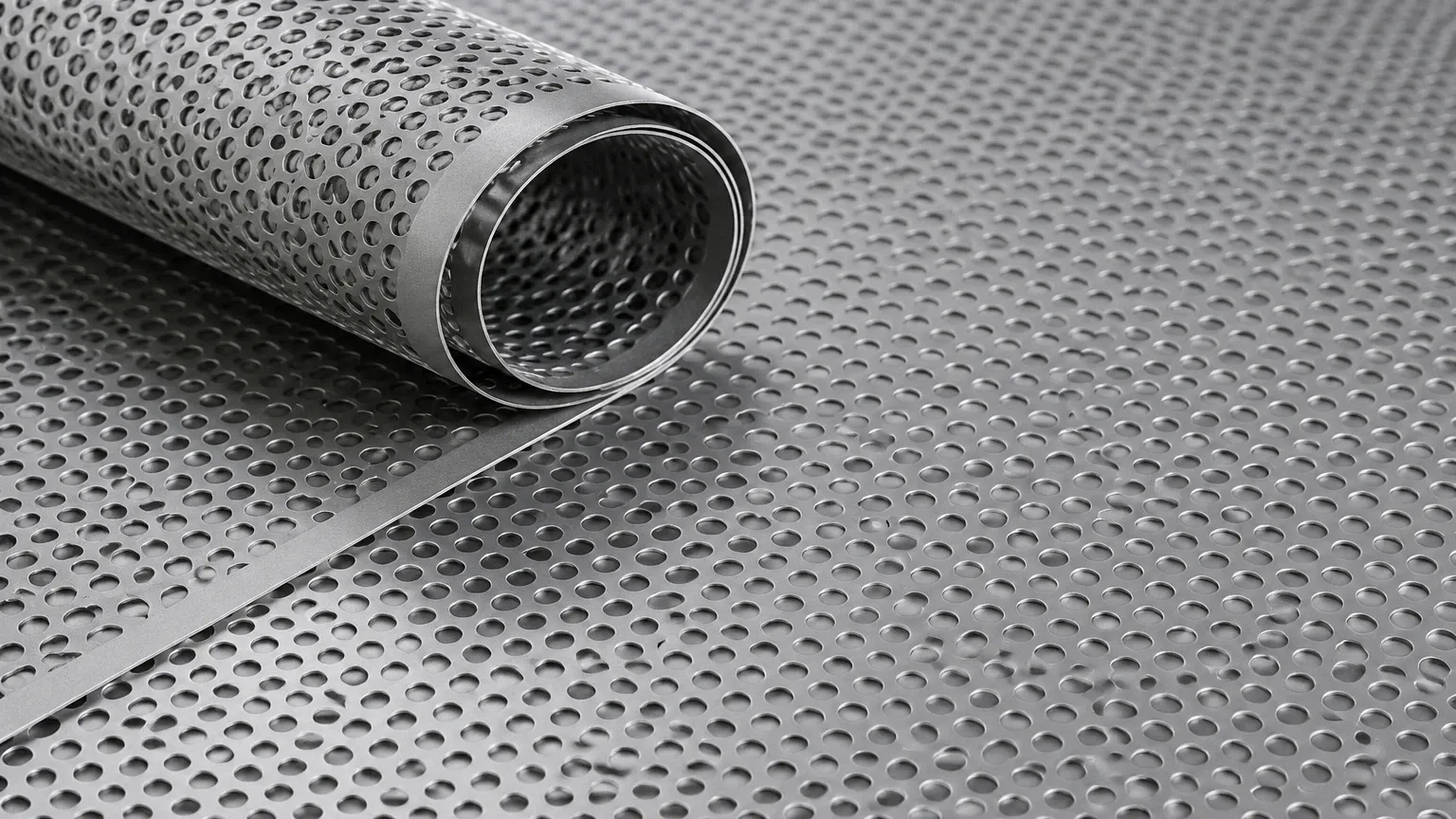
The most common configuration for 1/4" perforations is the 60-degree staggered pattern. In this arrangement, the holes are offset, providing the highest degree of structural integrity while maximizing the open area. For example, a 1/4" hole on 3/8" staggered centers is a standard industrial specification.
Alternatively, straight-line patterns align holes in both horizontal and vertical rows. While easier to align for certain aesthetic or specific directional flow applications, straight-line patterns generally offer lower structural rigidity compared to staggered configurations. The distance between the centers of the holes (the pitch) determines how much solid material remains between the perforations, which directly impacts the sheet's resistance to bending and tension.
Calculating the Open Area
The "open area" is the percentage of the sheet that is comprised of holes. This is a critical metric for calculating flow rates and pressure drops in filtration systems. For a standard 60-degree staggered pattern, the formula is:
Open Area % = (D² × 90.69) / C²
*(Where D = Hole Diameter and C = Center-to-Center distance)*
Using a 1/4" (0.25") hole on 3/8" (0.375") centers, the open area is approximately 40%. Increasing the pitch reduces the open area, which increases the strength of the plate but restricts flow. Conversely, a tighter pitch increases the open area but may require a heavier gauge material to prevent warping or structural failure under pressure.
Engineering Considerations: Flow Dynamics and Pressure Drop
In B2B industrial applications, 1 4 inch perforated metal is rarely a standalone component; it is often part of a larger fluid or gas handling system. Engineers must evaluate how the perforation geometry affects the medium passing through it.
Flow Rate and Velocity
The 40% open area typical of 1/4" perforations allows for significant throughput, making it ideal for high-volume intake screens or primary strainers. However, as fluid passes through the perforations, the effective narrowing of the flow path causes a localized increase in velocity. If the velocity becomes too high, it can lead to turbulence, which may damage sensitive downstream components or cause premature erosion of the perforated plate itself.
Pressure Drop (Delta P)
Every perforated plate introduces a degree of resistance to flow. For 1 4 inch perforated metal, the pressure drop is influenced by the fluid viscosity, the velocity, and the thickness of the plate. A thicker plate (lower gauge number) creates a longer "tunnel" for the fluid to pass through, slightly increasing the resistance compared to a thinner sheet with the same hole size. Kaifil’s engineering team works with clients to calculate these variables, ensuring that the selected filter or screen does not exceed the system's pump capacity or structural limits.
Material Selection for Industrial Environments
The durability of 1 4 inch perforated metal is heavily dependent on the alloy selected. In the industrial sectors served by Kaifil, stainless steel is the gold standard due to its corrosion resistance and mechanical properties.
Stainless Steel 304 vs. 316
* Type 304: This is the most common grade for general industrial use. It offers excellent formability and good resistance to atmospheric corrosion and many organic and inorganic chemicals. It is frequently used in food processing and general water treatment.
* Type 316: For environments involving chlorides, high salinity, or aggressive chemical processing (such as phosphoric or sulfuric acids), Type 316 is required. The addition of molybdenum provides superior pitting resistance, making it the preferred choice for marine and pharmaceutical applications.
Special Alloys and Gauges
Beyond standard stainless steel, applications involving extreme temperatures or highly specialized chemical reactions may require Duplex stainless steel or nickel alloys. The gauge (thickness) of the material is equally important. For 1/4" holes, common thicknesses range from 20 gauge (0.036") for light screening to 11 gauge (0.120") or even 1/4" plate for heavy-duty industrial strainers. Choosing a gauge that is too thin can lead to "oil-canning" or vibration-induced fatigue, while a gauge that is too thick can complicate the manufacturing process and increase costs unnecessarily.
Applications in Industrial Filtration and Structural Support
The versatility of 1 4 inch perforated metal allows it to function across a broad spectrum of industrial roles. Its primary utility lies in its ability to act as a robust barrier while maintaining high permeability.
Primary Strainers and Coarse Filtration
In water treatment and chemical processing, 1/4" perforated metal is often used as a primary strainer to remove large debris, such as stones, wood chips, or plastic fragments, before the fluid reaches finer filtration stages. This protects pumps and high-precision filter cartridges from mechanical damage.
Support Media for Fine Mesh
One of the most technical applications for 1 4 inch perforated metal is as a support core or outer shroud for fine wire mesh filters. Fine mesh lacks the structural strength to withstand high differential pressures. By wrapping the mesh around a 1/4" perforated stainless steel tube, the assembly gains the necessary rigidity to operate in high-pressure hydraulic or steam systems without collapsing.
Protective Guards and Diffusers
In machinery manufacturing, these perforated sheets are used as safety guards that allow for airflow and visibility while preventing accidental contact with moving parts. In gas processing, they serve as diffusers, breaking up high-velocity gas streams to ensure even distribution across a catalyst bed or heat exchanger.
Customization and OEM Manufacturing Capabilities
Standard off-the-shelf perforated sheets often fail to meet the specific tolerances required for precision engineering. Kaifil specializes in customized 1 4 inch perforated metal solutions that address specific operational challenges.
Custom Margins and Blank Areas
Standard perforated sheets usually have "random" margins where the pattern is cut off at the edges. For OEM components, custom margins are often required to facilitate welding or mechanical fastening. We can produce sheets with specific unperforated borders or blank areas within the pattern to accommodate mounting holes or structural ribs.
Precision Forming and Finishing
Perforated metal often requires secondary processing, such as rolling into cylinders for filter cartridges, flanging, or precision shearing. Kaifil utilizes advanced manufacturing techniques to ensure that the 1/4" holes remain undistorted during the forming process. Furthermore, surface finishes such as electropolishing or passivating are available to enhance corrosion resistance and ensure the components meet the stringent hygiene standards of the pharmaceutical and food industries.
Maintenance, Cleaning, and Lifecycle Management
The total cost of ownership for industrial filtration components is determined by their service life and ease of maintenance. 1 4 inch perforated metal is favored in many industries because it is inherently easier to clean than woven wire mesh.
Cleaning Protocols
Because the holes are punched with smooth edges (especially when deburred), there are fewer places for particles to become wedged. In many applications, simple backwashing or high-pressure hosing is sufficient to clear the surface. For sticky or biological contaminants, ultrasonic cleaning or chemical soaking can be used without damaging the structural integrity of the stainless steel.
Inspection and Replacement Cycles
While 1/4" perforated metal is highly durable, it is not immune to wear. In abrasive environments, such as mining or slurry processing, the edges of the holes can eventually round off, or the bridge (the material between holes) can thin due to erosion. Regular inspection for stress cracks between holes or signs of localized corrosion is vital. Because Kaifil maintains detailed records of OEM specifications, replacing worn components with exact matches is a streamlined process, minimizing downtime.
Conclusion: Selecting the Right Partner for Perforated Solutions
Selecting 1 4 inch perforated metal involves more than just picking a hole size. It requires a deep understanding of material science, fluid dynamics, and manufacturing constraints. Whether the goal is to protect a high-pressure pump, support a delicate filter membrane, or provide a durable safety barrier, the technical specifications must be precisely aligned with the application's demands.
Kaifil’s commitment to quality and engineering excellence ensures that our Perforated & Expanded Metal products deliver reliable performance in the most challenging industrial environments. By focusing on precision manufacturing and customized designs, we help engineering and purchasing teams achieve filtration solutions that are efficient, durable, and cost-effective. When evaluating your next project involving 1 4 inch perforated metal, consider the long-term benefits of a solution engineered for your specific operational parameters.
