


1/8 Perforated Metal
In industrial filtration and structural engineering, the specification of hole size is a critical variable that dictates flow velocity, particle retention, and structural integrity. Among the various configurations available in the realm of Perforated & Expanded Metal, the 1/8-inch hole diameter stands as one of the most versatile standards. This dimension, approximately 3.175 mm, is frequently utilized in applications ranging from heavy-duty industrial strainers to precision support cores for fine wire mesh filters.
Selecting the correct 1/8 perforated metal requires a deep understanding of material properties, open area percentages, and the mechanical stresses the component will face during its service life. For engineers and procurement specialists, evaluating these factors is essential to ensure long-term performance and to minimize the total cost of ownership in demanding environments such as chemical processing, food production, and hydraulic systems.
Technical Specifications and Hole Geometry
The performance of 1/8 perforated metal is defined not just by the hole diameter, but by the arrangement of those holes and the distance between them, known as the pitch or centers. The geometry of the perforation pattern significantly impacts both the fluid dynamics and the mechanical strength of the sheet.
Staggered vs. Straight Patterns
The most common configuration for 1/8-inch perforations is the 60-degree staggered pattern. In this arrangement, each hole is equidistant from the surrounding holes, creating a uniform distribution of material. This pattern is preferred in filtration because it provides the highest possible open area while maintaining structural rigidity.
Conversely, straight-row patterns align holes in parallel vertical and horizontal lines. While easier to manufacture for certain specialized decorative applications, straight patterns generally offer lower structural integrity under pressure and are less efficient for high-flow filtration tasks. In industrial settings, the staggered pattern is the engineering standard for optimizing the strength-to-weight ratio.
Calculating Open Area
The "open area" is the percentage of the sheet that consists of holes. For a 1/8-inch hole, the open area varies based on the center-to-center spacing. For example:
* 1/8" holes on 3/16" staggered centers: This provides approximately a 40% open area. It is a balanced configuration that offers good flow with high structural strength.
* 1/8" holes on 5/32" staggered centers: This increases the open area to approximately 58%, allowing for much higher flow rates but reducing the overall stiffness of the metal sheet.
Engineers must calculate the required open area based on the maximum allowable pressure drop across the filter element. A higher open area reduces resistance but may require a thicker base material to prevent deformation under hydraulic surges.
Material Selection for Industrial Environments
Kaifil specializes in stainless steel solutions because the material's durability is paramount in B2B industrial applications. When specifying 1/8 perforated metal, the choice of alloy is often dictated by the chemical composition of the fluid being filtered and the operating temperature.
Stainless Steel 304 vs. 316L
* Type 304 Stainless Steel: This is the standard grade for general industrial use. It offers excellent corrosion resistance and is suitable for most water treatment, food processing, and architectural applications. It is cost-effective and provides the necessary durability for non-acidic environments.
* Type 316L Stainless Steel: For more aggressive environments, such as marine applications, pharmaceutical production, or chemical processing involving chlorides, 316L is the preferred choice. The addition of molybdenum enhances resistance to pitting and crevice corrosion. The "L" denotes low carbon content, which is vital for components that require welding, as it prevents carbide precipitation and maintains corrosion resistance at the weld joints.
Specialty Alloys
In extreme cases involving high-temperature oxidation or highly corrosive acids, specialty alloys like Monel, Inconel, or Hastelloy may be required. These materials ensure that the 1/8-inch perforations maintain their precise dimensions over time, preventing "hole enlargement" caused by chemical erosion, which would otherwise compromise filtration accuracy.
Performance Metrics: Flow Rate and Pressure Drop
In any filtration system, the 1/8 perforated metal acts as a functional barrier. The primary engineering concern is how this barrier affects the system's hydraulic performance.
Pressure Drop (Delta P)
As fluid passes through the 1/8-inch apertures, a localized increase in velocity occurs, leading to a drop in pressure. If the pressure drop is too high, it can lead to cavitation in pumps or mechanical failure of the filter element. Engineers must use the open area percentage to model the flow characteristics. A 1/8-inch hole is large enough to prevent significant clogging from microscopic particles but small enough to capture larger debris or provide a stable foundation for secondary filter media.
Flow Distribution
Uniformity in the perforation process is critical. If the 1/8-inch holes are not punched with precision, or if the spacing is inconsistent, it can lead to "channeling." Channeling occurs when fluid takes the path of least resistance, leading to uneven wear on the filter and potential bypass of contaminants. High-quality manufacturing ensures that the flow is distributed evenly across the entire surface area of the metal.
Structural Role in Multi-Layer Filtration Systems
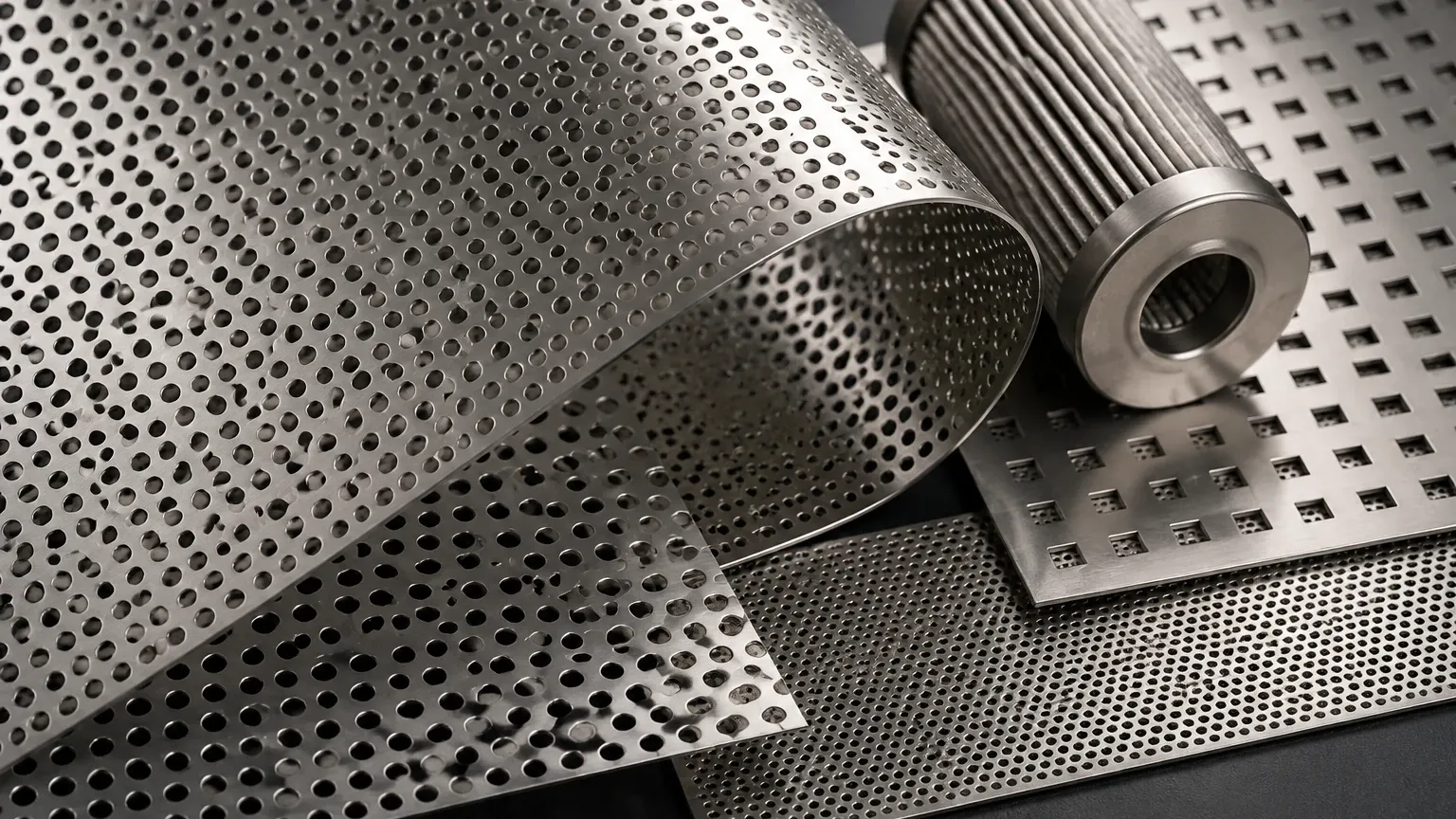
While 1/8 perforated metal can function as a standalone strainer, it is frequently used as a support structure in multi-layer filter cartridges. In these designs, a fine wire mesh or a non-woven fiber media is wrapped around or pleated inside a perforated metal core.
Internal Support Cores
In high-pressure hydraulic or oil filtration, the inner core must withstand significant collapse pressure. A 1/8-inch perforated tube provides the necessary rigidity to prevent the fine mesh from imploding under the force of the fluid. The size of the hole is specifically chosen so that the mesh does not "blind" (clog) against the solid portions of the metal, while still providing enough surface contact to support the mesh fibers.
Outer Protective Shrouds
Conversely, perforated metal can be used as an outer shroud to protect delicate filter media from mechanical damage during installation or from large, high-velocity debris in the fluid stream. The 1/8-inch hole size is ideal here as it allows for high throughput while blocking large objects that could puncture the primary filter layer.
Manufacturing Tolerances and Customization Options
Precision in manufacturing is what separates industrial-grade 1/8 perforated metal from generic hardware-grade materials. When ordering components for OEM applications, several customization factors must be confirmed.
Thickness and Gauge
The thickness of the metal (gauge) must be compatible with the 1/8-inch hole size. A general rule of engineering in perforation is that the material thickness should not exceed the hole diameter (1:1 ratio). Attempting to punch 1/8-inch holes in 1/4-inch thick plate can lead to tool breakage and distorted hole shapes. For most filtration applications, gauges ranging from 22ga to 11ga are standard.
Margins and Blank Areas
Customized filtration components often require "margins"—solid areas around the edges of the perforated sheet where no holes are present. These margins are essential for welding the sheet into a cylinder or bolting it into a frame. Specifying exact margin dimensions ensures that the final component fits perfectly into the housing without the need for additional machining.
Finishing Treatments
After the perforation process, the metal may have burrs or sharp edges. For the food and pharmaceutical industries, these must be removed through electropolishing or mechanical deburring. Electropolishing not only smooths the surface to prevent bacterial growth but also enhances the chromium oxide layer on stainless steel, further improving corrosion resistance.
Industry-Specific Applications
1/8 perforated metal is a staple in various sectors due to its balance of aperture size and structural strength.
* Food and Beverage: Used in grain drying, fruit juice straining, and as support screens in large-scale brewing vats. The 1/8-inch size is effective for removing seeds and large pulp while allowing liquid to pass freely.
* Chemical Processing: Utilized in catalyst support grids and chemical reactor internals. The use of 316L stainless steel ensures the material can withstand corrosive reagents.
* Pulp and Paper: Employed in the screening process to separate wood chips and fibers. The durability of perforated metal is superior to woven mesh in these high-abrasion environments.
* Water Treatment: Acts as a primary intake screen to prevent aquatic life and large debris from entering pumps and treatment facilities.
Procurement and Selection Criteria for Engineers
When transitioning from a design phase to procurement, engineers should verify the following data points with their manufacturer to ensure the 1/8 perforated metal meets the application requirements:
1. Exact Alloy Grade: Confirm if 304, 316, or 316L is required based on the chemical environment.
2. Hole Pattern and Pitch: Specify 60-degree staggered and the center-to-center distance to lock in the open area percentage.
3. Sheet Thickness: Ensure the gauge is sufficient for the pressure requirements but within the manufacturability limits for a 1/8-inch hole.
4. Flatness Requirements: Perforation can introduce internal stresses that cause the metal to curl. Specify leveling if the sheet must be perfectly flat for precision assembly.
5. Compliance Standards: For food or pharma, ensure the material meets FDA or 3A sanitary standards.
By focusing on these technical boundaries, purchasing teams can acquire filtration components that offer predictable performance and extended service life. Whether used as a standalone screen or a critical support component, 1/8 perforated metal remains a foundational element in modern industrial filtration technology.
