


3mm Perforated Metal Sheet
In industrial filtration and structural engineering, the specification of a 3mm perforated metal sheet represents a versatile standard used across diverse sectors, including chemical processing, food production, and hydraulic systems. Whether the "3mm" refers to the hole diameter, the sheet thickness, or the center-to-center pitch, understanding the technical nuances of these dimensions is critical for ensuring mechanical integrity and filtration efficiency. As a specialized manufacturer, Kaifil provides precision-engineered Perforated & Expanded Metal solutions tailored to meet the rigorous demands of industrial environments.
Selecting the correct 3mm perforated metal sheet requires more than choosing a material; it involves a detailed evaluation of open area percentages, hole patterns, and material properties. This guide examines the engineering considerations necessary for integrating these components into industrial systems.
Technical Specifications and Hole Geometry
The performance of a 3mm perforated metal sheet is primarily dictated by its geometric configuration. In most industrial contexts, a "3mm" specification refers to the aperture or hole diameter. However, the performance of this aperture is influenced by the pattern in which the holes are arranged.
Staggered vs. Straight Row Patterns
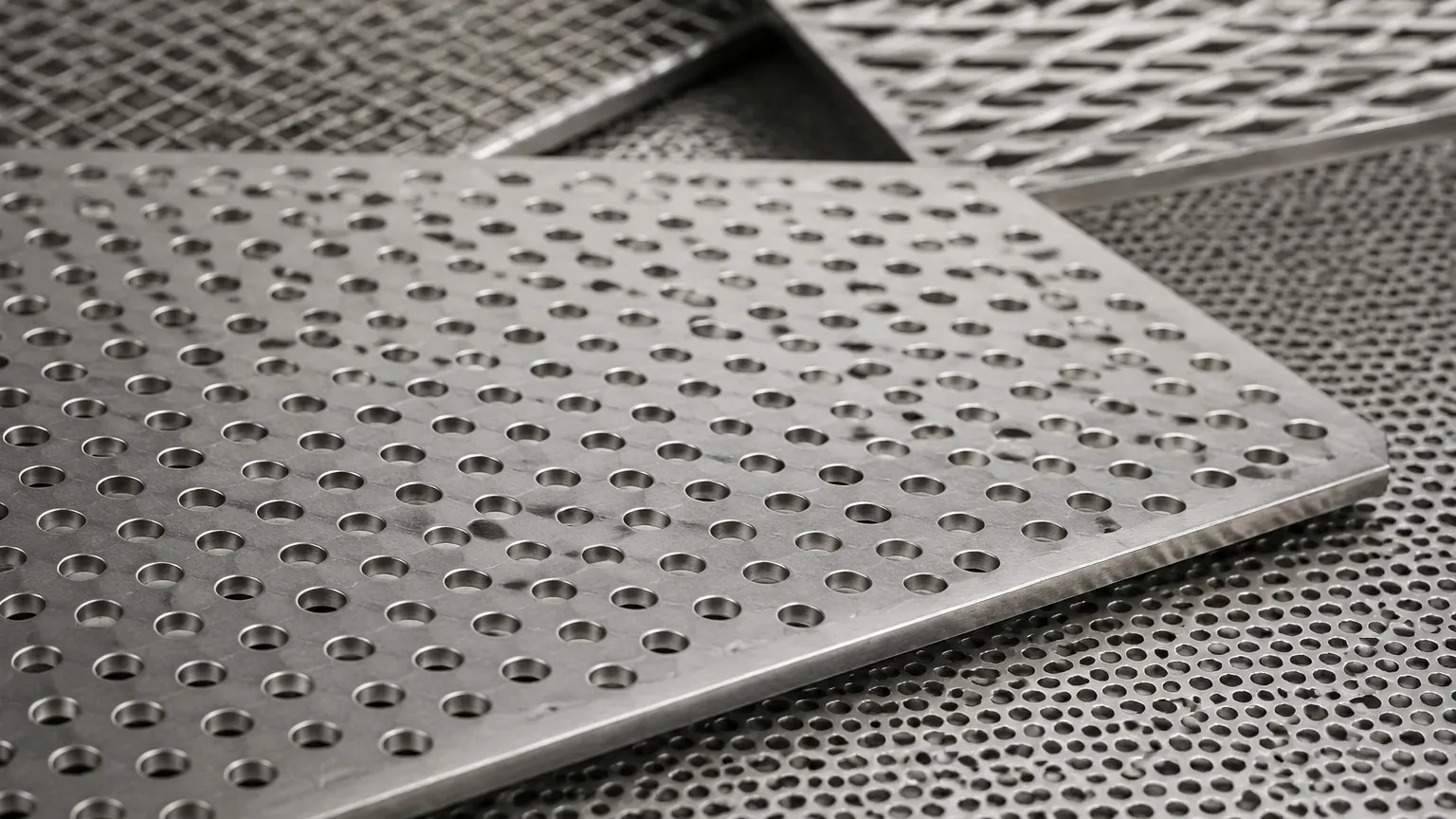
* 60-Degree Staggered Pattern: This is the most common configuration for industrial filtration. It provides the highest open area and structural uniformity. In a 60-degree staggered layout, the holes are offset, which prevents the formation of "weak lines" in the metal, enhancing the sheet's resistance to pressure and mechanical stress.
* Straight Row Pattern: Holes are aligned both horizontally and vertically. While easier to manufacture for certain architectural applications, straight rows typically offer lower structural strength and are more prone to deformation under high-pressure flow conditions.
Calculating the Open Area
The open area percentage is a vital metric for engineers calculating flow rates and pressure drops. For a 3mm perforated metal sheet with a staggered pattern, the open area (OA%) is calculated using the hole diameter (D) and the pitch (P—the distance from the center of one hole to the center of the next):
OA% = (D² × 90.69) / P²
For example, a 3mm hole on a 5mm pitch results in an open area of approximately 32.6%. Increasing the pitch reduces the open area, which enhances structural rigidity but increases resistance to fluid flow. Conversely, a tighter pitch increases the open area but may compromise the sheet's ability to support heavy loads or resist vibration.
Material Selection for Industrial Environments
Material choice is the most significant factor in determining the lifespan and maintenance requirements of a 3mm perforated metal sheet. Kaifil specializes in stainless steel alloys, which are preferred for their superior corrosion resistance and mechanical properties.
Stainless Steel 304 vs. 316L
* Grade 304: The standard industrial grade, offering excellent formability and resistance to atmospheric corrosion. It is suitable for food processing, architectural guards, and general-purpose filtration where exposure to highly corrosive chemicals is minimal.
* Grade 316L: Containing molybdenum, 316L provides enhanced resistance to pitting and crevice corrosion, particularly in chloride-rich environments. This makes it the authoritative choice for pharmaceutical manufacturing, marine applications, and chemical processing where aggressive cleaning agents or saline solutions are present.
Specialty Alloys and Coatings
In specific high-temperature or highly acidic environments, other materials such as Duplex stainless steel or Monel may be required. Furthermore, surface treatments like electropolishing can be applied to 3mm perforated metal sheets used in the food and beverage industry to ensure a burr-free, ultra-smooth surface that prevents bacterial growth and facilitates Clean-in-Place (CIP) procedures.
Perforated vs. Expanded Metal: Engineering Trade-offs
When specifying components for filtration or screening, engineers often compare perforated metal with expanded metal. While both fall under the category of Perforated & Expanded Metal, their manufacturing processes and physical characteristics differ significantly.
Perforated Metal Characteristics
Perforated metal is produced by punching holes into a solid sheet. This process allows for extreme precision in hole size and placement. The primary advantage of a 3mm perforated metal sheet is its predictability; the hole size remains constant regardless of the pressure applied (within the material's elastic limit). This precision is essential for fine particle separation and consistent flow control.
Expanded Metal Characteristics
Expanded metal is created by slitting and stretching the sheet simultaneously. This creates diamond-shaped openings. While expanded metal is often more cost-effective because there is no material waste (scrap), it lacks the precise aperture control of perforated sheets. Expanded metal is typically used for heavy-duty walkways, safety guards, or as a support layer for finer mesh filters where exact micron-level filtration is not the primary requirement.
Key Performance Metrics in Industrial Filtration
For engineers integrating a 3mm perforated metal sheet into a filtration system, several performance metrics must be evaluated to ensure the component does not become a bottleneck or a point of failure.
Pressure Drop (Delta P)
The pressure drop across a perforated sheet is a function of the fluid velocity, viscosity, and the open area of the sheet. A 3mm hole size is relatively large in the context of fine filtration, often serving as a primary strainer or a support core for finer wire mesh. If the open area is too low, the resulting pressure drop can strain pumps and reduce system efficiency.
Particle Retention and Sieve Analysis
A 3mm perforated metal sheet will effectively retain particles larger than 3,000 microns. In multi-stage filtration systems, these sheets act as "trash strainers," protecting downstream sensitive components like high-precision filter cartridges or membranes from large debris. Ensuring the hole diameter is consistent across the entire sheet is critical to preventing bypass of oversized contaminants.
Structural Load and Burst Strength
In hydraulic and high-pressure applications, the perforated sheet must withstand significant differential pressure. The thickness of the sheet (often ranging from 0.5mm to 3mm for these hole sizes) determines its burst strength. Engineers must calculate the maximum expected pressure and select a sheet thickness that provides an adequate safety factor to prevent buckling or tearing.
Customization and Manufacturing Precision
Standard off-the-shelf perforated sheets often fail to meet the specific requirements of complex industrial machinery. Customization is frequently necessary to ensure a perfect fit and optimal performance.
Margins and Blank Areas
Unlike standard sheets, custom-manufactured 3mm perforated metal sheets can include unperforated margins. These solid borders are essential for welding the sheet into a frame or a filter housing. Precise margins ensure that the structural integrity of the weld is not compromised by holes near the edge, which could lead to stress fractures over time.
Flatness and Leveling
The punching process can introduce internal stresses into the metal, causing it to curl or warp. High-quality industrial sheets undergo a leveling process to ensure they are perfectly flat. This is particularly important for sheets used in vibrating screens or automated sorting equipment where even a slight deviation in flatness can disrupt the process flow.
Bolt Hole Integration
For components that require frequent replacement, integrating pre-punched bolt holes or mounting slots during the manufacturing phase reduces installation time and ensures alignment accuracy. Kaifil works with engineering teams to provide OEM components that are ready for immediate installation into existing systems.
Installation and Maintenance Considerations
The longevity of a 3mm perforated metal sheet depends heavily on correct installation and a proactive maintenance schedule.
Installation Best Practices
* Orientation: In liquid filtration, the "smooth" side of the perforated sheet (the side the punch entered) should generally face the incoming flow to minimize turbulence and facilitate easier cleaning.
* Support Structures: For large spans, perforated sheets may require additional support ribs to prevent sagging under the weight of the filtered media.
* Galvanic Corrosion: When installing stainless steel sheets, ensure that the fasteners and support frames are made of compatible materials to prevent galvanic corrosion, which can rapidly degrade the metal in moist environments.
Cleaning and Replacement Cycles
While stainless steel is durable, the accumulation of debris (blinding) can reduce the effective open area over time. Regular inspection is necessary to identify signs of erosion or chemical attack.
1. Mechanical Cleaning: For 3mm holes, manual brushing or high-pressure water jets are usually sufficient to remove surface buildup.
2. Chemical Cleaning: In the food and pharmaceutical sectors, caustic or acidic washes are used. Ensure the material grade (e.g., 316L) is compatible with the specific cleaning agents used.
3. Replacement: A perforated sheet should be replaced if there is visible thinning of the metal bridges between holes, significant deformation, or if the holes have enlarged due to abrasive wear, as this will compromise filtration accuracy.
Conclusion
The 3mm perforated metal sheet is a fundamental component in industrial design, offering a balance between transparency, strength, and filtration capability. By carefully considering the hole pattern, open area, and material grade, engineers can optimize their systems for maximum throughput and durability.
For technical assistance in selecting the right specifications or to request a custom design for your filtration needs, Review product options and application support through Kaifil’s comprehensive range of metal filtration solutions. Our expertise in manufacturing precision Perforated & Expanded Metal ensures that your components meet the highest standards of industrial performance.
