


Perforated Metal Sheet 3d Model Free Download
In the realm of industrial design and filtration engineering, the transition from a conceptual design to a functional physical component begins with precise digital modeling. Engineers and CAD designers often search for a perforated metal sheet 3d model free download to accelerate the prototyping phase. While these digital assets provide a visual representation for assemblies, the transition to high-performance industrial filtration requires a deep understanding of material properties, hole geometries, and manufacturing tolerances that a generic 3D model may not fully encapsulate.
For industries such as chemical processing, food and beverage, and pharmaceuticals, the selection of Perforated & Expanded Metal is a critical decision that impacts flow rates, pressure drops, and the structural integrity of the entire filtration system. This guide explores the technical considerations of using 3D models in filtration design and the essential specifications required to move from a digital download to a manufactured reality.
The Role of 3D Modeling in Filtration Engineering
3D modeling has revolutionized how engineers approach the design of filtration housings and internal components. By utilizing a perforated metal sheet 3d model free download, a designer can quickly integrate a representation of a filter screen into a larger system to check for spatial clearances, mounting points, and overall aesthetic integration.
However, in industrial filtration, the 3D model serves a purpose beyond simple visualization. It is a tool for:
1. Fluid Dynamics Simulation (CFD): Engineers use detailed models to simulate how liquids or gases pass through the perforated media. This helps in predicting turbulence and identifying potential dead zones within a filter housing.
2. Structural Analysis (FEA): Finite Element Analysis allows designers to test how a perforated sheet will behave under high differential pressure. This is vital in hydraulic and high-pressure chemical applications where material fatigue can lead to system failure.
3. Assembly Verification: Ensuring that the margins and unperforated areas of a sheet align perfectly with weld points or gaskets in a multi-stage filtration assembly.
While a free download provides a geometric baseline, it often lacks the metadata or parametric flexibility needed for precise engineering. Professional-grade models must be adjustable to reflect specific hole diameters, pitches, and sheet thicknesses.
Where to Find and How to Use Perforated Metal Sheet 3D Models
When searching for a perforated metal sheet 3d model free download, engineers typically look toward established CAD libraries such as GrabCAD, TraceParts, or 3D ContentCentral. These platforms offer various file formats, including STEP, IGES, and Parasolid, which are compatible with major software like SolidWorks, AutoCAD, and Rhino.
Limitations of Generic Models
When using a downloaded model, it is important to recognize common pitfalls:
* Pattern Accuracy: Many free models use "textures" or simplified visual representations rather than actual hole geometry to save on computational processing. For filtration calculations, the actual hole geometry must be modeled to accurately reflect the open area.
* Scale and Units: Models may be uploaded in imperial units when your project requires metric, leading to conversion errors if not carefully checked.
* Material Assumptions: A generic model rarely accounts for the specific weight and density of stainless steel grades like SS304 or SS316L, which are standard in industrial filtration.
To overcome these limitations, engineers should use the downloaded model as a placeholder and then define the exact mechanical requirements based on the intended application's filtration accuracy and flow requirements.
Technical Specifications Beyond the Digital Model
Once the initial design phase is complete, the focus shifts from the digital asset to the technical specifications of the Perforated & Expanded Metal. A 3D model tells you where the holes are, but it does not define the performance characteristics. The following parameters are essential for a successful filtration component:
Hole Pattern and Pitch
The arrangement of holes significantly affects the strength and efficiency of the filter. The most common arrangement is the 60-degree staggered pattern, which provides the highest open area and uniform strength. Straight-row patterns are also available but are generally used for aesthetic or specific mechanical sorting applications rather than high-efficiency fluid filtration.
Calculating Open Area
The "Open Area" is the percentage of the sheet that is comprised of holes. This is the most critical factor in determining flow capacity and pressure drop. For a 60-degree staggered pattern, the formula for calculating open area is:
Percentage of Open Area = (D² × 90.69) / P²
*Where D = Hole Diameter and P = Pitch (center-to-center distance between holes).*
If your 3D model does not match the calculated open area required for your flow rate, the system will experience excessive backpressure, leading to increased energy consumption and potential pump damage.
Margins and Blank Areas
Unlike a simple 3D pattern that may repeat infinitely, a manufactured perforated sheet requires specific margins. These are the unperforated areas along the edges of the sheet. Proper margin specification is necessary for welding the sheet into a cartridge or bolting it into a frame. Without defined margins, the perforation process may leave partial holes at the edges, compromising the structural integrity and making assembly difficult.
Evaluating Perforated vs. Expanded Metal for Industrial Use
In many B2B applications, engineers must decide between perforated metal and expanded metal. While both can be represented by a 3D model, their functional characteristics differ.
Perforated Metal
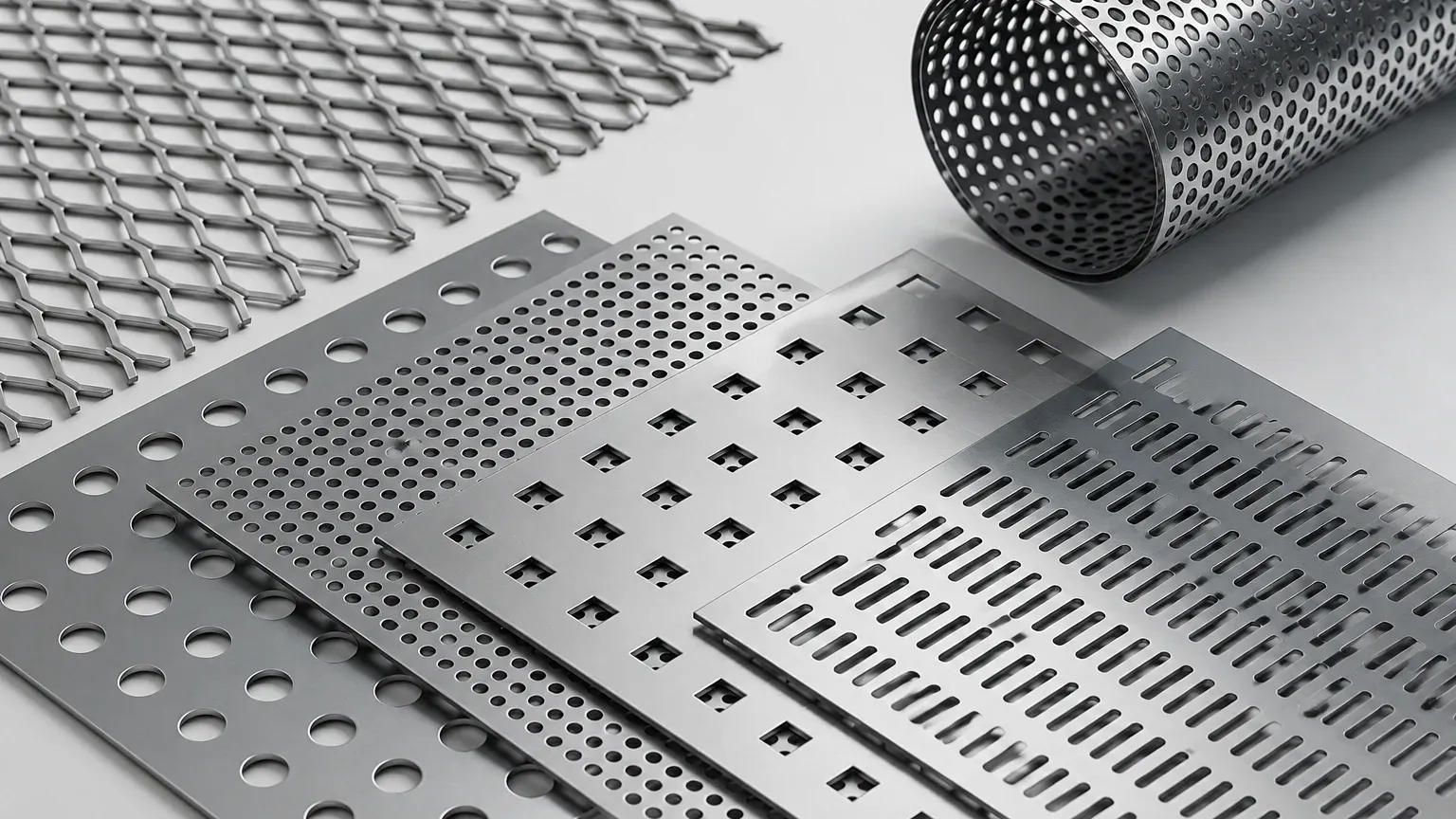
Perforated metal is created by punching holes into a solid sheet. It offers high precision in hole size and shape, making it ideal for applications requiring specific micron ratings. It is the preferred choice for stainless steel filter cartridges used in the pharmaceutical and food industries because the smooth surface is easy to clean and sterilize.
Expanded Metal
Expanded metal is produced by slitting and stretching a sheet simultaneously. This process creates diamond-shaped openings. The advantage of expanded metal is that it is produced without waste (no "slugs" are punched out), making it a cost-effective solution for structural support or coarse filtration. However, it lacks the precise filtration accuracy of perforated metal and can be more difficult to clean due to the angled strands.
When choosing between the two, consider whether the primary goal is precision filtration (perforated) or structural reinforcement and cost-efficiency (expanded).
Customization and Manufacturing Realities
Bridging the gap between a perforated metal sheet 3d model free download and a finished industrial product requires a manufacturer with advanced OEM capabilities. Standard off-the-shelf perforated sheets rarely meet the specific needs of specialized industrial equipment.
Custom Hole Geometries
While round holes are standard, certain applications benefit from square, slotted, or hexagonal perforations. For example, slotted holes are often used in the sugar industry or for vibrating screens where particle orientation is a factor. A professional manufacturer can customize these patterns to match the exact requirements of your process.
Material Selection
In demanding environments, material selection is as important as hole size.
* Stainless Steel 304: Suitable for general-purpose industrial applications with moderate corrosion resistance.
* Stainless Steel 316L: The gold standard for chemical processing and marine environments due to its superior resistance to pitting and crevice corrosion.
* Specialty Alloys: For extreme temperatures or highly acidic environments, alloys like Monel or Hastelloy may be required.
Surface Finishing
Post-perforation treatments such as deburring, degreasing, and electropolishing are vital. In the food and pharmaceutical sectors, any burrs or rough edges left by the punching process can harbor bacteria or contaminate the product stream. A 3D model will not show these microscopic details, but they are essential for compliance with industry standards.
Key Considerations Before Finalizing Your Design
Before moving from the design phase to procurement, engineers should confirm several factors to ensure the longevity and efficiency of the filtration component:
1. Pressure Differential (ΔP): Ensure the thickness (gauge) of the metal is sufficient to withstand the maximum expected pressure without deforming. If the open area is too high, the structural integrity of the sheet may be compromised.
2. Compatibility: Verify that the metal grade is chemically compatible with the fluid being filtered to prevent premature failure.
3. Replacement Cycles: Consider how often the filter will need to be cleaned or replaced. Perforated stainless steel is often chosen for its durability and ability to be backwashed or ultrasonically cleaned, providing a lower total cost of ownership compared to disposable media.
4. Tolerances: Clearly define the acceptable variance in hole diameter and sheet flatness. In precision filtration, even a small deviation can result in bypass or inefficient separation.
Conclusion
A perforated metal sheet 3d model free download is a valuable starting point for any design project, providing the visual framework necessary for initial planning. However, the success of an industrial filtration system depends on the technical details that follow. By focusing on accurate open area calculations, appropriate material selection, and precise manufacturing tolerances, engineers can ensure that their Perforated & Expanded Metal components perform reliably in the most demanding environments.
At Kaifil, we specialize in transforming digital designs into high-performance filtration solutions. Our expertise in custom stainless steel fabrication allows us to support engineers from the initial concept through to the production of durable, precision-engineered filter components. Whether you are designing a new chemical processing system or optimizing a food production line, understanding the transition from 3D model to physical product is the key to achieving optimal filtration performance.
Download Perforated Metal Sheet 3d Model Free Download as a PDF
