


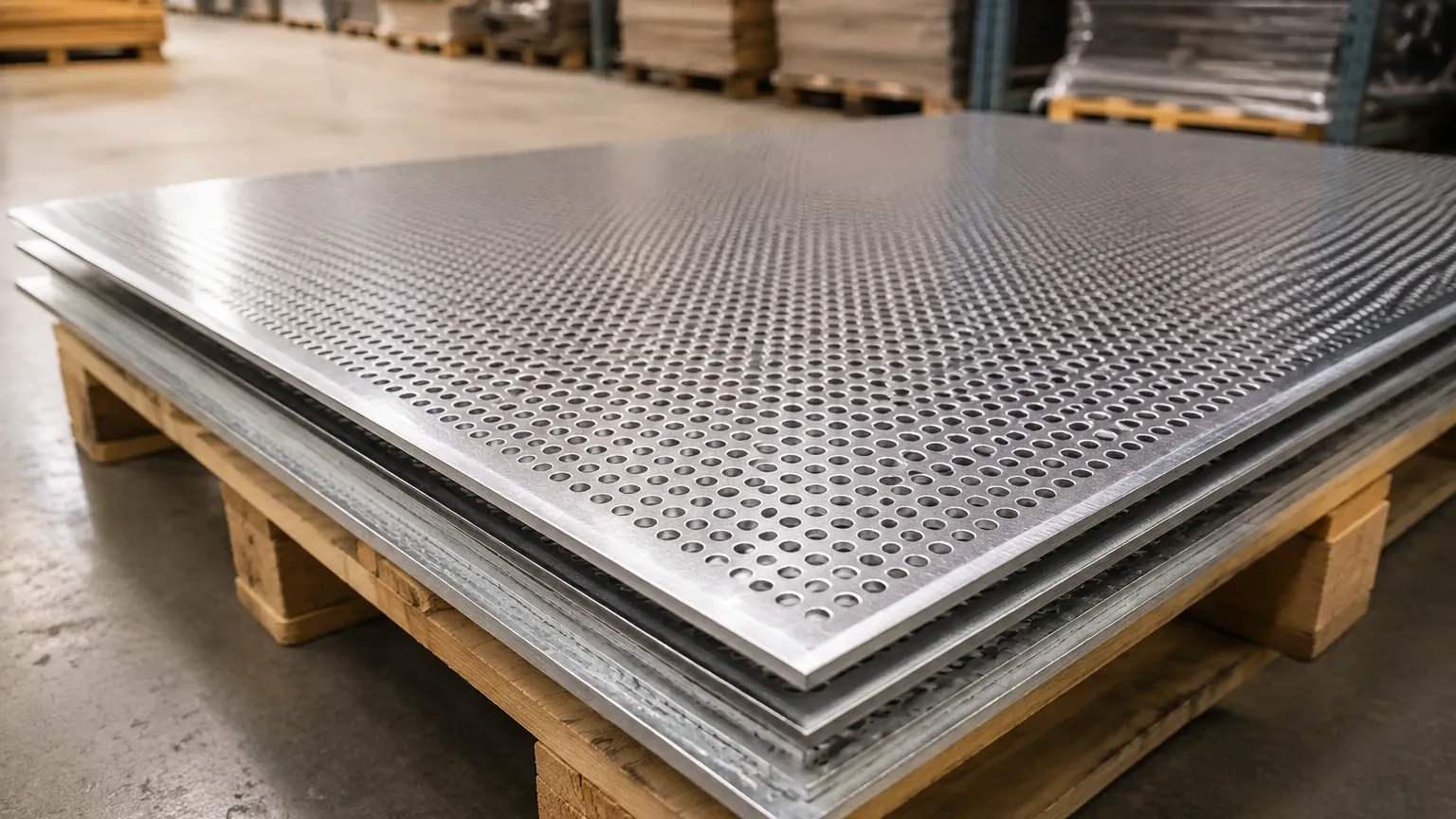
4×8 Perforated Metal Sheet Home Depot
In the procurement process for industrial components, engineers and purchasing managers often begin their search with familiar retail benchmarks. The search for a 4×8 perforated metal sheet home depot usually signals a need for a standard-sized, versatile material for structural or filtration applications. However, for industrial environments—ranging from chemical processing to food and beverage production—the transition from consumer-grade retail products to engineered industrial solutions is critical for performance, longevity, and safety.
While a standard 4×8 sheet is a common dimensional requirement, the technical specifications required for industrial filtration and structural support often exceed what is available in a general hardware inventory. Understanding the nuances of material grades, hole patterns, and manufacturing tolerances is essential for selecting the right Perforated & Expanded Metal for demanding applications.
The Industrial Context of 4×8 Perforated Metal Sheets
A 4×8 foot sheet (48 inches by 96 inches) is the industry standard for metal distribution. In the context of perforated metal, this size provides a substantial surface area that can be used as a single panel or fabricated into smaller, specialized components such as filter baskets, machine guards, or architectural screens.
Perforated metal is created through a cold-punching process where a series of holes are removed from a solid metal sheet. This process allows for precise control over the "open area"—the percentage of the sheet that consists of holes versus solid material. For engineers, this percentage is a primary calculation factor for determining flow rates in liquid filtration or air pressure drops in ventilation systems.
While the 4×8 perforated metal sheet home depot search might lead to basic aluminum or galvanized steel options intended for decorative or light-duty residential use, industrial projects typically require high-grade stainless steel (such as 304 or 316L) to withstand corrosive environments and high-pressure differentials.
Retail vs. Industrial Grade: Evaluating Procurement Options
When evaluating a 4×8 perforated metal sheet home depot option versus an industrial manufacturer like Kaifil, several technical distinctions become apparent. Retail products are designed for general-purpose utility, which often means limitations in material thickness (gauge), alloy variety, and hole precision.
Material Integrity and Alloys
In industrial filtration, the alloy is paramount. A retail-grade sheet may be listed simply as "stainless steel," but for a pharmaceutical or chemical plant, the distinction between Grade 304 and Grade 316L is the difference between a successful operation and catastrophic stress-corrosion cracking. Industrial suppliers provide material certifications (Mill Test Reports) that guarantee the chemical composition of the metal, ensuring it meets ASTM or ISO standards.
Precision and Tolerances
Industrial applications often require tight tolerances on hole diameter and pitch (the distance between the centers of adjacent holes). If a perforated sheet is being used as a support core for a fine wire mesh filter, any irregularity in the perforation pattern can create stress points that lead to premature mesh failure. Retail sheets rarely offer the precision required for high-frequency vibration environments or high-pressure hydraulic systems.
Edge Margins and Customization
A standard retail sheet usually has "random" margins, meaning the perforation pattern may be cut off at the edges. For industrial fabrication, "safe margins" (solid borders around the perforated area) are often required to facilitate welding or mounting into a frame. Custom industrial manufacturing allows for specific margin widths, which are essential for maintaining the structural integrity of the finished component.
Technical Parameters: Hole Patterns and Open Area
Selecting the right Perforated & Expanded Metal involves more than just choosing a sheet size. Engineers must specify the geometry of the perforations based on the mechanical requirements of the application.
Round Hole Patterns
Round holes are the most common and efficient for most filtration tasks. They offer the best ratio of open area to structural strength.
* 60-Degree Staggered: This is the most popular arrangement, providing maximum open area and uniform strength in all directions.
* Straight Line: Holes are aligned in rows and columns. While easier to align for certain aesthetic applications, this pattern offers less structural rigidity than staggered patterns.
Square and Slotted Holes
Square holes provide a higher open area for applications requiring maximum airflow or visibility but offer less resistance to mechanical deformation. Slotted holes are typically used for sorting and grading processes where the shape of the particles being filtered is elongated.
Calculating Open Area
The open area percentage is calculated using the hole diameter (D) and the pitch (P). For a 60-degree staggered round hole pattern, the formula is:
Open Area % = (D² × 90.69) / P²
Understanding this calculation is vital for engineers who need to ensure that a filter cartridge provides enough throughput to avoid pump cavitation or system overheating.
Applications in Industrial Filtration and Beyond
Perforated metal serves as the backbone for many complex filtration systems. Its primary role is often structural, providing the necessary rigidity to thinner filtration media.
Support Cores for Filter Cartridges
In high-pressure hydraulic or water treatment systems, fine wire mesh is often wrapped around a perforated metal cylinder. The perforated core allows the fluid to pass through while preventing the mesh from collapsing under the pressure of the flow. In these cases, the 4×8 sheet is precision-sheared, rolled, and seam-welded to create a durable internal support.
Protective Screens and Strainers
For coarse filtration, such as removing large debris from a cooling water intake, perforated metal acts as the primary filter. Its durability allows it to be cleaned repeatedly through backwashing or mechanical scraping without losing its shape.
Acoustic and Thermal Management
Beyond filtration, perforated metal is used in industrial silencers and heat shields. The hole patterns can be engineered to disrupt sound waves or facilitate specific convective cooling patterns in power generation equipment.
Engineering Considerations for Selection
Before finalizing a purchase based on a 4×8 perforated metal sheet home depot search, engineers should confirm several critical factors to ensure the material is fit for purpose.
1. Pressure Differential: Will the sheet be subjected to high pressure? If so, the thickness (gauge) and the hole-to-bar ratio must be calculated to prevent buckling.
2. Corrosive Exposure: Will the material be exposed to acids, chlorides, or high-temperature steam? This dictates the need for 316L stainless steel or specialized coatings.
3. Burr Removal: Industrial punching can leave sharp edges (burrs). For applications in food processing or pharmaceutical manufacturing, the metal must be deburred or electropolished to ensure it does not harbor bacteria or contaminate the product.
4. Flatness Requirements: Large 4×8 sheets can develop internal stresses during the punching process, causing them to curl or "oil can." Industrial suppliers use leveling rollers to ensure the sheet remains perfectly flat for precision fabrication.
Customization: Moving Beyond the Standard 4×8 Sheet
While the 4×8 dimension is a convenient starting point, many industrial projects benefit from custom-sized sheets or pre-fabricated components. Customization reduces material waste (scrap) and eliminates the need for on-site cutting, which can be difficult with thick-gauge stainless steel.
Industrial manufacturers can provide:
* Custom Dimensions: Sheets cut to exact sizes (e.g., 3×10 or 5×12) to fit specific equipment frames.
* Bolt Hole Circles: Pre-punched mounting holes in the solid margins for easy installation.
* Forming and Welding: Delivering the perforated metal already rolled into cylinders or folded into trays.
* Surface Finishes: Including pickling, passivation, or powder coating to enhance corrosion resistance.
Conclusion: Making an Informed Procurement Decision
For a DIY project or a simple residential repair, a 4×8 perforated metal sheet home depot might suffice. However, for technical professionals and engineers, the stakes are significantly higher. The performance of a filtration system or the safety of a machine guard depends on the mechanical integrity of the metal used.
By sourcing from a specialized manufacturer like Kaifil, procurement teams gain access to technical expertise, material traceability, and customization options that retail outlets cannot provide. Whether you require a standard 4×8 sheet for a prototype or a thousand custom-fabricated filter cores, focusing on industrial-grade Perforated & Expanded Metal ensures that your components will meet the rigorous demands of your specific application.
When selecting perforated metal, always prioritize the technical specifications—alloy, open area, and tolerances—over the convenience of retail availability to ensure long-term operational efficiency and a lower total cost of ownership.
