


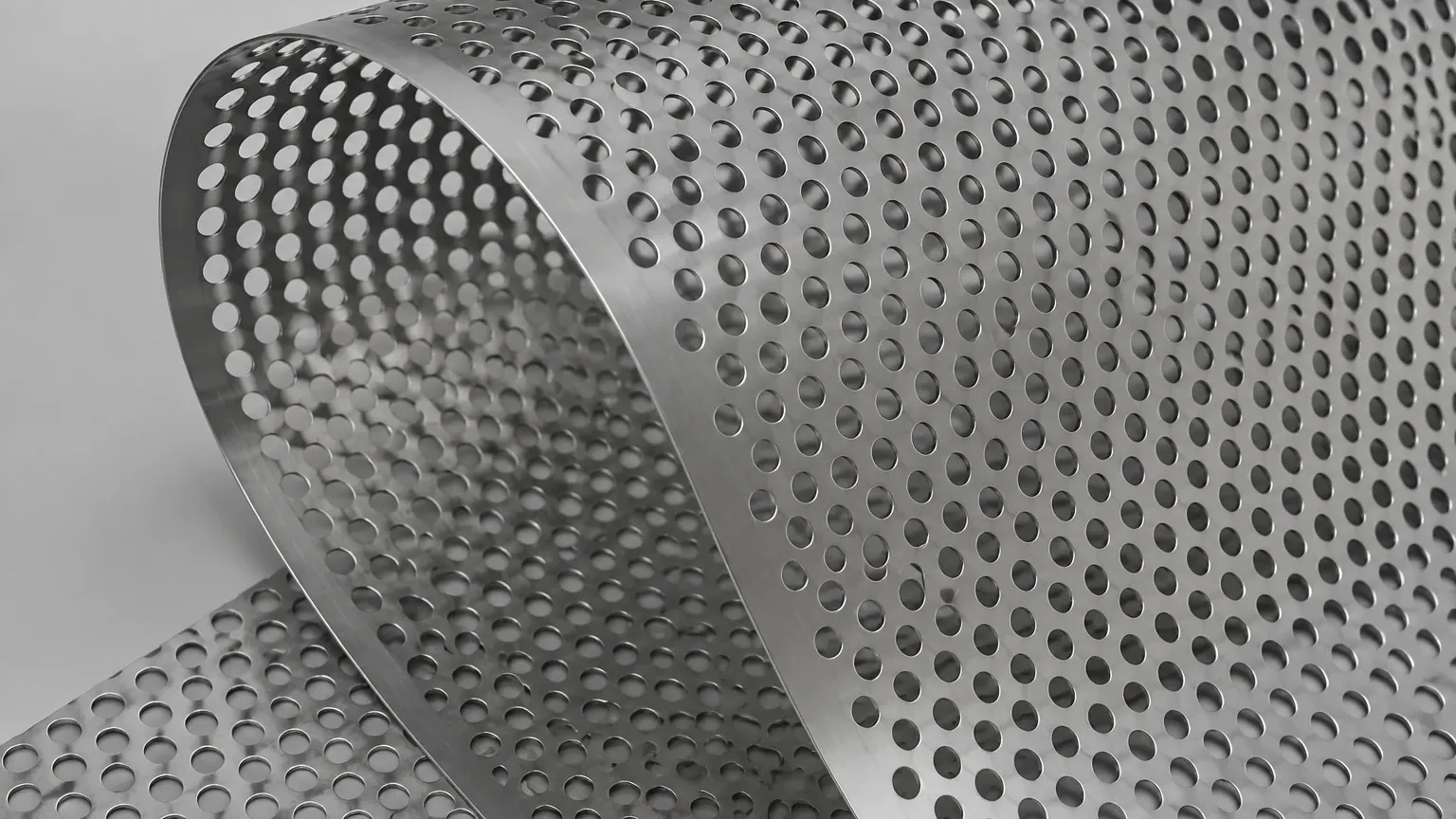
Perforated Metal 5mm
In industrial filtration and structural engineering, the specification of perforated metal components requires a precise balance between mechanical integrity and functional performance. Perforated metal 5mm—referring typically to a 5mm hole diameter—serves as a versatile standard in various processing environments. Whether utilized as a primary filtration media, a support structure for finer mesh, or a protective screen, understanding the technical nuances of this specification is essential for engineers and procurement teams.
At Kaifil, we specialize in the manufacturing of custom stainless steel filtration solutions, where Perforated & Expanded Metal components form the backbone of many high-performance systems. This guide explores the engineering considerations, material selection, and application-specific variables that define the utility of 5mm perforated metal in industrial contexts.
Technical Specifications and Geometry
When specifying perforated metal 5mm, the hole diameter is only one part of the equation. Engineers must also define the pitch, the pattern, and the resulting open area, as these factors directly influence flow rates and structural rigidity.
Hole Patterns and Pitch
The most common configuration for 5mm perforations is the 60-degree staggered round hole pattern. This layout provides the highest degree of structural uniformity and is preferred for most industrial applications. The pitch—the distance from the center of one hole to the center of the adjacent hole—determines the "open area" percentage. For a 5mm hole, a typical pitch might range from 7mm to 10mm.
Calculating Open Area
The open area is a critical metric for fluid dynamics. For a staggered 60-degree pattern, the formula is:
Open Area % = (D² × 90.69) / P²
Where *D* is the hole diameter (5mm) and *P* is the pitch. A 5mm hole on an 8mm pitch results in an open area of approximately 35%. Increasing the pitch reduces the open area but increases the mechanical strength of the sheet, which is vital for high-pressure hydraulic or chemical processing environments.
Material Selection for 5mm Perforated Components
The longevity of a perforated metal 5mm component depends heavily on the alloy selected. Since these components are often exposed to corrosive fluids or extreme temperatures, material choice is a primary engineering decision.
Stainless Steel 304 and 316L
Stainless steel is the industry standard for precision filtration. Grade 304 offers excellent corrosion resistance for general industrial use, such as food processing or HVAC screening. However, for more demanding environments involving chlorides or acidic solutions, Grade 316L is preferred due to its molybdenum content, which provides superior resistance to pitting and crevice corrosion.
Specialty Alloys
In specific chemical processing or high-heat applications, materials like Duplex stainless steel or Monel may be required. These alloys provide the necessary tensile strength and chemical stability that standard carbon steel or aluminum cannot offer, particularly when the perforated sheet must maintain its 5mm aperture precision under thermal expansion.
Perforated vs. Expanded Metal: Engineering Trade-offs
While both Perforated & Expanded Metal are used in industrial screening, they are manufactured through different processes that result in distinct mechanical properties.
* Perforated Metal: Created by punching holes through a solid sheet. This process allows for extremely precise 5mm circular apertures and flat surfaces. It is the preferred choice when exact particle retention and ease of cleaning are required.
* Expanded Metal: Produced by slitting and stretching the metal. While it is more cost-effective and creates no scrap waste, it does not produce a perfectly circular 5mm hole. Instead, it creates diamond-shaped openings. Expanded metal is often used for structural walkways or secondary support layers where precise filtration is less critical than weight-to-strength ratios.
For most filtration cartridges and precision strainers, perforated metal 5mm is the superior choice due to the predictability of the flow path and the ability to maintain consistent margins for welding.
Filtration Performance and Fluid Dynamics
In a filtration system, a 5mm aperture is classified as coarse filtration. Its primary role is often to protect downstream equipment—such as pumps, valves, and finer filter membranes—from large debris or to act as a catalyst support bed.
Pressure Drop Considerations
Every perforated plate introduces a pressure drop ($ΔP$) into the system. With a 5mm hole size, the pressure drop is relatively low compared to micron-rated mesh, but it must still be calculated based on fluid viscosity and flow velocity. Engineers must ensure that the total open area of the perforated metal 5mm component is sufficient to prevent cavitation in pumping systems.
Particle Retention and the "Bridge" Effect
While a 5mm hole will theoretically pass any particle smaller than 5mm, the "bridge" effect can occur in high-concentration slurries. This happens when multiple particles smaller than 5mm arrive at the aperture simultaneously and wedge together, effectively blocking the hole. Understanding the solids loading of the process fluid is essential when determining if a 5mm perforation is appropriate or if a different aperture geometry is needed.
Manufacturing and Customization Capabilities
Standard off-the-shelf perforated sheets often fail to meet the rigorous requirements of custom industrial machinery. At Kaifil, we emphasize the importance of tailored manufacturing for perforated metal 5mm components.
Custom Margins and Blank Areas
Unlike standard sheets, custom-manufactured perforated components can include "unperforated" margins. These solid edges are crucial for seam welding into filter cartridges or for bolting the plate into a housing without compromising the structural integrity of the perforated pattern.
Forming and Fabrication
Perforated metal 5mm sheets are frequently rolled into cylinders to create filter baskets or cartridges. This requires precise calculation of the "stretch" during the rolling process to ensure the 5mm holes do not deform into ovals, which would change the filtration characteristics. Advanced CNC punching and rolling equipment ensure that the finished component meets the exact tolerances required by the assembly.
Applications of 5mm Perforated Metal
The utility of this specific aperture size spans multiple heavy industries, each with unique performance requirements.
1. Food and Beverage Processing: Used in grain drying, malt kilning, and as large-scale strainers for fruit processing. The 5mm size allows for high-volume fluid flow while retaining large organic solids.
2. Water Treatment: Perforated metal 5mm plates serve as intake screens for municipal and industrial water systems, preventing fish, leaves, and large debris from entering the treatment plant.
3. Chemical and Petrochemical: Often used as support grids for molecular sieves or catalyst beds. The 5mm holes provide a stable platform for the catalyst media while allowing the processed gas or liquid to pass through with minimal resistance.
4. Hydraulic Systems: In large-scale hydraulic reservoirs, 5mm perforated screens act as diffusers to reduce fluid turbulence and prevent large contaminants from reaching the suction line.
Maintenance and Replacement Cycles
For engineers, the total cost of ownership (TCO) is as important as the initial purchase price. Perforated metal 5mm components made from high-quality stainless steel are designed for durability, but they are not maintenance-free.
Cleaning Protocols
Because 5mm holes are relatively large, they are less prone to irreversible fouling than fine wire mesh. However, in applications like food processing, biological buildup can occur. The smooth surface of punched perforated metal allows for effective Clean-in-Place (CIP) procedures, including high-pressure washing and chemical sanitization.
Monitoring Wear and Erosion
In abrasive environments—such as mining or slurry transport—the edges of the 5mm perforations can erode over time. As the holes enlarge, the filtration accuracy decreases. Regular inspection of the hole diameters using calibrated gauges is recommended to ensure the system remains within specification. If the material thickness was underspecified, the "bridges" between the holes may crack under cyclic pressure loading, necessitating immediate replacement to avoid downstream damage.
Key Considerations Before Purchasing
Before finalizing a procurement order for perforated metal 5mm, technical teams should confirm the following parameters with their manufacturer:
* Material Grade: Is 304 sufficient, or does the environment demand 316L or a specialty alloy?
* Thickness (Gauge): Does the sheet thickness provide enough rigidity for the expected pressure differential?
* Open Area Requirement: Is the pitch optimized for the required flow rate?
* Edge Requirements: Are specific margins needed for welding or mounting?
* Surface Finish: Is a mill finish acceptable, or is electropolishing required for sanitary applications?
As a dedicated manufacturer, Kaifil provides the engineering support necessary to navigate these decisions. Our expertise in Perforated & Expanded Metal ensures that every component is optimized for its specific industrial environment, from material selection to final fabrication.
Conclusion
Perforated metal 5mm is a fundamental component in the industrial landscape, offering a reliable solution for coarse filtration and structural support. By focusing on the technical details—such as open area calculations, material compatibility, and custom fabrication needs—engineers can ensure their filtration systems operate with maximum efficiency and minimal downtime. When precision and durability are paramount, choosing a manufacturer with deep expertise in stainless steel filtration is the most effective way to achieve long-term performance goals.
