


Perforated Metal 50 Open
In industrial engineering and filtration design, the specification of "50 open" refers to a perforated metal sheet where exactly 50% of the surface area has been removed through the punching or drilling process. This specific ratio is a critical benchmark for engineers who require a precise balance between fluid throughput and structural rigidity. Selecting a perforated metal 50 open configuration involves more than just choosing a hole size; it requires a deep understanding of hole patterns, material thickness, and the mechanical stresses the component will face in its operational environment.
At Kaifil, we specialize in manufacturing high-precision Perforated & Expanded Metal solutions tailored to the rigorous demands of the chemical, pharmaceutical, and food processing industries. Understanding the technical nuances of the 50% open area specification is essential for optimizing the performance of filtration systems, acoustic panels, and ventilation components.
Understanding the 50% Open Area Specification
The "open area" of a perforated sheet is the percentage of the total area that is occupied by the openings. For a 50% open area, the void space is equal to the solid material space. This is often considered a high-flow specification. In filtration, the open area directly correlates to the face velocity and the pressure drop across the medium.
When an engineer specifies perforated metal 50 open, they are looking for a configuration that minimizes resistance to air or liquid flow while maintaining enough "bridge" (the material between the holes) to prevent the sheet from buckling under pressure. This balance is particularly vital in high-pressure hydraulic systems or large-scale industrial strainers where the perforated metal acts as a support for finer wire mesh layers.
Engineering Calculations for Perforated Metal Patterns
Achieving exactly 50% open area depends on the geometric arrangement of the holes. The two most common patterns are the 60-degree staggered pattern and the straight-line pattern. Each offers different mechanical properties and flow characteristics.
60-Degree Staggered Pattern
The 60-degree staggered pattern is the industry standard due to its inherent structural strength and uniform distribution of openings. To calculate the open area (OA) for round holes in a staggered pattern, the following formula is used:
OA = (D² × 90.69) / C²
Where:
* D is the hole diameter.
* C is the center-to-center distance (pitch).
For example, to achieve approximately 50% open area with a 3mm hole diameter, the center-to-center distance would need to be approximately 4.04mm. This pattern provides the highest degree of structural integrity because it avoids creating long, continuous lines of weakness in the metal.
Straight-Line Pattern
In a straight-line pattern, holes are aligned in both the horizontal and vertical axes. The formula for open area is simpler:
OA = (D² × 78.5) / C²
While easier to manufacture for certain specialized applications, straight patterns are generally weaker than staggered patterns. An engineer might choose a straight pattern for perforated metal 50 open if the application requires specific alignment with other components or if the sheet is not subjected to significant mechanical loads.
Balancing Flow Efficiency and Structural Integrity
The primary challenge with a 50% open area is the reduction in the material's cross-sectional area. As the open area increases, the mechanical strength of the sheet decreases. This relationship is non-linear; a small increase in open area can lead to a significant decrease in the yield strength of the component.
The Importance of the "Bridge"
The "bridge" or "bar" is the solid material remaining between the holes. In a 50% open area configuration, the bridge width is often narrow. Engineers must ensure that the bridge is thick enough to withstand the "hoop stress" in cylindrical filter cartridges or the "bending stress" in flat vibrating screens. If the bridge is too narrow relative to the material thickness, the punching process itself can introduce internal stresses that lead to warping or premature fatigue failure.
Pressure Drop Considerations
In filtration applications, a 50% open area is highly effective at reducing the initial pressure drop (ΔP). This allows for higher flow rates without requiring larger pumps or increased energy consumption. However, if the perforated metal is used as a support for a fine mesh, the effective open area may be lower than 50% due to the overlap of the mesh wires and the perforated bridges. This "shadowing effect" must be accounted for during the design phase to ensure the system meets its performance targets.
Material Selection for Demanding Industrial Environments
Because perforated metal 50 open has a high surface-area-to-volume ratio, it is more susceptible to corrosion and environmental degradation than solid plate. Choosing the correct alloy is paramount for longevity.
Stainless Steel 304 and 316L
For most industrial filtration and processing applications, stainless steel is the preferred material.
* Grade 304: Suitable for general-purpose applications, including food processing and architectural grilles. It offers excellent formability and cost-effectiveness.
* Grade 316L: Essential for chemical processing, marine environments, and pharmaceutical manufacturing. The addition of molybdenum and the lower carbon content provide superior resistance to pitting and crevice corrosion, which is particularly important around the edges of the punched holes where the protective oxide layer may be thinner.
Specialized Alloys
In high-temperature or highly acidic environments, alloys such as Duplex stainless steel or Monel may be required. These materials maintain their structural properties even when perforated to a 50% open area, ensuring that the filter or screen does not fail in critical service.
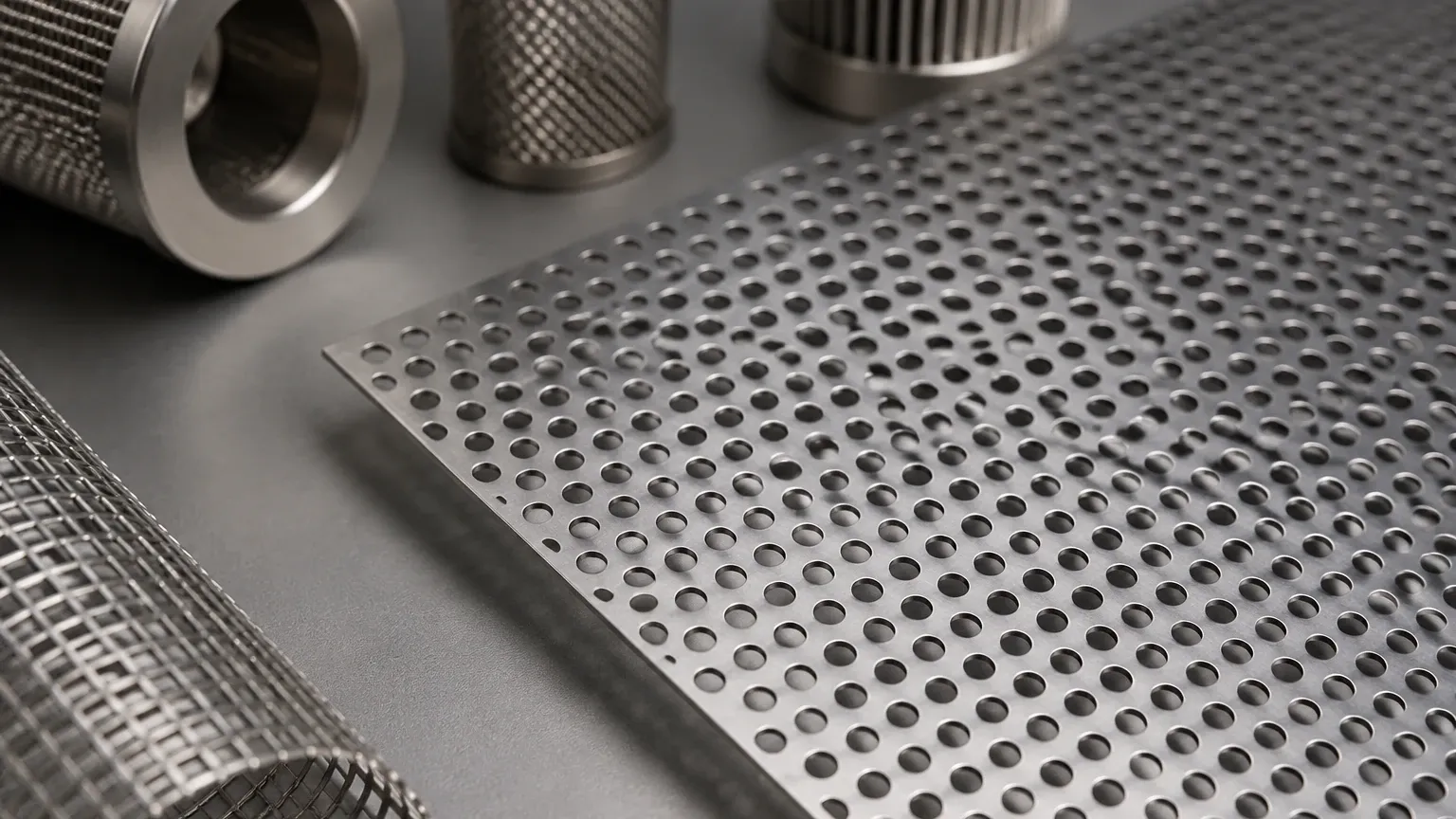
Key Applications in Filtration and Fluid Management
The versatility of perforated metal 50 open makes it a staple in various technical sectors. Its ability to act as both a primary filter and a secondary support structure is invaluable.
Filter Cartridge Support Cores
In industrial liquid filtration, pleated filter elements or wire mesh sleeves require a rigid internal core to prevent collapse. A 50% open area perforated tube provides the necessary radial strength while ensuring that the support structure does not impede the flow of the filtrate. This is common in hydraulic systems where fluid viscosity can vary significantly with temperature.
Acoustic Damping and Sound Attenuation
Perforated metal is widely used in silencers and acoustic panels. A 50% open area allows sound waves to pass through the metal and into sound-absorbing material (such as mineral wool) behind it. The specific hole size and pitch can be tuned to target certain frequency ranges, making it an engineering tool for noise control in industrial machinery rooms.
Centrifuge Baskets and Drying Trays
In the food and pharmaceutical industries, perforated metal 50 open is used for centrifuge baskets and drying trays. The high open area facilitates rapid drainage of liquids and efficient heat transfer during drying cycles. The smooth, burr-free finish provided by Kaifil’s manufacturing process is essential here to prevent product entrapment and ensure easy cleaning (CIP/SIP compatibility).
Specifying Custom Perforated Metal for OEM Projects
When ordering perforated metal for a specific project, providing a complete technical specification is necessary to ensure the final product meets the application's requirements. Engineers and purchasing teams should confirm the following parameters:
1. Material Grade: Specify the exact alloy (e.g., SS316L) and any required certifications (e.g., FDA compliance for food contact).
2. Hole Diameter and Shape: While round holes are standard, square or hexagonal holes may be used to achieve higher open areas or specific flow patterns.
3. Pitch and Pattern: Confirm whether a 60-degree staggered or straight-line pattern is required.
4. Sheet Thickness: This must be balanced against the open area to ensure structural integrity.
5. Margins: Specify the unperforated borders required for welding or mounting. Large margins can significantly reduce the overall "effective" open area of a panel.
6. Flatness Requirements: Punching can cause material distortion. Specify if precision leveling is required after perforation.
7. Surface Finish: Options include de-burring, pickling, passivating, or electropolishing to enhance corrosion resistance and cleanliness.
Kaifil’s engineering team works closely with global customers to develop customized Perforated & Expanded Metal components. By controlling the manufacturing process from material selection to final finishing, we ensure that every sheet of perforated metal 50 open delivers the reliability and performance demanded by modern industrial applications.
Total Cost of Ownership and Maintenance
While the initial purchase price of perforated metal is a factor, the total cost of ownership (TCO) is driven by durability and maintenance requirements. A 50% open area sheet that is improperly specified—perhaps using a material that is too thin or an alloy that is not corrosion-resistant—will lead to frequent replacements and costly system downtime.
In filtration systems, the ease of cleaning the perforated support is also a TCO factor. High-quality perforation with clean-cut edges prevents the buildup of contaminants and reduces the time required for maintenance cycles. For engineers looking to optimize their filtration performance, investing in precision-engineered perforated metal is a strategic decision that pays off in long-term operational efficiency.
