


Metal Perforated Panels
In the landscape of industrial filtration and structural engineering, metal perforated panels serve as essential components that balance mechanical strength with precise permeability. These panels are not merely sheets of metal with holes; they are engineered solutions designed to manage fluid dynamics, provide structural support for finer filtration media, and withstand the rigorous demands of chemical, pharmaceutical, and food processing environments.
Understanding the technical nuances of Perforated & Expanded Metal is critical for engineers and procurement teams who must specify materials that meet strict performance tolerances. This guide examines the manufacturing principles, material science, and engineering considerations required to select the optimal metal perforated panels for industrial applications.
Technical Foundations: Perforation vs. Expansion
While often discussed together, perforated metal and expanded metal are produced through distinct mechanical processes that result in different physical properties and performance characteristics.
Perforated Metal Panels
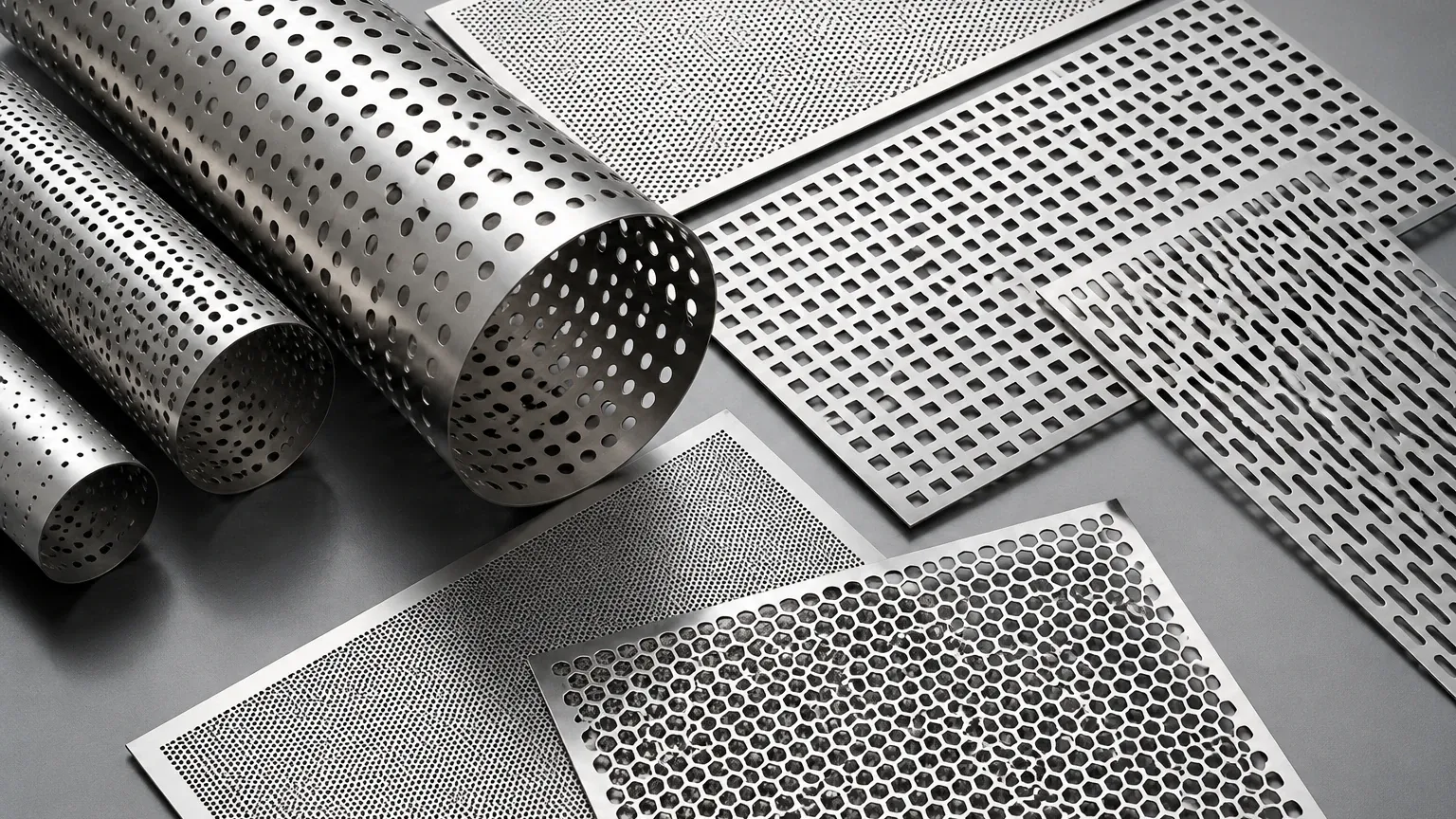
Perforation involves a subtractive manufacturing process where a series of holes are punched into a solid metal sheet using a CNC press or a rotary pinned cylinder. This process allows for extreme precision in hole placement, size, and geometry. The primary advantage of metal perforated panels is their versatility; they can be manufactured with round, square, slotted, or decorative patterns, with hole diameters ranging from micrometers to several centimeters. Because the base material remains a flat sheet, these panels maintain high dimensional stability and are easily integrated into filter cartridges and support housings.
Expanded Metal
In contrast, expanded metal is produced through a simultaneous slitting and stretching process. A single sheet of metal is cut and pulled, creating a diamond-shaped mesh pattern. Unlike perforation, expansion is a non-subtractive process, meaning no material is lost during production. This makes expanded metal a cost-effective alternative for applications where high open areas and lightweight structures are required. However, the expansion process creates a three-dimensional texture that may require "flattening" if a smooth surface is necessary for secondary bonding or filtration layers.
Material Selection and Metallurgical Considerations
The longevity and reliability of metal perforated panels depend heavily on the alloy selected. In industrial filtration, where exposure to corrosive chemicals, high temperatures, and high-pressure differentials is common, stainless steel is the industry standard.
1. Type 304 Stainless Steel: The most common grade used for general industrial applications. It offers excellent formability and weldability with reasonable corrosion resistance. It is suitable for food processing and general water treatment where extreme chemical exposure is not a primary concern.
2. Type 316/316L Stainless Steel: For more demanding environments, such as marine applications, chemical processing, or pharmaceutical manufacturing, 316L is preferred. The addition of molybdenum enhances resistance to pitting and crevice corrosion, particularly in chloride-rich environments. The "L" (low carbon) designation ensures that the material maintains its corrosion resistance after welding by preventing carbide precipitation.
3. Specialty Alloys: In high-temperature or highly acidic environments, materials such as Duplex stainless steel, Monel, or Inconel may be specified. These alloys provide the mechanical integrity required for specialized filtration systems in the petrochemical sector.
Engineering Specifications: Patterns and Open Areas
When specifying metal perforated panels, engineers must calculate the "Open Area Percentage." This figure determines the flow rate, pressure drop, and filtration efficiency of the component.
Hole Patterns and Pitch
* Round Holes (60° Staggered): This is the most popular configuration due to its inherent structural strength and high open-area potential. The 60-degree alignment ensures that the stress is distributed evenly across the panel.
* Straight Row Patterns: Used when specific directional flow is required, though generally weaker than staggered patterns.
* Slotted Holes: Often utilized in solid-liquid separation where the shape of the particles is elongated. Slotted panels are frequently found in grain processing and wastewater screening.
Calculating Open Area
The formula for calculating the open area of a staggered round-hole pattern is:
Open Area % = (D² × 90.69) / P²
*(Where D = Hole Diameter and P = Pitch/Center-to-Center distance)*
A higher open area reduces the pressure drop across the filter but may compromise the structural integrity of the panel. Engineers must find the "sweet spot" where the panel is porous enough to allow efficient flow but rigid enough to withstand the mechanical stress of the system.
The Role of Perforated Panels in Filtration Systems
In the context of Kaifil’s expertise in custom filtration solutions, metal perforated panels often serve as the "backbone" or support structure for more delicate filtration media.
Support for Wire Mesh
Fine stainless steel wire mesh lacks the structural rigidity to withstand high-pressure differentials on its own. In a typical filter cartridge construction, a perforated metal core provides the internal support, while an outer perforated wrap protects the mesh from external impacts. This "sandwich" construction ensures that the filtration accuracy of the mesh is maintained even under fluctuating hydraulic loads.
Primary Filtration
In applications involving coarse particles, such as cooling water intake or large-scale food processing, the perforated panel itself acts as the primary filter. The precision of modern CNC punching allows for hole sizes that can effectively capture debris while maintaining a high flow rate that mesh filters might struggle to sustain without frequent clogging.
Evaluation Criteria for Quality Assurance
When sourcing metal perforated panels for industrial use, several quality factors must be verified to ensure long-term performance:
* Burr-Free Edges: During the punching process, small metal burrs can form on the exit side of the hole. For filtration applications, these burrs must be removed through mechanical or chemical polishing to prevent particle entrapment and to ensure the safety of personnel handling the components.
* Flatness and Tolerances: Panels must meet strict flatness requirements, especially if they are to be rolled into cylinders for filter cartridges. Excessive bowing or warping can lead to gaps in the filter assembly, resulting in bypass—where unfiltered fluid escapes through the seams.
* Margin Specifications: Engineers must define the "margins" (the unperforated areas along the edges of the sheet). Proper margins are essential for welding the panel to end caps or support frames without damaging the perforated pattern.
Customization and OEM Integration
Industrial filtration is rarely a one-size-fits-all field. Customization is often required to meet specific flow dynamics or spatial constraints. Kaifil specializes in providing tailored metal perforated panels that align with specific OEM requirements.
Customization options include:
* Variable Hole Sizes: Graduated perforation patterns to manage flow distribution across a large surface area.
* Custom Shapes: Beyond flat sheets, panels can be supplied as pre-formed cylinders, cones, or baskets.
* Surface Treatments: Electropolishing, passivating, or specialized coatings to enhance the chemical resistance or hygienic properties of the stainless steel.
Total Cost of Ownership and Maintenance
While the initial purchase price of metal perforated panels is a factor, the total cost of ownership (TCO) is determined by durability and maintenance cycles. High-quality stainless steel panels may have a higher upfront cost than galvanized or plastic alternatives, but their resistance to thermal shock and chemical degradation results in a significantly longer service life.
Replacement Cycles
In most industrial systems, perforated panels are considered permanent or semi-permanent components. Unlike disposable filter elements, these metal panels can often be cleaned through backwashing, ultrasonic cleaning, or chemical soaking. Replacement is typically only necessary if the panel suffers mechanical deformation or if the hole edges have eroded over years of abrasive flow.
Procurement Checklist for Engineers
Before finalizing a specification for metal perforated panels, confirm the following technical details:
1. Media Compatibility: Is the alloy resistant to the specific pH levels and chemicals in the process stream?
2. Pressure Differential: What is the maximum expected pressure, and can the selected thickness and open area support it without buckling?
3. Filtration Grade: Does the hole size provide the necessary protection for downstream equipment?
4. Compliance: Does the material meet industry-specific standards, such as FDA or 3A requirements for food and beverage applications?
Conclusion
Metal perforated panels are critical engineering components that require a deep understanding of material science and fluid mechanics. By selecting the correct perforation pattern, material grade, and structural specifications, industrial operators can ensure efficient filtration, reduced downtime, and long-term system reliability. Whether used as a standalone screen or as a support structure for complex filter cartridges, the quality of the Perforated & Expanded Metal remains a determining factor in the success of industrial processing operations. For engineers and purchasing teams, partnering with a manufacturer that understands these technical boundaries is the most effective way to optimize filtration performance and achieve a lower total cost of ownership.
