


Tea Strainers
In the industrial beverage sector, the precision of filtration components directly impacts product clarity, flavor profile, and operational efficiency. While a consumer might view tea strainers as simple kitchen tools, for engineers and procurement professionals in the food and beverage industry, these components are critical precision-engineered elements. High-performance tea strainers are essential for large-scale extraction, concentrate production, and the manufacturing of ready-to-drink (RTD) beverages. Selecting the appropriate Strainers & Baskets requires a deep understanding of material science, mesh geometry, and fluid dynamics to ensure consistent quality and equipment longevity.
Material Selection and Food Safety Compliance
The primary consideration for any industrial filtration component used in beverage production is material integrity. Tea contains tannins and other organic acids that can be mildly corrosive over long periods of exposure, especially at high extraction temperatures. Therefore, the choice of stainless steel is non-negotiable for professional applications.
Stainless Steel 304 vs. 316
Most industrial tea strainers are manufactured using Stainless Steel 304 (SS304) or Stainless Steel 316 (SS316). SS304 offers excellent corrosion resistance and is the standard for most food-grade applications. However, in environments where the filtration system is exposed to high concentrations of chlorides or more aggressive cleaning agents, SS316 is preferred due to its molybdenum content, which provides superior pitting resistance.
Regulatory Standards
For B2B buyers, ensuring that the materials meet international food safety standards such as FDA or EC 1935/2004 is vital. This ensures that the metal does not leach harmful substances into the beverage and that the surface finish is smooth enough to prevent bacterial growth. A precision-manufactured strainer will often undergo electropolishing to achieve a Ra (Roughness Average) value that facilitates easy cleaning and sanitization.
Engineering Filtration Efficiency: Mesh and Micron Ratings
The performance of tea strainers is defined by their ability to remove solids while maintaining the desired flow rate. This balance is achieved through the careful selection of wire mesh specifications.
Mesh Count and Aperture Size
Mesh count refers to the number of openings per linear inch. For tea filtration, the required mesh count depends on the grade of the tea leaf being processed.
- Whole Leaf Tea: Requires coarser mesh (typically 20 to 40 mesh) to allow for high flow rates while capturing large leaves.
- Fannings and Dust: Used in tea bag production or concentrates, these require much finer filtration, often ranging from 100 to 400 mesh (approximately 37 to 149 microns).
Open Area Percentage
The "open area" is the ratio of the total area of the holes to the total area of the mesh. A higher open area reduces the pressure drop across the filter, which is critical for maintaining pump efficiency in automated lines. However, thinner wires used to increase open area may compromise the structural integrity of the strainer under high-pressure conditions. Engineers must calculate the optimal wire diameter to ensure the strainer can withstand the mechanical stresses of the filtration cycle without deforming.
Structural Design of Industrial Strainers & Baskets
Unlike consumer-grade products, industrial tea strainers must be integrated into complex piping systems or large extraction vats. The structural design determines how easily the component can be installed, removed, and cleaned.
Basket and Cone Configurations
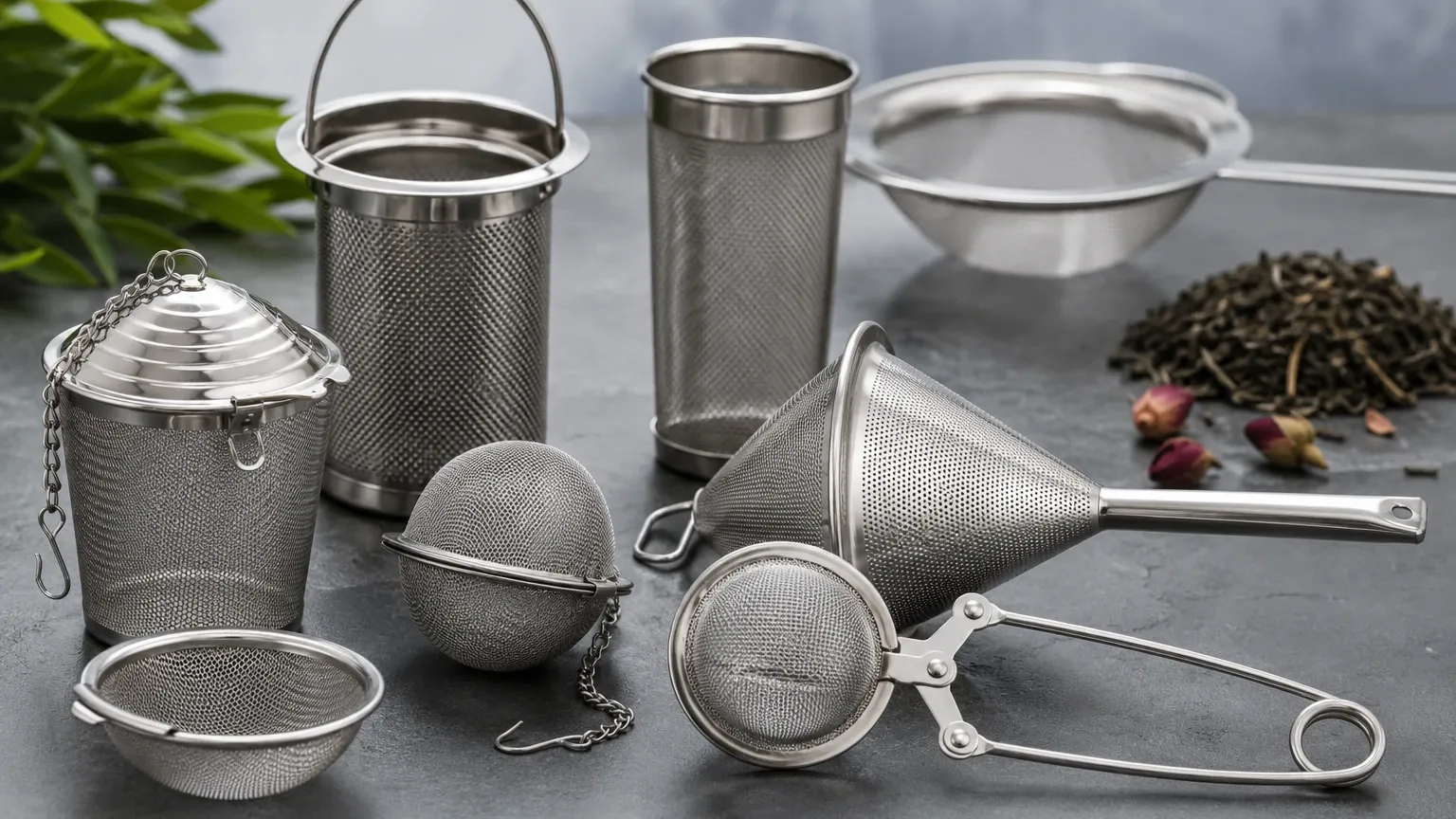
Basket strainers are the most common design for batch processing. They provide a large surface area for filtration, which extends the time between cleaning cycles. For high-velocity in-line filtration, cone-shaped or "witch’s hat" strainers are often used. These designs distribute the pressure more evenly across the mesh surface, reducing the risk of mesh failure.
Reinforcement and Support
Fine wire mesh is inherently delicate. To prevent the mesh from bursting or collapsing under the weight of wet tea leaves or the force of fluid flow, industrial strainers often feature a perforated metal backup or a heavy-duty support frame. This multi-layer construction ensures that the fine filtration layer remains intact even during high-pressure surges.
Custom Flanges and Handles
Customization is a key factor for OEM equipment manufacturers. Strainers must often be designed with specific flange types (such as ANSI, DIN, or JIS) or specialized handles to facilitate rapid removal during maintenance. In high-volume production environments, reducing the "down-time" required to swap or clean a strainer is a major factor in total cost considerations.
Application in Large-Scale Beverage Processing
The role of tea strainers extends across various stages of the production line, from the initial steeping to the final bottling process.
Primary Extraction
In the primary extraction phase, large basket strainers are used to separate the bulk tea leaves from the liquid extract. The challenge here is the volume of solids. The strainer must be designed to hold a significant weight of saturated leaves without obstructing the flow of the extract.
Polishing and Final Filtration
Before bottling, the tea extract often undergoes a "polishing" phase to remove fine particulates that could cause turbidity (cloudiness) in the final product. This requires high-precision wire mesh filters that can capture particles down to the sub-100 micron level. Consistent filtration at this stage is essential for maintaining the visual clarity and shelf-stability of RTD tea products.
Protection of Downstream Equipment
Beyond product quality, strainers serve a protective function. They prevent rogue tea stems or foreign particulates from entering pumps, heat exchangers, or filling nozzles. A failure in a primary strainer can lead to catastrophic damage to expensive downstream machinery, making the reliability of the filtration component a critical safety net for the entire facility.
Maintenance, Cleaning, and Replacement Cycles
To maintain hygiene and performance, industrial tea strainers require a rigorous maintenance schedule. The ease with which a strainer can be cleaned is a significant factor in its operational value.
Clean-In-Place (CIP) Compatibility
Modern beverage plants rely on CIP systems to sanitize equipment without disassembly. Strainers designed for CIP must have no "dead zones" where organic material can accumulate and harbor bacteria. Smooth welds and polished surfaces are essential technical requirements for these environments.
Manual Cleaning and Durability
In many applications, strainers are removed and cleaned manually. This involves high-pressure water jets or ultrasonic cleaning. A high-quality industrial strainer must be robust enough to withstand repeated handling and aggressive cleaning without the wire mesh fraying or the seams splitting. Frayed mesh is a significant risk, as broken wires can contaminate the product stream.
Monitoring Pressure Differential
Engineers monitor the performance of tea strainers by measuring the pressure differential (Delta P) across the filter. An increasing Delta P indicates that the strainer is becoming clogged and requires cleaning. By tracking these metrics, plant managers can optimize replacement cycles and prevent unplanned downtime.
Total Cost of Ownership vs. Initial Purchase Price
When procuring filtration components, it is tempting to focus solely on the initial unit cost. However, for industrial applications, the Total Cost of Ownership (TCO) is a more accurate metric.
Longevity and Reliability
A low-cost strainer made from inferior mesh or with poor welding will likely fail prematurely, leading to production halts and potential product loss. In contrast, a precision-engineered stainless steel strainer may have a higher upfront cost but will offer a significantly longer service life and lower risk of failure.
Customization and OEM Support
Working with a manufacturer that offers OEM and customized filtration solutions allows engineers to tailor the strainer to the specific needs of their equipment. This includes selecting the exact mesh weave, reinforcement structure, and dimensions required for optimal performance. Custom-designed Strainers & Baskets ensure a perfect fit, reducing the risk of bypass—where unfiltered liquid leaks around the edges of the strainer.
Conclusion: Selecting the Right Filtration Partner
Industrial tea filtration is a specialized field that demands high-quality materials and precise engineering. Whether you are designing a new extraction system or looking to optimize an existing production line, the choice of tea strainers should be based on technical performance data and application-specific requirements.
By focusing on material grade, mesh accuracy, and structural durability, purchasing teams can ensure they are acquiring components that support both product quality and operational efficiency. For engineers, the priority remains finding a reliable manufacturer capable of delivering consistent, high-performance filtration solutions that meet the rigorous demands of the modern food and beverage industry.
