


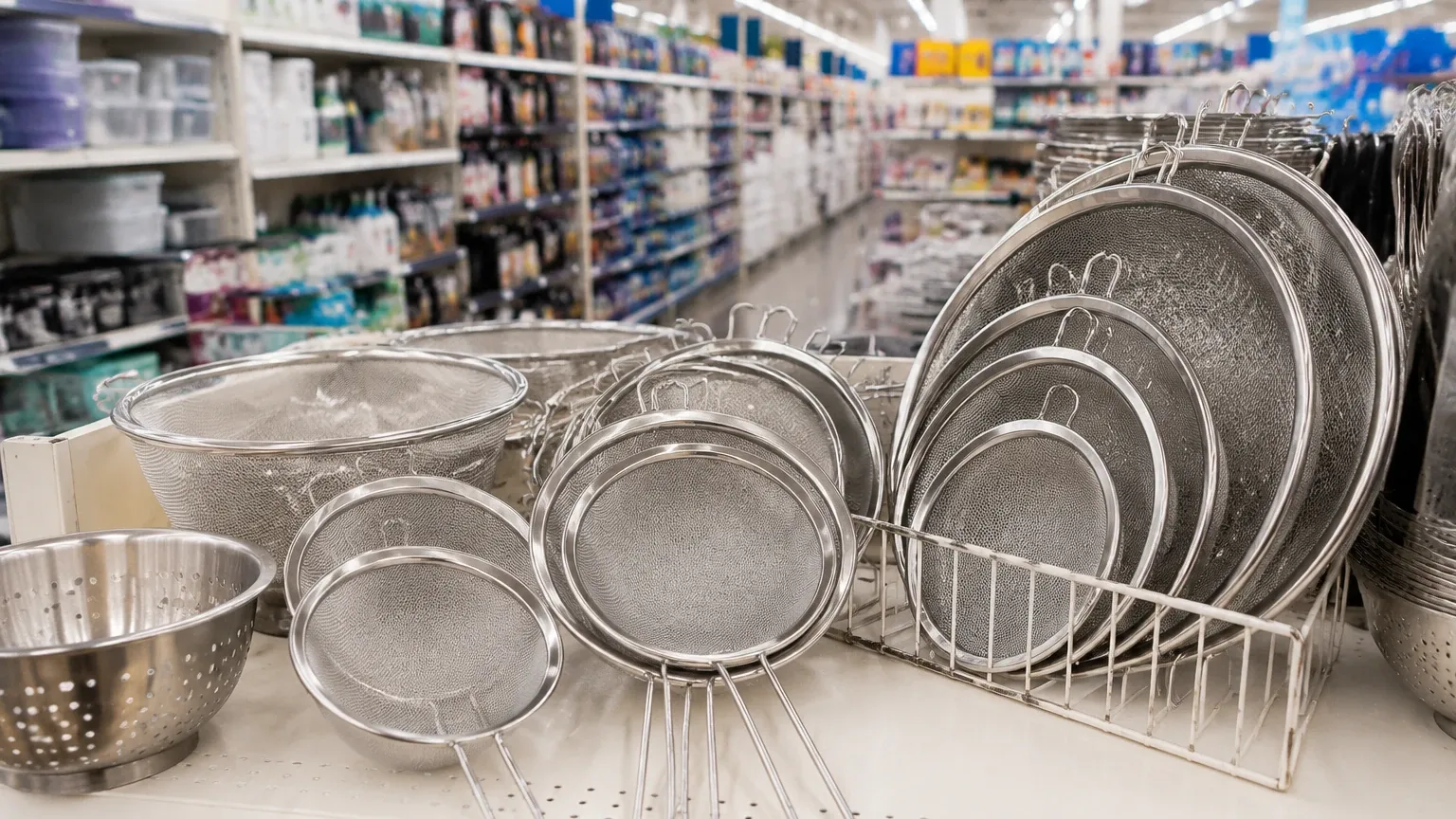
Strainers at Walmart
When maintenance teams or procurement officers begin a search for "strainers at walmart," the primary driver is often immediate availability or cost-efficiency for a quick fix. However, in the context of industrial fluid handling, chemical processing, and high-pressure hydraulic systems, the distinction between a retail-grade consumer product and a precision-engineered industrial component is a matter of operational safety and system longevity. While retail outlets provide excellent solutions for domestic kitchen use or light-duty household tasks, industrial applications require a level of material integrity and filtration accuracy that consumer-grade products are not designed to meet.
For engineers and technical professionals, understanding the boundaries of retail equipment is the first step in selecting the correct Strainers & Baskets for a facility. This guide examines the technical limitations of consumer-grade strainers, the critical engineering criteria for industrial filtration, and why customized stainless steel solutions are essential for demanding B2B environments.
Understanding the Limitations of Retail-Grade Strainers
The products typically categorized as strainers at Walmart are designed for the "consumer goods" market. These items are optimized for price-point accessibility and general-purpose utility, such as straining pasta, rinsing produce, or basic sink drainage. From an engineering perspective, these products possess several inherent limitations that make them unsuitable for industrial use:
Material Composition and Grade
Consumer strainers are often manufactured using 200-series stainless steel or low-grade plastics. While these materials are sufficient for intermittent contact with water at room temperature, they lack the chromium and nickel content necessary to resist pitting and crevice corrosion in industrial environments. In contrast, industrial strainers utilize 304 or 316L stainless steel, which provides the chemical resistance required for processing acids, alkalis, and high-salinity fluids.
Structural Integrity and Pressure Ratings
A retail strainer is designed to support the weight of a few pounds of solid material under atmospheric pressure. In an industrial pipeline, a strainer must withstand significant differential pressure (ΔP). If a consumer-grade mesh is placed in a pressurized line, the lack of a reinforced support structure—such as a perforated metal backing—will lead to immediate mechanical failure, resulting in "media migration" where the filter material itself enters the downstream flow.
Filtration Precision
Retail strainers are rarely rated by micron size. Their mesh openings are often irregular and intended only to catch large visible debris. Industrial processes, however, require specific particulate retention, often ranging from 5 microns to several millimeters, to protect sensitive equipment like pumps, nozzles, and heat exchangers.
Key Differences Between Consumer and Industrial Strainers & Baskets
When transitioning from a retail mindset to an industrial procurement strategy, it is vital to evaluate the specific design features that differentiate professional-grade components. Industrial strainers and baskets are engineered as pressure vessels or critical system components rather than simple tools.
| Feature | Retail/Consumer Strainers | Industrial Strainers & Baskets |
| :— | :— | :— |
| Material | 200-series SS, Plastic, Chrome-plated steel | 304, 316L, Monel, Hastelloy |
| Joining Method | Crimping or spot welding | TIG, Plasma, or high-strength resistance welding |
| Pressure Rating | Not rated (Atmospheric) | High-pressure (ANSI classes 150 to 2500) |
| Customization | Standardized sizes only | Fully customizable dimensions and mesh |
| Durability | Disposable/Short-term | Multi-year service life with cleaning cycles |
Industrial baskets are often equipped with heavy-duty handles, reinforced rings, and precision-machined flanges to ensure a leak-proof seal within the strainer housing. These features are absent in retail products, which are typically designed for handheld use.
Engineering Considerations for Industrial Filtration
Selecting the right filtration component requires a deep dive into the physics of the fluid being processed. Engineers must look beyond the surface level of a product to ensure it meets the following technical requirements:
Flow Rate and Open Area Ratio
The efficiency of a strainer is determined by its "Open Area Ratio" (OAR). This is the ratio between the total open area of the mesh and the cross-sectional area of the inlet pipe. A high-quality industrial basket typically offers an OAR of at least 6:1 or 8:1. This ensures that even as the basket collects debris, the pressure drop remains low enough to prevent pump cavitation. Retail strainers do not provide these calculations, making it impossible to predict how they will affect system hydraulics.
Mesh Weave and Micron Ratings
In industrial manufacturing, the type of weave used in the wire mesh is critical. Options include:
* Plain Weave: Suitable for general-purpose straining with high flow rates.
* Twill Weave: Allows for heavier wire diameters in finer meshes, increasing strength.
* Dutch Weave: Provides superior strength and finer filtration for high-pressure applications.
Industrial manufacturers like Kaifil specialize in these precise weaves, ensuring that the strainer performs exactly to the specified micron rating—a level of detail unavailable in the consumer market.
Material Selection and Chemical Compatibility
One of the most common causes of failure when using sub-standard strainers is chemical incompatibility. In the chemical processing and pharmaceutical industries, even minor trace elements in the metal can contaminate the product or lead to rapid oxidation.
* 304 Stainless Steel: The standard for food and beverage applications. It provides excellent resistance to organic chemicals and most dairy products.
* 316L Stainless Steel: Contains molybdenum, which provides superior resistance to chlorides and marine environments. This is the gold standard for pharmaceutical and heavy chemical industries.
* Specialty Alloys: For highly corrosive environments involving sulfuric or hydrochloric acids, industrial baskets can be fabricated from exotic metals that are never found in retail stores.
Using a "strainer at Walmart" in a chemical line could result in the metal leaching into the fluid, causing batch contamination that can cost a company tens of thousands of dollars in lost product and regulatory fines.
When to Transition from Retail to Custom Industrial Solutions
There are specific triggers that indicate a facility must move away from off-the-shelf retail solutions and toward professional OEM filtration components. If your application involves any of the following, a custom industrial strainer is mandatory:
1. High Temperature: Standard retail plastics or low-grade adhesives will melt or degrade at temperatures exceeding 150°F (65°C). Industrial stainless steel strainers can operate at temperatures exceeding 800°F.
2. Sanitary Requirements: In food, beverage, and pharma, strainers must be "sanitary," meaning they have smooth, crevice-free welds that prevent bacterial growth. Retail strainers with crimped edges are impossible to clean to these standards.
3. High Viscosity Fluids: Straining oils, resins, or syrups requires a basket that can withstand the high shear forces and pressure required to move thick fluids through a mesh.
4. Automated Systems: Industrial strainers are often part of a duplex system or an automated backwash system. These require precise tolerances to fit into specialized housings, something that mass-produced consumer goods cannot offer.
Evaluating Total Cost of Ownership (TCO)
While the initial price of a retail strainer might be significantly lower than a custom-engineered industrial basket, the Total Cost of Ownership (TCO) tells a different story. Procurement teams must consider:
* Replacement Frequency: A retail strainer may fail every few weeks under industrial stress, whereas a Kaifil stainless steel basket can last for years with proper cleaning.
* Downtime Costs: Every time a strainer fails, the production line must be halted for replacement. In many industries, an hour of downtime costs more than the price of a hundred high-end industrial strainers.
* Downstream Protection: The primary job of a strainer is to protect expensive equipment like pumps and turbines. A $10 retail strainer that fails and allows a bolt to enter a $20,000 pump is an incredibly expensive mistake.
The Role of Customization in Industrial Performance
Every industrial facility has unique piping configurations and flow requirements. This is where OEM manufacturers provide the most value. Unlike the "one-size-fits-all" approach of retail outlets, industrial filtration solutions can be tailored to the specific needs of the engineer:
* Custom Dimensions: Baskets can be manufactured to fit existing housings, regardless of the age or brand of the equipment.
* Reinforcement Options: For high-pressure drops, baskets can be reinforced with internal or external skeletons to prevent collapsing.
* Handle Designs: Specialized lifting handles can be added to facilitate easier removal and cleaning in confined spaces.
Conclusion
While the search for "strainers at walmart" may be a starting point for those unfamiliar with the rigors of industrial fluid dynamics, it quickly becomes clear that professional applications demand professional equipment. The risks associated with using consumer-grade products—ranging from mechanical failure and chemical contamination to catastrophic pump damage—far outweigh any perceived savings in initial cost.
By focusing on high-quality Strainers & Baskets, engineers can ensure their systems operate with maximum efficiency, safety, and reliability. Investing in precision-engineered stainless steel filtration is not just about buying a part; it is about protecting the integrity of the entire industrial process. For those requiring dependable performance in demanding environments, custom manufacturing remains the only viable path forward.
