


Titan Strainers
In industrial fluid handling, the integrity of downstream equipment—such as pumps, meters, control valves, and heat exchangers—is paramount to operational efficiency and safety. Industrial strainers serve as the primary line of defense, mechanically removing solids from flowing liquids or gases through a perforated or wire mesh straining element. Among the industry standards for these components, titan strainers have established a reputation for robust construction and reliable performance across diverse sectors, including chemical processing, oil and gas, and water treatment.
For engineers and procurement professionals, selecting the right filtration component requires a deep understanding of mechanical design, material compatibility, and flow dynamics. This guide explores the technical nuances of titan strainers and the broader category of Strainers & Baskets, providing the necessary framework for making informed industrial purchasing decisions.
Understanding the Role of Titan Strainers in Industrial Piping
Titan strainers are engineered to handle the rigorous demands of high-pressure and high-temperature environments. Their primary function is to protect expensive system components from damage caused by scale, rust, joint compound, and other foreign debris. Unlike filters, which are often designed to remove microscopic particles and are frequently replaced, strainers are typically designed to remove larger particles and are intended for reuse after cleaning.
In B2B applications, the choice of a strainer often hinges on its ability to withstand specific line pressures and the chemical nature of the fluid. Titan strainers are frequently specified in projects where ASME (American Society of Mechanical Engineers) compliance and rigorous testing are required. For engineers, the "Titan" designation often implies a specific standard of casting quality and wall thickness that ensures longevity in heavy-duty industrial cycles.
Key Categories of Strainers and Their Applications
The architecture of a strainer determines its suitability for a specific application. While the term "titan strainers" covers a broad range, the most common configurations include Y-strainers, basket strainers, and duplex strainers.
Y-Strainers
Y-strainers are characterized by their compact, cylindrical shape and are typically used in applications where the amount of solids to be removed is relatively small. They are favored for steam, gas, or high-pressure liquid lines because they can handle higher pressures than basket-style strainers of the same size. A significant advantage of the Y-design is its ability to be installed in either a horizontal or vertical position, provided the "leg" of the Y points downward to collect debris.
Simplex Basket Strainers
Basket strainers are used where high flow capacity is required. Because the basket is larger than the straining element in a Y-strainer, it offers a greater surface area for debris collection, resulting in a lower pressure drop and longer intervals between cleanings. Simplex baskets are used in systems where the flow can be interrupted for cleaning. In many industrial settings, titan strainers of the simplex variety are the standard for liquid applications where batch processing allows for scheduled downtime.
Duplex Basket Strainers
For continuous flow operations where the system cannot be shut down for maintenance, duplex strainers are essential. These units consist of two separate strainer chambers connected by a diversion valve. When one basket becomes clogged, the flow is diverted to the clean chamber, allowing the operator to remove and clean the first basket without interrupting the process. This is critical in chemical plants and cooling water systems where a stoppage could lead to significant financial loss or equipment damage.
Material Selection and Engineering Considerations
The performance of titan strainers is heavily dependent on the materials used for both the housing and the internal straining element. Material selection must account for corrosion resistance, thermal expansion, and mechanical strength.
Housing Materials
* Carbon Steel: Frequently used in the oil and petrochemical industries due to its high strength and resistance to thermal shock.
* Stainless Steel (304/316): The standard for food and beverage, pharmaceutical, and corrosive chemical applications. Stainless steel provides excellent resistance to oxidation and prevents contamination of the process fluid.
* Ductile Iron: Often used for water and non-corrosive utility lines where cost-effectiveness is a priority but higher strength than standard cast iron is required.
Straining Elements (Baskets and Screens)
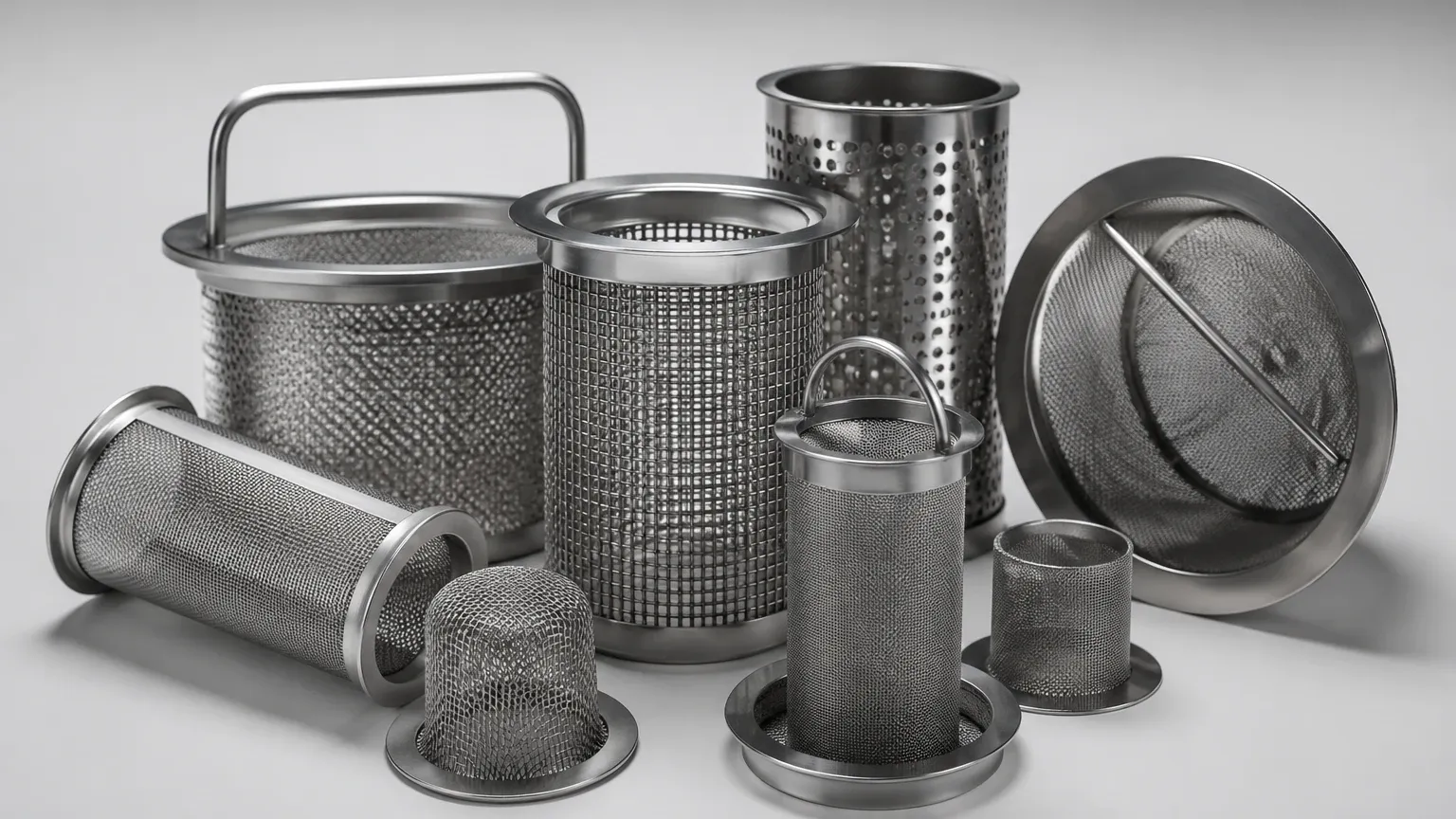
The internal element is the heart of the strainer. Kaifil specializes in custom stainless steel filtration solutions, emphasizing that the mesh or perforation size must be precisely matched to the particle size intended for removal.
* Perforated Metal: Used for removing larger particles. Common hole sizes range from 1/32" to 1/2".
* Wire Mesh: For finer filtration, a stainless steel wire mesh is lined inside a perforated basket. This allows for filtration down to the micron level (e.g., 40 microns or 400 mesh).
Technical Specifications: Pressure Drop and Open Area Ratio
One of the most critical engineering metrics when evaluating titan strainers is the pressure drop (Delta P). As fluid passes through the strainer, the restriction causes a loss in pressure. If the pressure drop is too high, it can lead to cavitation in pumps or insufficient flow to downstream processes.
The Open Area Ratio (OAR)
The OAR is the relationship between the internal cross-sectional area of the pipe and the total open area of the holes in the strainer basket. A well-designed industrial strainer should typically have an OAR of at least 6:1. A higher OAR means the strainer can collect more debris before the pressure drop becomes unacceptable, thereby extending the maintenance cycle. When sourcing Strainers & Baskets, engineers must verify that the OAR meets the specific flow requirements of their system.
Differential Pressure Monitoring
To optimize the replacement or cleaning cycle, titan strainers should be equipped with differential pressure gauges. By measuring the pressure before and after the strainer, operators can determine exactly when the basket is full. Cleaning a strainer too early results in unnecessary labor, while cleaning it too late can lead to basket collapse or system failure.
Customization and OEM Solutions
While standard titan strainers meet many industrial needs, unique system geometries or highly specific filtration requirements often necessitate customized solutions. This is where manufacturers like Kaifil provide significant value.
Customization options often include:
1. Specialized Coatings: For highly abrasive or corrosive fluids, internal linings such as Tefzel or Epoxy can be applied to the strainer body.
2. Custom Mesh Configurations: Utilizing multi-layer sintered wire mesh or reinforced baskets to handle high-viscosity fluids or extreme pressure differentials.
3. Non-Standard Connections: While ANSI flanges are standard, some systems require DIN, JIS, or specialized sanitary fittings (Tri-Clamp) for pharmaceutical and food-grade applications.
4. Heating Jackets: In applications involving fluids that solidify at room temperature (like bitumen or certain resins), steam jackets are added to the strainer housing to maintain fluid temperature.
Common Risks and Procurement Pitfalls
When purchasing industrial strainers, technical buyers often encounter risks that can affect the total cost of ownership.
* Undersizing: Selecting a strainer based solely on the pipe size rather than the flow rate can lead to excessive pressure drop.
* Material Mismatch: Using carbon steel in a system where stainless steel is required can lead to rapid corrosion and downstream contamination.
* Ignoring Gasket Compatibility: The seals and gaskets in titan strainers must be compatible with the process fluid. For example, EPDM may be suitable for water but fail in the presence of oils, where Viton or PTFE would be required.
* Oversizing the Mesh: It is a common mistake to specify a mesh that is much finer than necessary. Finer mesh clogs faster, increases maintenance frequency, and creates higher initial pressure drops. The rule of thumb is to use a mesh size just slightly smaller than the smallest particle that needs to be removed.
Maintenance and Long-Term Reliability
The longevity of titan strainers is tied directly to the maintenance protocol. For basket strainers, the cleaning process involves venting the pressure, opening the cover (often via quick-opening swing bolts), and removing the basket.
Engineers should confirm the following before finalizing a purchase:
* Cover Type: Is a bolted cover sufficient, or is a quick-opening cover required for frequent cleaning?
* Blow-down Ports: For Y-strainers, does the unit have a blow-down connection that allows for cleaning without removing the screen?
* Spare Parts Availability: Ensure that replacement baskets and gaskets are readily available to prevent extended downtime.
Conclusion: Selecting the Right Filtration Partner
Titan strainers are essential components that ensure the reliability of industrial piping systems. However, the hardware is only as effective as the engineering logic behind its selection. Whether you are dealing with high-pressure steam, corrosive chemicals, or delicate food products, the choice of Strainers & Baskets must be guided by technical data and application-specific requirements.
By focusing on material integrity, precise filtration accuracy, and robust mechanical design, facilities can significantly reduce maintenance costs and protect their capital equipment. For organizations requiring specialized designs or OEM manufacturing, partnering with a manufacturer that understands the nuances of stainless steel fabrication and industrial filtration—such as Kaifil—ensures that the final solution is optimized for both performance and durability. Always confirm the pressure ratings, material certifications, and flow coefficients (Cv) with your supplier to ensure the selected strainer aligns with the engineering specifications of your project.
