


Strainers and Colanders
In the landscape of industrial fluid handling and processing, the terminology used to describe separation equipment often overlaps with domestic contexts. While terms like strainers and colanders are frequently associated with commercial kitchens or household use, in an industrial B2B environment, these components represent critical engineering solutions designed for high-volume filtration, particle separation, and equipment protection. For engineers and procurement specialists, understanding the technical nuances between different types of Strainers & Baskets is essential for maintaining process integrity and protecting downstream assets.
Industrial filtration relies on the precise management of flow rates, pressure drops, and particle retention. Whether a facility is processing chemical precursors, food-grade liquids, or hydraulic fluids, the choice of filtration media—be it a coarse strainer or a fine-mesh colander-style basket—directly impacts the efficiency and longevity of the entire system.
Industrial Filtration: Distinguishing Strainers and Colanders
In a technical context, the distinction between strainers and colanders primarily relates to their design, aperture size, and intended application. While both serve the purpose of separating solids from liquids, their engineering profiles differ significantly.
The Role of Industrial Strainers
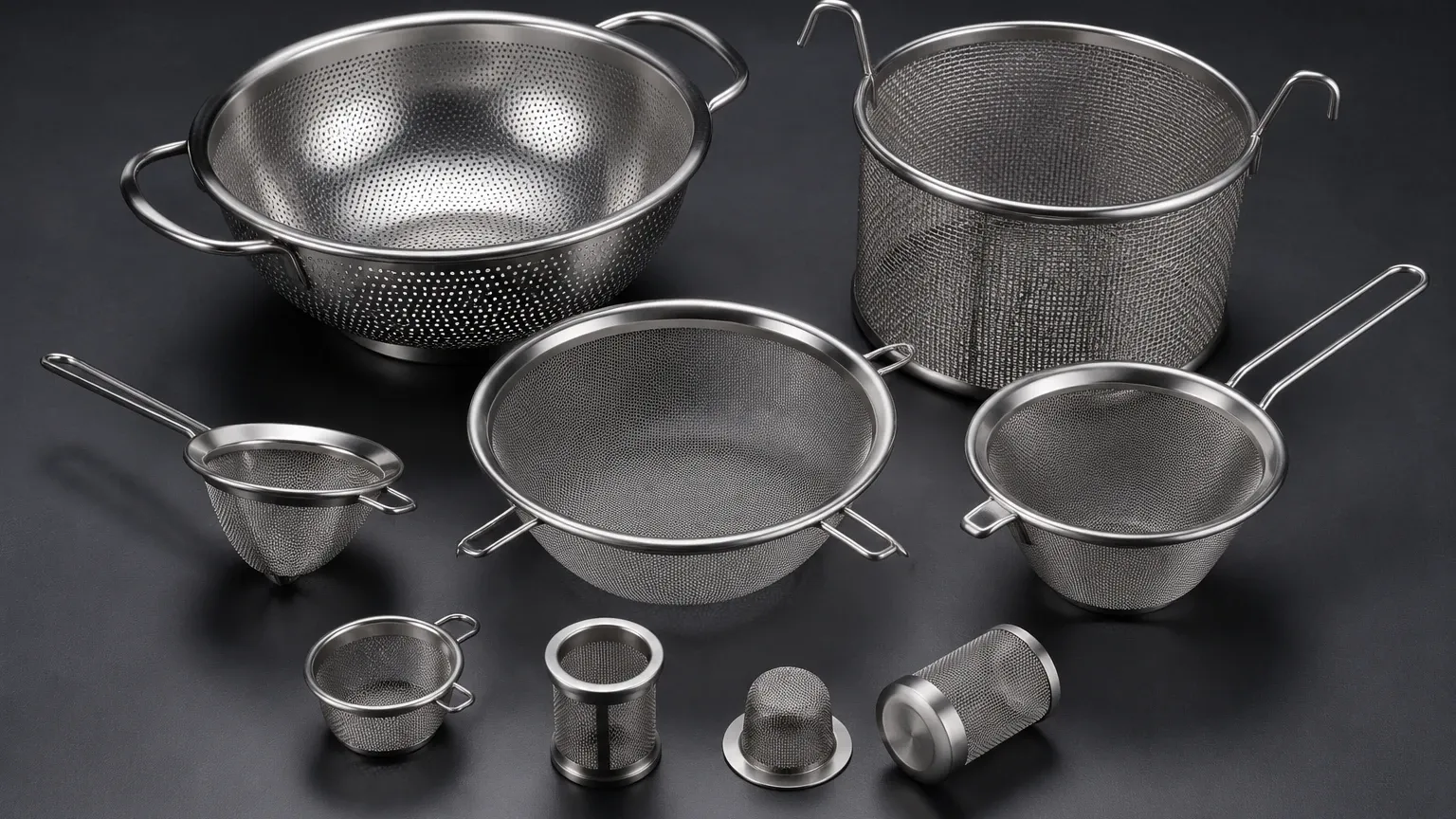
Industrial strainers are typically integrated into piping systems to remove larger debris that could damage pumps, valves, or heat exchangers. They are heavy-duty components, often constructed from perforated metal or heavy wire mesh. The focus of a strainer is "protection filtration," where the goal is to ensure that no particles above a specific size pass through to sensitive machinery. These are often found in Y-strainer or T-strainer configurations, where the basket is housed within a pressurized vessel.
The Industrial Colander Concept
When engineers refer to strainers and colanders in a B2B setting, the "colander" aspect usually describes open-top basket filters or gravity-fed separation units. Unlike inline strainers, industrial colanders are often used for batch processing, where solids are collected for recovery or where the liquid is drained from a bulk product. These units often feature a higher density of perforations or a finer mesh lining to accommodate delicate materials, such as those found in the pharmaceutical or specialty chemical industries.
Engineering Specifications for High-Performance Strainers & Baskets
Selecting the correct filtration component requires a deep dive into technical specifications. A mismatch between the process requirements and the strainer design can lead to premature clogging, excessive pressure drop, or mechanical failure.
Micron Ratings and Aperture Size
One of the first considerations is the filtration accuracy. This is measured in microns (μm) or mesh count. For coarse separation, perforated plate baskets with hole diameters ranging from 1mm to 10mm are common. For finer requirements, stainless steel wire mesh is layered or pleated to achieve ratings as low as 5 to 10 microns. Engineers must balance the need for fine filtration with the allowable pressure drop across the media.
Flow Dynamics and Pressure Drop (ΔP)
Every strainer introduces a degree of resistance to the flow. This is quantified as the pressure drop. If the open area of the strainers and colanders is too low, the velocity of the fluid increases, which can lead to turbulence and potential damage to the filter media. Ideally, the ratio of the open area of the basket to the cross-sectional area of the inlet pipe should be at least 6:1 to minimize maintenance frequency and energy consumption.
Structural Integrity and Burst Strength
In high-pressure systems, the basket must withstand the differential pressure that builds up as the filter becomes loaded with contaminants. Industrial baskets are often reinforced with external skeletons or internal support layers to prevent collapsing or "blow-by," where the mesh detaches from the frame under stress.
Material Science in Industrial Filtration Components
The environment in which the filtration occurs dictates the material selection. Because many industrial processes involve corrosive chemicals, high temperatures, or strict hygiene standards, stainless steel is the industry standard.
Type 304 vs. Type 316L Stainless Steel
- Type 304 Stainless Steel: This is the most common material for general industrial use. It offers excellent durability and good corrosion resistance for water treatment and standard hydraulic applications.
- Type 316L Stainless Steel: For more demanding environments, such as chemical processing or marine applications, 316L is preferred. The addition of molybdenum enhances resistance to pitting and crevice corrosion, especially in the presence of chlorides. The "L" (low carbon) designation is crucial for components that require extensive welding, as it prevents carbide precipitation and maintains the integrity of the weld zones.
Specialty Alloys and Coatings
In extreme cases involving highly acidic or alkaline fluids, specialty alloys like Hastelloy or Monel may be required. Additionally, surface treatments such as electropolishing are often applied to strainers used in the food and beverage or pharmaceutical sectors. Electropolishing reduces surface roughness (Ra), making the baskets easier to clean and preventing bacterial growth in microscopic crevices.
Application-Specific Design for Diverse Industries
No single filtration solution fits every scenario. The design of strainers and colanders must be tailored to the specific rheology of the fluid and the nature of the solids being removed.
Food and Beverage Processing
In this sector, the primary concern is sanitation. Baskets must be designed with "clean-in-place" (CIP) capabilities. This means eliminating dead zones where organic material could accumulate. Welds must be ground smooth, and the mesh must be securely bonded to the frame to prevent wire fragments from entering the product stream.
Chemical and Petrochemical Sectors
Here, the focus shifts to compatibility and safety. Strainers often handle volatile or hazardous fluids at elevated temperatures. The structural design must account for thermal expansion, and the gaskets or seals used in the housing must be compatible with the chemical profile of the process fluid.
Hydraulic and Lube Oil Systems
In hydraulic systems, even microscopic particles can cause catastrophic failure of precision-machined components. Strainers in these systems are often used as a first line of defense, capturing large debris before the fluid reaches high-efficiency, low-micron synthetic filters. These baskets must be able to handle high-viscosity fluids without causing cavitation in the pumps.
Operational Efficiency and Maintenance Protocols
To ensure the long-term performance of industrial filtration systems, a rigorous maintenance schedule is required. The total cost of ownership (TCO) of a strainer is not just the purchase price, but the cost associated with downtime and cleaning.
Monitoring Differential Pressure
Installing pressure gauges upstream and downstream of the strainer is the most effective way to monitor its condition. A sudden increase in ΔP indicates that the basket is reaching its holding capacity. Automated systems can trigger a backwash cycle or alert operators to perform a manual cleaning.
Cleaning and Regeneration
Depending on the design, industrial baskets can be cleaned using several methods:
- Manual Wash: Removing the basket and using high-pressure water or air to dislodge particles.
- Ultrasonic Cleaning: Using high-frequency sound waves in a solvent bath to remove fine particles embedded deep within the wire mesh.
- Chemical Soaking: Using specialized detergents to dissolve organic or mineral scaling.
Replacement Cycles
While stainless steel strainers are durable, they are not permanent. Over time, the mesh may suffer from fatigue due to pressure fluctuations, or the support structure may show signs of erosion. Regular visual inspections are necessary to identify thinning wires or compromised welds before a failure occurs.
Customization and OEM Capabilities for Technical Professionals
Standard off-the-shelf solutions often fall short in specialized industrial applications. This is where custom manufacturing becomes vital. When sourcing strainers and colanders, engineers should seek partners capable of providing bespoke designs that integrate seamlessly into existing infrastructure.
Tailored Geometry and Fitment
Customization allows for the optimization of the basket's dimensions to fit specific housings, ensuring a perfect seal and preventing bypass. This includes custom flange types, handle designs for easy retrieval, and specialized bottom configurations (e.g., flat, conical, or slanted) to facilitate drainage.
Multi-Layer Mesh Sintering
For applications requiring both high strength and fine filtration, sintered mesh is an excellent option. By bonding multiple layers of wire mesh together through a heat-and-pressure process, manufacturers can create a filter medium that is structurally rigid while maintaining precise micron ratings. This technology is particularly useful in high-pressure gas or liquid filtration where traditional mesh might deform.
Collaborative Engineering
Working with a manufacturer that understands the complexities of industrial filtration—from material selection to flow simulation—enables the development of high-performance components. By providing detailed application data, including fluid viscosity, temperature, flow rate, and particle characteristics, purchasing teams can ensure they receive a product that meets the specific demands of their environment.
In conclusion, while the terms strainers and colanders may seem simple, their role in industrial B2B operations is anything but. By focusing on material integrity, engineering precision, and application-specific design, facilities can achieve reliable, cost-effective filtration that protects their equipment and ensures the quality of their output. For those looking to optimize their processes, exploring the full range of Strainers & Baskets is a critical step in industrial system design.
