


Strainers and Filters
In industrial fluid handling systems, the integrity of downstream equipment often depends on the effective removal of solid contaminants. While the terms are sometimes used interchangeably in casual conversation, engineers and procurement specialists must distinguish between strainers and filters to ensure system reliability and process efficiency. Understanding the technical nuances, material requirements, and design parameters of these components is essential for optimizing industrial filtration performance.
Industrial filtration solutions, such as those manufactured by Kaifil, are designed to protect pumps, valves, heat exchangers, and spray nozzles from damage caused by debris. Whether the application involves chemical processing, food production, or hydraulic systems, selecting the appropriate configuration requires a deep dive into particle size, flow velocity, and pressure drop characteristics.
Defining the Technical Boundary: Strainers vs. Filters
The primary distinction between strainers and filters lies in the size of the particles they are designed to remove and the nature of the media used.
Strainers
A strainer is typically a coarse filtration device used to remove larger, visible particles from a liquid or gas stream. In most industrial contexts, strainers are utilized as a first line of defense. They are characterized by their ability to handle high flow rates with relatively low pressure drops. The media in a strainer is usually a perforated plate or a wire mesh, which can be cleaned and reused multiple times. Strainers are generally rated by "mesh size" or the diameter of the perforations.
Filters
Filters are engineered to remove much finer contaminants, often measured in microns (μm). Unlike strainers, which primarily perform surface filtration, many filters utilize depth filtration media to trap smaller particles within the thickness of the material. Filters often require more frequent replacement or specialized cleaning processes compared to industrial strainers. In many systems, a strainer is placed upstream of a fine filter to extend the service life of the more expensive filtration media.
When evaluating [strainers and filters](#), engineers must consider the "Total Open Area" (TOA) and the "Open Area Ratio" (OAR). A high OAR ensures that the system can operate longer before the pressure drop across the component becomes critical, necessitating maintenance.
Engineering Considerations for Material Selection
Material compatibility is a non-negotiable factor in industrial filtration. The choice of material affects not only the durability of the component but also the purity of the end product. Kaifil specializes in stainless steel solutions, which are preferred in demanding environments due to their mechanical strength and corrosion resistance.
Stainless Steel 304 vs. 316
* Stainless Steel 304: This is the standard grade for most industrial applications. It offers excellent strength and good corrosion resistance for water treatment and general industrial fluid handling.
* Stainless Steel 316: For applications involving corrosive chemicals, saline environments, or stringent sanitary requirements (such as in the pharmaceutical or food and beverage industries), SS316 is the preferred choice. The addition of molybdenum enhances its resistance to pitting and crevice corrosion, particularly in chloride-rich environments.
Mechanical Integrity and Pressure Ratings
Industrial strainers and filters must withstand significant differential pressures ($ΔP$). As the mesh or basket becomes clogged with debris, the pressure on the upstream side increases. If the component is not engineered with sufficient structural support—such as a perforated metal backup for fine wire mesh—the media may collapse, leading to catastrophic system failure and downstream contamination.
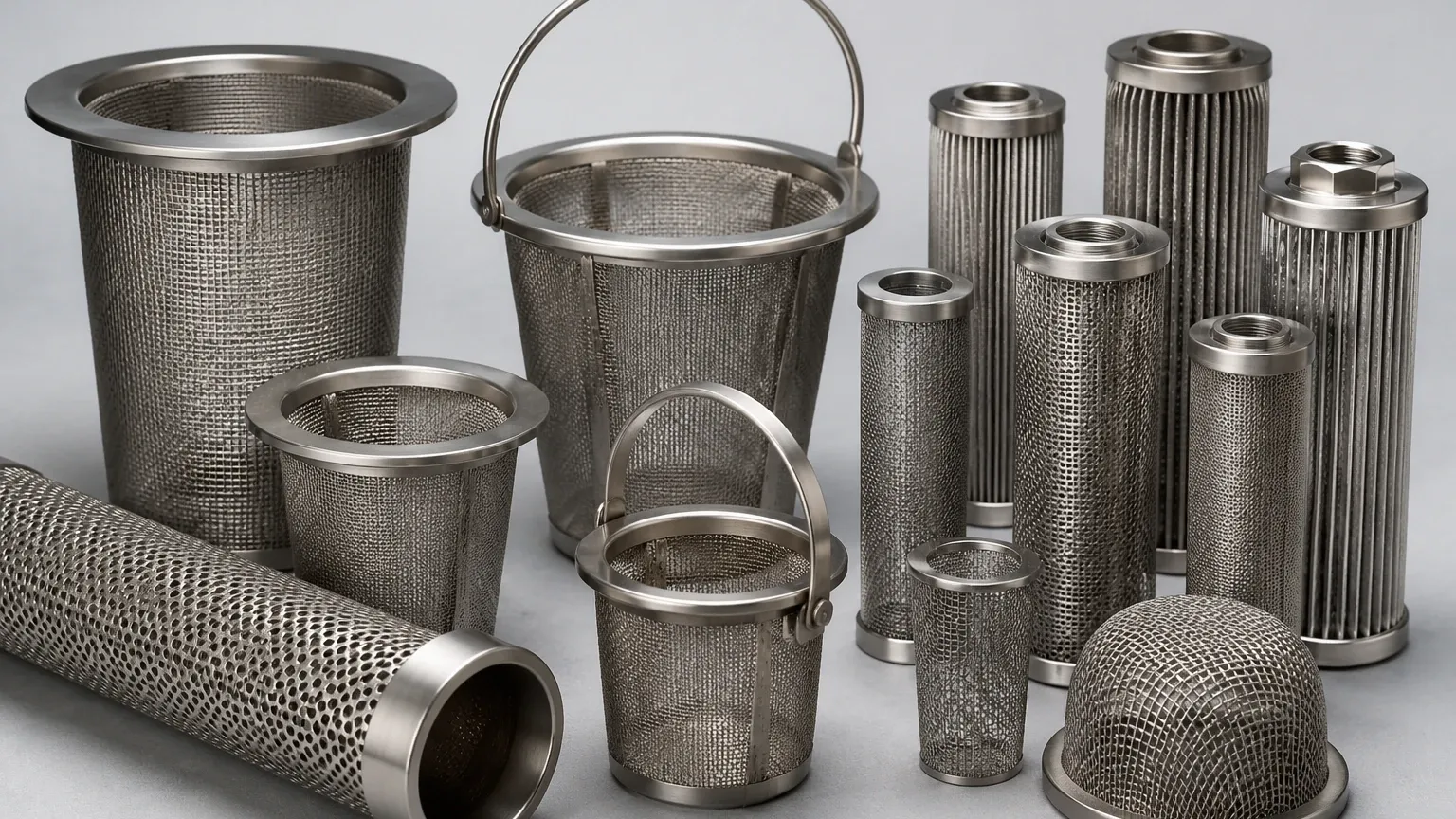
Types of Industrial Strainers & Baskets
The physical configuration of the filtration housing and the internal element determines how easily the system can be maintained. Strainers & Baskets come in several standard designs, each suited to specific operational needs.
Simplex Basket Strainers
Simplex strainers are used in systems where the flow can be temporarily shut down for cleaning. They feature a top-loading basket that can be easily removed. These are common in batch processing applications where downtime is scheduled between runs.
Duplex Strainers
For continuous processes where flow cannot be interrupted, duplex strainers are required. These consist of two separate strainer chambers connected by a diverting valve. When one side becomes clogged, the flow is switched to the clean chamber, allowing the operator to clean the dirty basket without stopping the process.
Y-Strainers
Y-strainers are typically used for gas or steam lines, or in liquid applications where the amount of debris is minimal. Their compact design makes them ideal for tight spaces, though they generally have a smaller dirt-holding capacity than basket-style strainers.
Custom Basket Designs
Customization is often necessary to meet specific flow dynamics. Baskets can be designed with slanted tops, specialized handles for easy extraction, or reinforced bottoms to handle heavy particulate loads. Kaifil provides OEM and customized filtration solutions that allow engineers to specify the exact dimensions and mesh counts required for their unique housing units.
Performance Evaluation and Sizing
Sizing a strainer or filter is not merely about matching the pipe size. An undersized unit will result in high fluid velocity through the media, causing excessive pressure drop and potentially forcing contaminants through the mesh. To correctly size strainers and filters, the following data points are required:
1. Flow Rate (GPM or m³/h): The volume of fluid passing through the system per unit of time.
2. Viscosity: Thicker fluids (like heavy oils or syrups) require larger surface areas and coarser mesh to maintain acceptable flow rates.
3. Specific Gravity: The density of the fluid affects the pressure drop calculations.
4. Operating Pressure and Temperature: These dictate the wall thickness of the housing and the type of gaskets or seals required.
5. Allowable Pressure Drop: The maximum $ΔP$ the system can tolerate before the pump efficiency is compromised or the filter media is at risk of damage.
Maintenance and Total Cost of Ownership (TCO)
While the initial purchase price of a strainer or filter is a factor, the Total Cost of Ownership (TCO) is driven by maintenance requirements and durability. A cheaply manufactured filter that requires frequent replacement or fails under pressure will ultimately cost more than a high-quality, custom-engineered stainless steel solution.
Cleaning Cycles
In many industrial environments, differential pressure gauges are installed across the strainer. When the $ΔP$ reaches a predetermined set point (usually 5-10 psi), the basket must be cleaned. Automated backwashing systems are available for some filter types, but for many basket strainers, manual cleaning remains the most reliable method for ensuring total removal of debris.
Durability and Reusability
Stainless steel wire mesh and perforated baskets are designed for longevity. Unlike disposable plastic or paper cartridges, these metal components can be ultrasonically cleaned or chemically treated to restore their original flow characteristics. This sustainability factor is increasingly important for companies looking to reduce their environmental footprint and operational waste.
Application-Specific Requirements
Different industries impose unique demands on filtration components. A "one size fits all" approach rarely works in high-stakes industrial environments.
* Chemical Processing: Requires extreme chemical compatibility and often high-temperature ratings. Precision metal filter components ensure that catalysts are recovered and downstream reactors are protected.
* Food and Beverage: Components must feature sanitary finishes (smooth surfaces with no crevices) to prevent bacterial growth. Stainless steel 316L is often the standard here, with mesh sizes designed to remove specific organic particulates.
* Hydraulic Systems: These systems operate under high pressure and require fine filtration to protect sensitive servo-valves. Here, the strength of the stainless steel mesh is critical to prevent "media migration" into the hydraulic fluid.
* Water Treatment: Large-scale basket strainers are used to remove sand, scale, and biological matter before the water enters membrane filtration or UV disinfection stages.
Technical Checklist for Engineers and Purchasing Teams
Before finalizing a purchase order for industrial filtration components, technical teams should confirm the following details with their manufacturer:
* Micron/Mesh Rating: Is the filtration fine enough to protect the most sensitive downstream component?
* Burst Pressure: What is the maximum differential pressure the internal basket or element can withstand before deforming?
* Seal Compatibility: Are the O-rings or gaskets (Viton, EPDM, PTFE) compatible with the process fluid and temperature?
* Connection Type: Does the unit require flanged (ANSI, DIN), NPT threaded, or sanitary clamp connections?
* Certification Requirements: Does the application require ASME code stamping or specific material traceability reports (MTRs)?
By focusing on these technical parameters, engineers can ensure they select strainers and filters that provide reliable, long-term service. Kaifil’s expertise in custom stainless steel manufacturing provides the necessary support for developing high-performance filtration components tailored to demanding industrial environments. From initial material selection to the final customized design, precision engineering ensures that the filtration system performs as intended, protecting both the equipment and the quality of the process output.
