


Strainers and Sieves
In industrial fluid handling and processing, the mechanical separation of solids from liquids or gases is a fundamental requirement for equipment protection and product quality. While the terms are often used interchangeably in casual conversation, the engineering distinction between industrial strainers and sieves is critical for system design. Understanding these components—ranging from high-capacity Strainers & Baskets to precision laboratory or process sieves—requires an analysis of flow dynamics, material compatibility, and particulate retention requirements.
For engineers and procurement teams, selecting the correct filtration component involves more than matching a pipe size. It requires a deep dive into the physical properties of the media, the operational environment, and the long-term maintenance cycles of the filtration system. This guide examines the technical nuances of strainers and sieves, focusing on their application in demanding industrial sectors like chemical processing, food and beverage, and pharmaceutical manufacturing.
The Engineering Distinction: Strainers vs. Sieves
To optimize a process, one must first define the objective of the separation. Although both devices use a porous medium to retain particles, their roles within a process flow differ significantly.
Industrial Strainers
Strainers are typically integrated into piping systems to protect downstream equipment—such as pumps, valves, heat exchangers, and spray nozzles—from damage caused by debris. They are designed for continuous or semi-continuous flow and are rated by their ability to handle specific flow rates with minimal pressure drop. In many applications, the primary goal of a strainer is "protection" rather than "refinement."
Industrial Sieves
Sieves are generally used for the classification or grading of materials by size. In liquid applications, sieving often refers to a more precise separation process where the goal is to ensure that no particle larger than a specific micron rating passes through. While strainers might handle large volumes of scale, rust, or weld slag, sieves are often employed in the final stages of production to ensure product consistency, particularly in the food and pharmaceutical industries.
When evaluating strainers and sieves, the focus shifts from simple protection to precise particle size distribution (PSD) control. For a manufacturer like Kaifil, the engineering of these components involves balancing the mechanical strength of the stainless steel mesh with the required filtration accuracy.
Material Selection and Structural Integrity
The performance of any filtration component is limited by its material of construction. In industrial environments, stainless steel is the gold standard due to its corrosion resistance and mechanical durability. Common alloys include:
* AISI 304 Stainless Steel: Suitable for general industrial applications where moderate corrosion resistance is required. It is frequently used in water treatment and basic hydraulic systems.
* AISI 316/316L Stainless Steel: The preferred choice for chemical processing and marine environments. The addition of molybdenum provides superior resistance to chlorides and pitting. The "L" (low carbon) variant is essential for components requiring extensive welding to prevent carbide precipitation.
* Specialty Alloys: For highly aggressive environments involving high temperatures or extreme pH levels, alloys like Monel or Hastelloy may be utilized in the construction of specialized strainers and baskets.
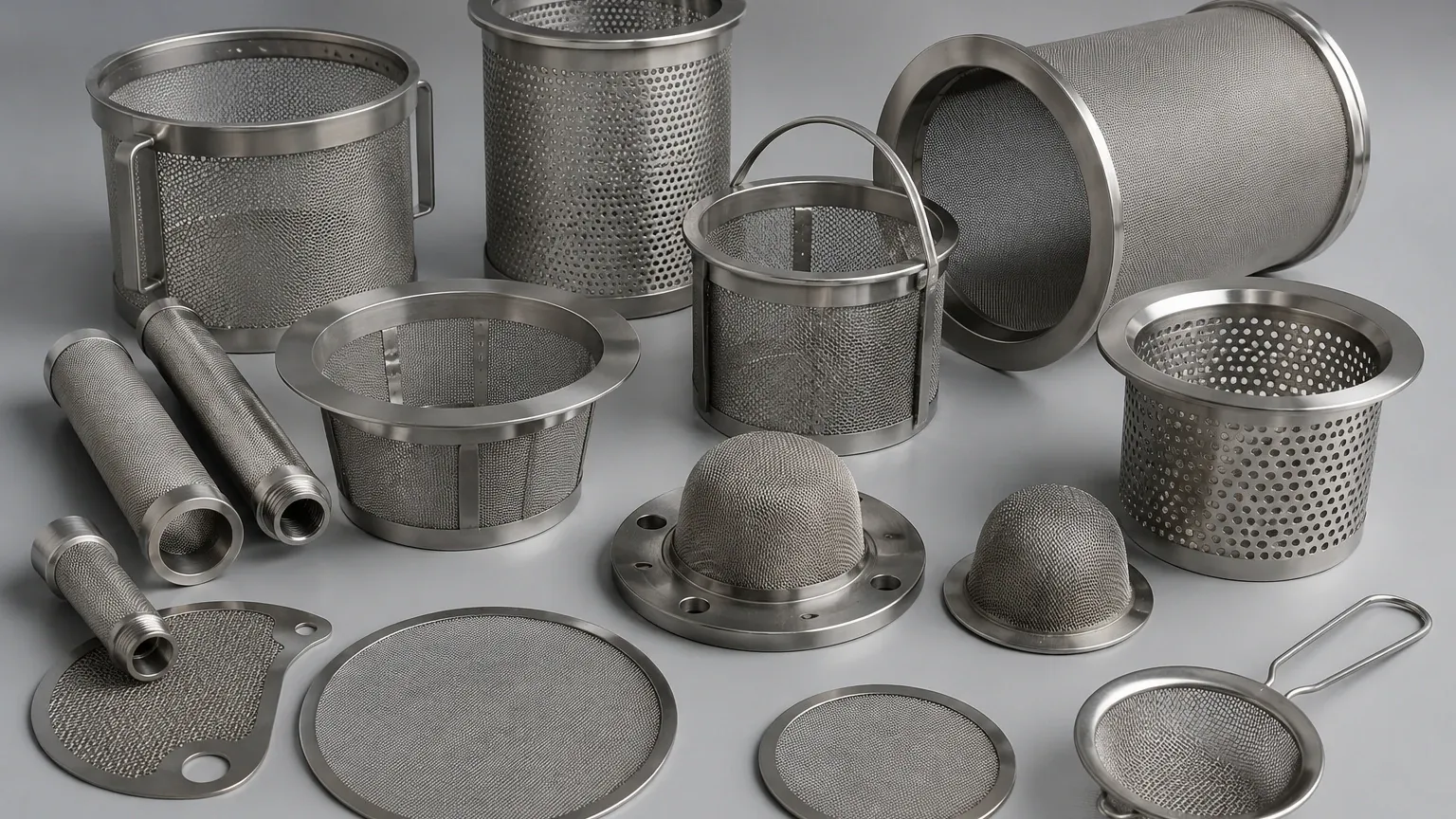
Beyond the alloy, the structure of the filter media determines the efficiency of the device. Kaifil utilizes various configurations, including perforated metal for coarse straining and multi-layered wire mesh for fine sieving. The choice between a single-layer mesh and a pleated or sintered construction depends on the required surface area and the pressure the component must withstand.
Technical Parameters for Selection
When specifying Strainers & Baskets, engineers must evaluate several key performance indicators to ensure the component does not become a bottleneck in the system.
1. Micron Rating and Mesh Count
The micron rating defines the largest particle that can pass through the media. However, in the context of wire mesh, "mesh count" (the number of openings per linear inch) is also used. It is vital to distinguish between absolute and nominal ratings. An absolute rating implies that 100% of particles at that size will be retained, whereas a nominal rating indicates a high percentage (typically 60-90%) of retention.
2. Open Area Ratio
The open area ratio is the relationship between the total area of the openings and the total area of the filter media. A higher open area ratio results in a lower initial pressure drop and longer intervals between cleanings. For industrial baskets, a ratio of 6:1 (six times the area of the inlet pipe) is often targeted to ensure efficient flow.
3. Pressure Drop ($ΔP$)
Every filter introduces resistance. As the strainer or sieve collects debris, the pressure drop increases. Engineers must calculate the maximum allowable $ΔP$ before the system's pump performance is compromised or the filter element itself collapses. High-quality stainless steel cartridges are engineered to withstand specific collapse pressures, which is a critical safety factor in high-pressure hydraulic or chemical lines.
Common Configurations in Industrial Straining
The geometry of the housing and the element determines how the strainers and sieves are maintained. The most common industrial configurations include:
* Y-Strainers: Named for their shape, these are used in pressurized lines, either liquid or gas. They are compact and typically used where the amount of material to be removed is small.
* Basket Strainers: These feature a vertical cylinder (the basket) that allows for a much larger holding capacity than a Y-strainer. They are ideal for high-flow applications where cleaning occurs frequently.
* Duplex Strainers: These consist of two separate basket chambers with a valve assembly that allows flow to be diverted from one to the other. This enables cleaning and maintenance without shutting down the entire process, which is essential for 24/7 manufacturing operations.
* Custom Sieve Elements: In pharmaceutical and food processing, sieves may be integrated into vibrating equipment or specialized inline housings to ensure that powders or liquids meet strict purity standards.
Application-Specific Considerations
Chemical and Petrochemical
In these sectors, chemical compatibility is the primary concern. The filtration media must resist degradation from solvents, acids, or bases. Stainless steel wire mesh filters are often the preferred choice because they can be cleaned and reused, reducing the waste associated with disposable plastic cartridges.
Food and Beverage
Hygiene and "cleanability" are paramount. Strainers and sieves used in this industry must often meet FDA or 3A sanitary standards. This involves using 316L stainless steel with specific surface finishes (Ra values) to prevent bacterial growth and ensure that the component can withstand CIP (Clean-In-Place) cycles.
Water Treatment and Hydraulics
In water treatment, the focus is often on removing sand, scale, and organic matter. For hydraulic systems, the strainer protects sensitive valves and actuators from metallic wear particles. In both cases, the durability of the mesh is essential to prevent "media migration," where parts of the filter itself break off and enter the downstream flow.
Maintenance, Cleaning, and Replacement Cycles
One of the primary advantages of stainless steel Strainers & Baskets is their longevity. Unlike disposable filters, these components are designed for repeated cleaning. However, an improper maintenance schedule can lead to system failure.
Cleaning Methods
* Backwashing: Reversing the flow to flush particles off the surface of the mesh.
* Ultrasonic Cleaning: Using high-frequency sound waves in a solvent bath to remove fine particulates trapped deep within the mesh layers.
* Chemical Cleaning: Using specific agents to dissolve scale or organic buildup, provided the chemicals are compatible with the stainless steel grade.
Signs of Wear
Engineers should inspect sieves for "blinding" (permanent clogging of the mesh) or mechanical deformation. If the wire mesh shows signs of fraying or if the perforated support basket is dented, the structural integrity of the unit is compromised, and it should be replaced to avoid downstream contamination.
The Value of Customization in Filtration
Off-the-shelf solutions often fail to meet the specific nuances of a complex industrial process. Customization allows for the optimization of the filter element to the specific viscosity, temperature, and particulate load of the application. As a specialist manufacturer, Kaifil provides OEM solutions that allow engineers to specify exact dimensions, mesh weaves, and reinforcement structures.
When sourcing strainers and sieves, confirming the following details with the manufacturer is essential:
1. Fluid Viscosity: High-viscosity fluids require larger mesh openings or increased surface area to maintain flow.
2. Operating Temperature: Thermal expansion can affect the fit of the strainer basket within the housing.
3. Flow Velocity: Excessive velocity can cause erosion of the mesh wires over time.
4. Nature of Solids: Are the particles abrasive, sticky, or fibrous? This dictates the type of weave (e.g., Dutch weave vs. Plain weave) required for effective separation.
Conclusion
Industrial strainers and sieves are the silent guardians of process integrity. By selecting high-performance stainless steel components, facilities can significantly reduce downtime, protect expensive machinery, and ensure product quality. Whether the application requires a simple Y-strainer for a steam line or a complex, multi-layered basket for chemical filtration, the focus must remain on technical precision and material quality. Investing in robust Strainers & Baskets is not just a procurement decision; it is a critical step in engineering a reliable and efficient industrial system.
