


Strainer Assembly
In industrial fluid handling, a strainer assembly is a critical mechanical component designed to remove unwanted solids from liquid, gas, or steam lines by means of a perforated or wire mesh straining element. Unlike fine filters that target microscopic particles, strainers are typically used to protect downstream equipment—such as pumps, valves, meters, and spray nozzles—from damage caused by scale, rust, weld beads, and other debris.
For engineers and procurement professionals, selecting the correct Strainers & Baskets involves more than just matching pipe sizes. It requires a technical understanding of flow dynamics, material compatibility, and the mechanical integrity of the strainer assembly under varying pressure and temperature conditions.
Understanding the Role of a Strainer Assembly in Industrial Systems
The primary function of a strainer assembly is the coarse filtration of fluids. While the terms "filter" and "strainer" are sometimes used interchangeably, the industry distinction usually lies in the particle size removed and the intended application. Strainers are generally used for larger particles (above 40 microns) and are designed for high-flow, low-pressure-drop applications where the goal is equipment protection rather than final product purification.
A well-engineered strainer assembly acts as a sacrificial barrier. By capturing debris at a centralized point, it prevents the catastrophic failure of expensive rotary equipment or the clogging of precision instruments. In sectors like chemical processing, water treatment, and oil and gas, the failure of a simple strainer can lead to significant downtime and maintenance costs. Therefore, the assembly must be robust enough to withstand the maximum system pressure even when the internal element is partially blinded.
Key Components of an Industrial Strainer Assembly
To evaluate a strainer assembly effectively, one must look at its constituent parts and how they interact to maintain system integrity. A standard industrial assembly consists of four primary components:
1. The Housing (Body)
The housing is the pressure vessel that contains the fluid and the straining element. It can be cast or fabricated. Cast housings are common for standard sizes and high-pressure ratings, while fabricated housings offer more flexibility for custom dimensions, nozzle orientations, and materials. The housing must be rated for the system's design pressure and temperature, often complying with ASME or ISO standards.
2. The Straining Element (Basket or Screen)
This is the core of the strainer assembly. It usually consists of a perforated metal backup for structural strength, often lined with a fine stainless steel wire mesh to achieve the desired filtration rating. The "Open Area Ratio" is a critical metric here; it is the ratio of the total open area of the screen to the cross-sectional area of the inlet pipe. A higher ratio (typically 4:1 to 8:1) ensures a lower initial pressure drop and longer intervals between cleanings.
3. The Cover and Closure
The cover provides access to the internal basket for cleaning. In applications requiring frequent maintenance, a quick-opening closure (such as a swing-bolt or T-bolt design) is preferred over a standard bolted flange to reduce labor time and system downtime.
4. Sealing Mechanisms
Gaskets or O-rings are essential to prevent fluid bypass and external leaks. The choice of sealing material depends heavily on the chemical composition of the fluid and the operating temperature. Common materials include EPDM, Viton, PTFE, and Buna-N.
Engineering Specifications for Efficient Performance
When specifying a strainer assembly, engineers must calculate several variables to ensure the component does not become a bottleneck in the process.
Pressure Drop (Delta P)
The pressure drop is the difference in pressure between the inlet and outlet of the strainer. It is influenced by the fluid's viscosity, flow velocity, and the percentage of the screen that is clogged. An assembly should be sized so that the initial (clean) pressure drop does not exceed 2 psi (0.14 bar). If the pressure drop is too high, it can lead to cavitation in downstream pumps or reduced flow rates throughout the system.
Filtration Accuracy
Filtration accuracy is defined by the size of the holes in the perforated metal or the openings in the wire mesh. This is typically measured in mesh size (number of openings per linear inch) or microns. Choosing a mesh that is too fine will lead to rapid clogging and excessive maintenance, while a mesh that is too coarse will fail to protect downstream equipment. The rule of thumb is to select a screen opening that is approximately 50% of the size of the smallest particle that needs to be removed.
Flow Velocity
High flow velocities can cause erosion of the strainer body and the element. For liquid applications, velocities are typically kept below 10 feet per second (3 meters per second) to minimize turbulence and pressure loss.
Material Selection and Chemical Compatibility
The longevity of a strainer assembly is largely determined by its material of construction. Stainless steel is the industry standard for most demanding B2B applications due to its corrosion resistance and mechanical strength.
* SS304: Suitable for general-purpose applications, including water treatment and non-corrosive chemical handling. It offers good strength and cost-effectiveness.
* SS316L: The preferred choice for pharmaceutical, food and beverage, and marine environments. The addition of molybdenum provides superior resistance to chlorides and pitting corrosion.
* Specialty Alloys: For highly aggressive chemical processing, materials like Monel, Hastelloy, or Duplex Stainless Steel may be required to prevent stress corrosion cracking and chemical degradation.
Beyond the metal, the surface finish of the strainer assembly is vital in the food and pharmaceutical industries. Electropolishing or high-grit mechanical polishing ensures that there are no microscopic pits where bacteria can grow, facilitating effective Clean-in-Place (CIP) procedures.
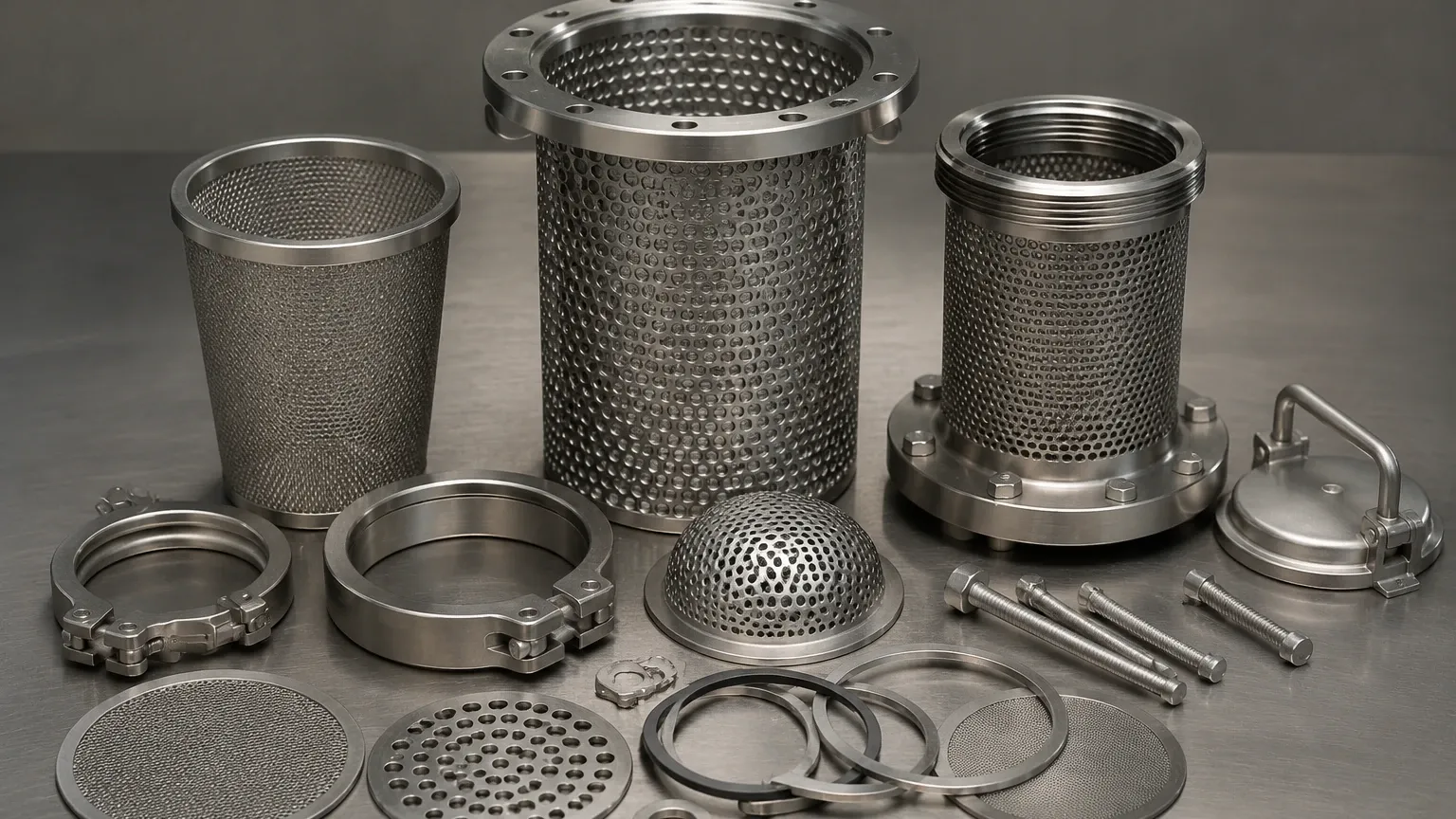
Types of Strainer Assemblies and Their Applications
Different system configurations require different strainer designs. The most common types found in industrial settings include:
Simplex Basket Strainers
These are used in systems where the flow can be interrupted for cleaning. The basket is accessed from the top, allowing for easy removal of large volumes of debris. They are commonly found in cooling water systems and chemical batch processing.
Duplex (Twin) Strainers
A duplex strainer assembly consists of two separate strainer chambers connected by a diverter valve. This design allows fluid to be diverted from one chamber to the other without stopping the flow. This is essential for continuous processes, such as lubrication systems for large turbines or continuous chemical production lines, where downtime is not an option.
Y-Strainers
Y-strainers are characterized by their compact, "Y" shaped design. They are typically used for gas and steam lines or in liquid applications where the amount of debris is minimal. Their primary advantage is their ability to handle high pressures and their smaller footprint compared to basket strainers.
Installation and Maintenance Procedures
A strainer assembly is only as effective as its installation and maintenance regime. Improper orientation is a frequent cause of failure. For example, a Y-strainer in a horizontal line must have its "leg" pointing downward to ensure that captured debris is not washed back into the pipe during low-flow periods. In vertical lines, the flow must be downward so that gravity assists in retaining the debris within the strainer leg.
Venting and Draining
Before opening a strainer assembly for maintenance, it must be properly vented and drained. High-pressure systems require dedicated vent valves to safely bleed off pressure. Draining the housing ensures that the technician is not exposed to the process fluid and prevents spills.
Monitoring Differential Pressure
The most reliable way to determine when a strainer needs cleaning is by monitoring the differential pressure (DP). Installing DP gauges across the inlet and outlet allows operators to see exactly when the basket is becoming blinded. A common practice is to clean the strainer once the DP reaches 10-15 psi above the clean pressure drop.
Customization and OEM Considerations for Engineering Teams
In many industrial applications, off-the-shelf strainer assemblies do not meet the specific spatial or performance requirements of a project. This is where custom manufacturing and OEM capabilities become essential.
Customization options often include:
* Custom Nozzle Configurations: Offsetting inlets and outlets to fit into tight piping skids.
* Reinforced Baskets: Designing elements that can withstand high differential pressures without collapsing (pleated mesh for increased surface area).
* Heating Jackets: For high-viscosity fluids like resins or chocolate, which must be kept at a specific temperature to maintain flow.
* Automatic Self-Cleaning: Integrating motorized scrapers or backwash mechanisms to eliminate manual cleaning in high-debris environments.
When collaborating with a manufacturer like Kaifil, engineers should provide a detailed process data sheet. This should include the fluid type, specific gravity, viscosity at operating temperature, maximum flow rate, design pressure, and the required filtration micron rating. Confirming these details early in the design phase prevents costly field modifications and ensures the strainer assembly performs as expected over its entire service life.
By focusing on these technical parameters—material integrity, pressure drop calculations, and appropriate assembly type—purchasing teams can secure filtration solutions that offer the best total cost of ownership through reduced maintenance and extended equipment life.
